
The recommendation
Consider the H15 Pro Heat for explicit controls and accessible roller removal, while allowing for bulk and manual care checks.
Grades at a glance
| Product | Overall | Steering, carry and placement | Controls and mode selection | Tank, roller and post-use care |
|---|---|---|---|---|
| Dreame H15 Pro Heat | 7.7 | 7.0 | 9.0 | 7.0 |
Does it fit your life?
Understandable operation is its strongest usability argument
The Dreame H15 Pro Heat is worth considering if you want separate controls for power, mode selection and self-clean, plus a display that shows the selected mode. Those details earn a 9/10 control grade. Our 7.7/10 overall usability grade also retains the less convenient parts of the Heat-specific report: a bulky feel, a head that follows movement less freely and a care routine that still needs inspection after self-clean.
Its appeal is clearest when your frustration is understanding the controls or reaching the roller. If your frustration is turning around closely spaced furniture, the reported bulk deserves more attention. The H15 Pro Heat can be easy to understand while still asking for deliberate movement and a careful finish. This review covers the Heat-specific handling, interface and care account; the model name itself does not establish a heating or cleaning advantage, and non-Heat H15 Pro features are not assumed.
Choose it if explicit controls and accessible roller removal answer a real frustration with your current cleaner. Hesitate if your main problem is tight furniture turns or if you expect a self-clean cycle to remove the need to look at the roller afterward. A straightforward interface can make operation easier to understand while leaving the physical route through a room less comfortable.
What the grades describe
| Everyday task | Grade out of 10 | Why |
|---|---|---|
| Steering, carry and placement | 7 | Reported bulk and limited head-following, with helpful upright parking |
| Controls and mode selection | 9 | Separate power, mode and self-clean controls, plus selected-mode information |
| Tank, roller and post-use care | 7 | Side roller access and a solids basket help, but checks and cleaning remain |
| Overall usability | 7.7 | Easy to understand with meaningful handling and care burdens |
The control grade does not certify app behavior, sensor accuracy or current firmware. Handling is not a measured lifting-force test, and care is not a laboratory cleanliness result. The numbers describe the reported everyday routine. They are most useful when paired with the particular inconvenience in the last column.
The Tineco S9 Artist Steam has the same overall usability grade for a different mix of prompts, carrying weight and drying work. The Roborock F25 GT is our stronger general shortlist at 9 overall. The six-model guide helps compare those routines without treating the scores as cleaning-performance rankings.
The Heat-specific account and its limits
The published H15 Pro Heat review describes reviewer use and testing, and promotes a product-price link. The available account does not state sample funding or other compensation. We retain the concrete handling, interface and care observations rather than adopting its entire set of test conclusions. This review does not report our own laboratory work.
That distinction matters because the source also discusses modes, app adjustments and comparisons with a non-Heat H15 Pro. Those surrounding details do not automatically become facts about every current Heat unit. The supported ordinary-control account is simpler: separate power, mode and self-clean buttons and a display identifying the selected mode. The handling account concerns body movement, head-following and upright parking.
The practical choice is between understanding an action and carrying it out comfortably. A selected-mode display can tell you what the machine is doing, but it cannot create room beside a chair or a place to handle a removed roller. Compare the controls with the physical route in your home. If the interface addresses your main frustration and there is room for the reported bulk, the Dreame deserves consideration despite its lower handling grade.
Bulk shows up at the turns
The reviewer describes the Heat as heavy and bulky. He finds the body responsive but says the head follows movement less freely. Those observations explain why it receives 7 for handling despite having a helpful upright parking function. Being easy to park is one part of placement; maneuvering around a narrow obstacle is another.
Before buying, picture the end of a pass rather than only the straight section. Do you need to turn beside a wall, move between table legs or reverse out of a narrow gap? The head-following reservation is more relevant to those situations than to an open rectangle of floor. Check the actual product dimensions and your route, rather than relying on an image of a machine reclining in clear space.
Carrying deserves its own purchase check. The handling account is useful for understanding bulk and head movement, but it cannot tell you whether lifting this cleaner will be comfortable. Consider how often lifting is unavoidable and who will do it. If the washer can stay on its main floor, turns may be the more important concern. If it has to travel between levels, assess carrying directly instead of letting the control display dominate the decision.
Upright parking helps with pauses
The Heat-specific account describes locking the cleaner in an upright position. That is a useful ordinary placement detail: a person may need to pause to move something or attend to another part of the task. It deserves recognition even though it does not resolve the steering reservation. A washer can be convenient to pause and less convenient to turn.
For your own room, identify where a pause would naturally happen. You may have to move a chair, open a door or clear the route to storage. This is a planning exercise, not a promise about an unattended parking condition or a substitute for supplied instructions. The source supports the existence of the described upright routine, not every situation in which someone might wish to leave the machine.
The distinction also helps shared users. Someone may find the start and pause routine understandable but still dislike threading the head around furniture. Ask the person who will do the routine work which transition is the real problem. A neat place to stop matters, yet it is not necessarily the same thing as a comfortable route through the room.
Separate controls reduce uncertainty about the action
The review describes three handle buttons with distinct jobs: power, mode selection and self-clean. It also describes a screen showing the selected mode and status. Those are concrete reasons for the strong control grade. They help separate changing how the washer is operating from initiating the care stage after floor use.
We do not need to import a detailed mode menu to recognize that benefit. Nor do we assume an app is required for every ordinary task because app tuning appears elsewhere in the historical account. If customization is essential to your purchase, verify the current model's instructions and software description separately. The routine supported here is the direct physical selection and mode information shown in the Heat review.
The screen's usefulness still depends on the person reading it. Inspect the current display if readability or reach matters to you. A 9 for control selection does not certify personal accessibility or guarantee that every status message will be obvious without learning. It means the described core choices are explicit, with enough feedback to understand the selected state rather than guess from the cleaner's behavior alone.
Roller access is a real convenience, with a qualification
The Heat report describes a roller removable from the side. That is a useful access detail because it concerns the part you may need to inspect or handle after use. It is more concrete than a general statement that maintenance is easy. But direct access does not tell us that removal will be comfortable for every hand or in every storage corner.
The side access makes storage layout worth checking before ordering. Picture the cleaner in its intended spot and the movement needed to inspect or remove the roller. Is there space beside it, or would you have to move the whole machine first? Where would you put the removed component? A location that looks tidy with everything assembled may be less convenient during care. Work through that motion on paper before deciding that the base fits simply because its footprint does.
The care grade remains 7 because removal is one part of finishing the job. The same source reports residue after a particular self-clean test. We retain that as a reason to check rather than assuming every cycle delivers a perfectly clean roller. It is not a prediction that every unit or mess will produce the same residue, and we do not use it as a performance ranking.
Handle the solids basket as a separate task
The dirty tank includes a solids basket in the published account. The reviewer notes that it can open too readily. This is a small but meaningful interaction: a component intended to help separate contents can still require deliberate handling. It supports keeping care in the purchase decision rather than treating the tank as a container that empties without attention.
Imagine that task at the place where you would actually dispose of the contents. Is there somewhere to support the tank and manage an opening part comfortably? The source observation is not a reason to expect a spill every time, but it is enough to make access and hand space relevant. A tidy base tucked into a narrow gap may not be the best place for the dirty part of the routine.
We do not turn one reported basket behavior into a durability or defect claim. Nor do we give a washing chemical, disposal method or exact drying interval as a model instruction. Follow the supplied documentation for care. The supported buying point is that opening, checking and handling remain human tasks, even when the machine can run a self-clean cycle.
A realistic end-of-job expectation
The published Heat review describes a roller that was not perfectly clean after a particular cycle, with marks remaining at the edges. That observation is relevant to care because someone must decide whether more attention is needed. It does not establish a universal result or justify importing the source's cleaning-performance comparisons into this review.
Think about when you usually decide a floor job is finished. If it is the moment the last pass is complete, the Dreame account asks you to allow for another stage: looking at the roller and deciding whether it needs attention. If checking parts already fits your habits, side access may be a useful convenience. If you want to put the machine away without looking again, the reported residue is a reason to reconsider that expectation.
The direct controls can help you understand which stage is running, while the care task still needs your judgment. Those two facts fit together. A cleaner is not necessarily hard to operate because its roller needs checking. It simply means the overall routine includes physical work beyond selecting a button, which is why the care and control grades differ.
H15 Pro Heat versus Tineco S9 Artist Steam
The Tineco review is the most useful comparison if clear communication is your priority. An affiliate-disclosed hands-on account describes a drying countdown and animated tank-empty guidance. Its unit funding is not stated. Dreame's concrete interface appeal is separate physical controls and selected-mode information; Tineco's is the next-action guidance described by its reviewer.
Both receive 7.7 overall, but their handling and care reservations are distinct. The Tineco account describes substantial carry weight offset during floor movement by assistance and swivel. Dreame's account instead highlights bulk and limited head-following. Tineco's detailed historical care account includes residual moisture and a shorter stand-alone drying routine that could require repetition; Dreame's includes residue inspection and a readily opening basket.
Choose by the transition that matters in your home. Repeated lifting, narrow turns, understanding a finished cycle and handling dirty parts are different problems. We do not recommend either model on a thermal or sanitation promise, and neither model's name establishes which will clean your particular spill better. The equal overall grade is a reason to compare the details, not to choose by appearance alone.
The simpler routines to consider first
The Roborock F25 GT is worth reading if accessible care matters more than a feature-rich interface. A purchased, affiliate-disclosed report describes balanced movement and an uncomplicated compartment. A second household demonstration, with funding unstated and less specific spoken identity, supports only tank opening and rinsing. Official GT manuals document ECO/MAX and separate operating functions, with state-dependent self-clean. They do not certify printed handle words or positions.
The BISSELL OmniForce 3882 is distinctive for dry pickup before mopping. Its purchased, affiliate-disclosed follow-up retains the dry-first correction and manual drying burden. The Eureka NEW200 has a direct matching corded demonstration, with brand association and absent spoken NEW200 number kept explicit. Its cable is a separate planning question, and its parts still need rinsing and drying.
The Shark AW261 offers straightforward placement in a purchased, affiliate-disclosed first-setup report. One historical unexpected tank-empty indication remains a limited observation, not a recurring defect. These alternatives are relevant if you want to simplify a particular task rather than add more settings. None eliminates all dirty-part care.
Buying verdict
The H15 Pro Heat makes sense for a buyer who values clear core controls, can accommodate the reported bulk and is willing to inspect and handle parts after self-clean. The 7.7 overall usability grade reflects a workable routine with meaningful reservations. If you expect effortless tight turns or a care cycle that always removes every trace without inspection, the published account does not support that expectation.
Confirm H15 Pro Heat on the listing and check current kit contents if an accessory affects your choice. The product image cannot settle revision or bundle details. This review was updated October 16, 2026 from published sources, without a fresh price or stock check or our own laboratory testing. For the buying decision, return to the physical questions: room to turn, room beside the roller and a comfortable place to handle the tank and its opening basket.
Its best argument is easy to state: the main controls have distinct jobs, and the roller is accessible. Its main purchase test is equally concrete: whether the physical route and dirty-part routine suit your home. Resolve those questions before letting the Heat name or a large feature list decide the order.
Dreame H15 Pro Heat
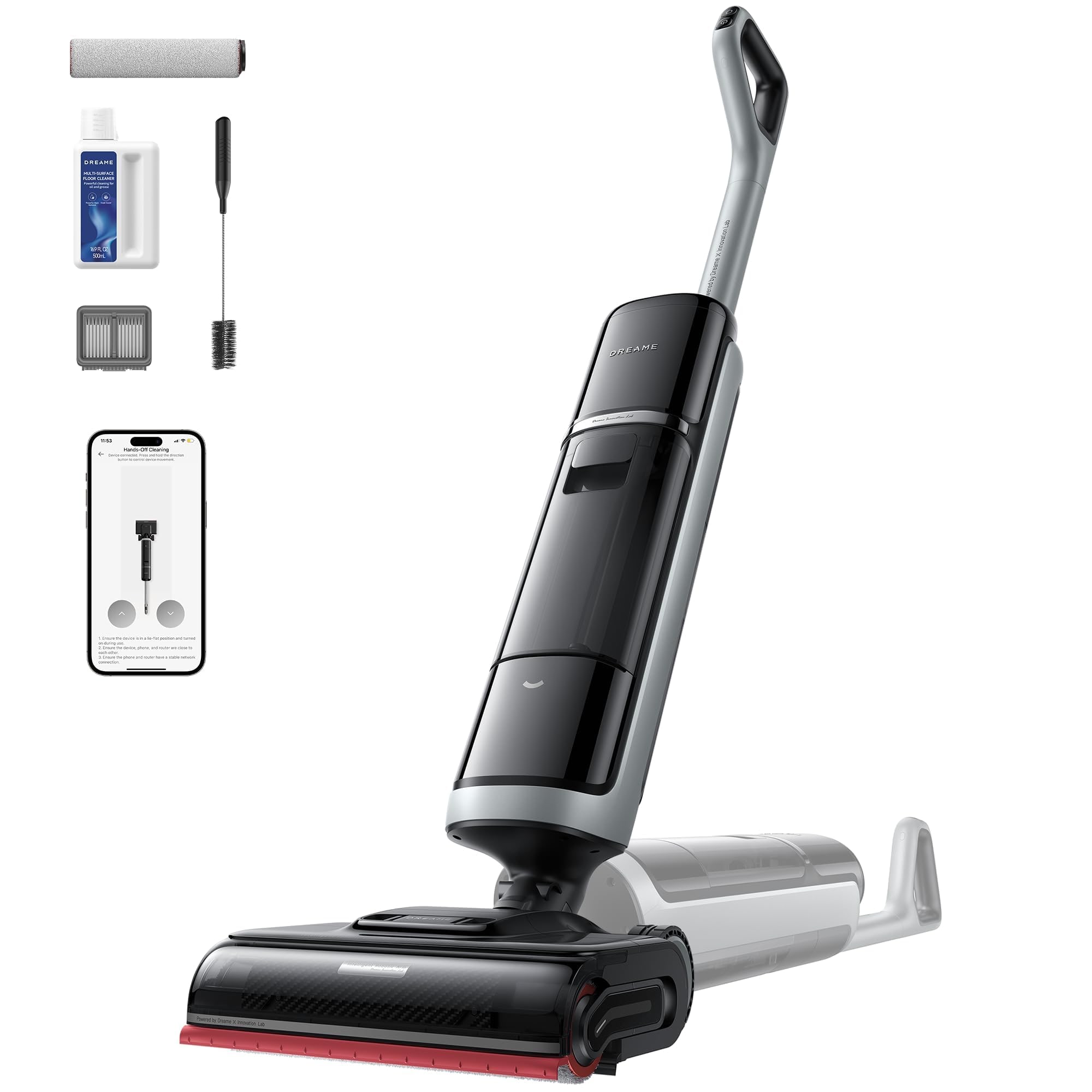
Dreame
Buyers who value explicit operating controls and accessible roller removal.
The Heat-specific review describes distinct core controls and selected-mode information, alongside bulk, limited head-following and post-use checking.
Reasons to choose it
- Separate power, mode and self-clean controls described in the Heat account.
- Display shows the selected mode.
- Upright parking and side roller removal provide useful access and placement.
Tradeoffs to know
- Reviewer describes a bulky feel and head movement that follows less freely.
- Solids basket can open readily and calls for deliberate handling.
- Residue remained after a particular reported self-clean test; inspection still matters.
Think twice if: Tight furniture turns or checking and handling dirty parts are your main objections.
Further reading
Ratings
Editorial score 7.7
Steering, carry and placement7
The Heat-specific review describes bulk and a head that follows movement less freely, with helpful upright parking. The review promotes a product-price link; funding is otherwise unstated.
Controls and mode selection9
The Heat report describes separate power, mode and self-clean controls and a display showing the selected mode. This supports understandable ordinary selection without borrowing a non-Heat model’s menu.
Tank, roller and post-use care7
The Heat report describes side roller access and a solids basket, but the basket opens readily and residue remained after one self-clean test. Accessible parts still need checking and manual care.
Sources & further reading
youtube.com review
youtube.com review
youtube.com review
cdn.awsusor0.fds.api.mi-img.com product information
cdn.awsusor0.fds.api.mi-img.com product information
youtube.com review
youtube.com review
youtube.com review
youtube.com review
youtube.com review
Keep reading
Something changed? Help us keep this useful.
Send a correction →