
The recommendation
Consider the AW261 for straightforward placement and a short ordinary routine, while retaining its initial-use caveat and manual care.
Grades at a glance
| Product | Overall | Steering, carry and placement | Controls and mode selection | Tank, roller and post-use care |
|---|---|---|---|---|
| Shark HydroVac MessMaster AW261 | 7.7 | 9.0 | 7.0 | 7.0 |
Does it fit your life?
A manageable start does not tell the whole story
The Shark HydroVac MessMaster AW261 is worth considering if you want a short operating routine and straightforward placement on a base. The published setup account shows upright parking, foot-assisted recline and returning the machine to charge. Those details support a 9/10 handling grade for ordinary placement. Our 7.7/10 overall usability grade also retains a less comfortable part of that same historical first session: a clean-tank-empty indication while the tank was not empty.
That event needs precise treatment. It occurred in one initial-use report and does not establish a recurring defect or a failure rate. The reviewer also had to wait for sufficient charge before self-clean. A charging prerequisite alone is not why the control grade is lower; state-dependent care exists elsewhere too. The additional issue is the confusing tank indication and the intervention shown in that particular session.
The AW261 deserves consideration when you value an uncomplicated start and a straightforward return to the base. Its appeal is less convincing if your main frustration is interpreting an unexpected indicator: the single setup account includes exactly that kind of interruption. Keep both observations in view. A short selection routine can be attractive while still requiring attention when a message appears, and the tank-and-roller work remains part of the finish whichever way you judge that initial session.
The grades at a glance
| Everyday task | Grade out of 10 | What is supported |
|---|---|---|
| Steering, carry and placement | 9 | Upright parking, foot-assisted recline and base placement in setup |
| Controls and mode selection | 7 | Simple ordinary selection, tempered by one confusing initial-use tank indication |
| Tank, roller and post-use care | 7 | Tank and roller access are shown; manual rinsing and drying remain |
| Overall usability | 7.7 | Approachable placement with setup and care follow-through |
These grades concern the ordinary routine, not measured cleaning power, runtime, sanitation or reliability. Handling is especially limited to the placement and start movements shown. It does not certify easy stair carrying or a measured steering effort. The setup account is helpful for seeing how the stages connect, but it cannot establish long-term behavior.
Read the full guide to compare the six selected machines. The Roborock F25 GT is our first general usability shortlist at 9 overall. The BISSELL OmniForce 3882 is the more specific alternative for dry pickup before wetting the roller.
What the published setup account shows
The AW261 unboxing and setup review identifies AW261 in its title; the spoken transcription renders the number less clearly. It concerns the white cordless MessMaster shown in that account. The presenter says he purchased the unit and was not paid for the video, while also disclosing affiliate commissions. We retain those qualifications rather than calling it independent long-term owner evidence.
The useful observations are ordinary actions: placing the machine upright, reclining it to begin the working movement, returning it to the base and dealing with the tank and roller. This is more informative for a buyer than a generic statement that a product is easy. It shows where the person is still involved, even before considering the unexpected indication later in the session.
Keep the shopping comparison specific to AW261. The account also discusses other HydroVac variants and earlier prices, but those remarks do not settle the contents or hardware of a current listing. Decide which shown actions matter to you—upright placement, recline, return to the base or component access—and compare the actual product on that basis. The first-use indication deserves its own consideration; it should neither be ignored because placement looks simple nor treated as proof of a problem across the range.
Upright parking and recline are distinct steps
The reviewer shows the cleaner standing upright, then describes using a foot-assisted recline to start the working movement. That is useful placement information for someone deciding where the machine will live and how they will begin a small task. The action can be understandable without telling us everything about its effort for a particular user.
Before buying, picture that transition in the intended storage area. Is there room to move from upright storage into the cleaning route without shifting other belongings? A neat corner may fit the assembled machine but still be inconvenient for the motion of taking it out. This is a layout question you can check before ordering, rather than a claim about a minimum clearance we have measured.
The setup is encouraging if taking the machine out and returning it to the base are your main concerns. Carrying between levels is a separate purchase question, and this account does not measure that effort. Consider who will move the washer, where it will live and whether lifting is unavoidable. If those decisions are settled, the shown upright-to-working transition is easier to assess against your needs. If they are not, assess the actual unit before relying on the handling score.
A short operating choice can be appealing
The source describes power and a stain-boost selection, with the ordinary wet routine otherwise kept simple in the demonstration. That can suit someone who does not want to work through a large mode menu for each local job. The buyer benefit is a limited set of decisions, not a guarantee that the machine automatically interprets every situation correctly.
The base also has a role in self-clean, so the meaning of an action depends on where the machine is and what state it is in. We describe that as part of the demonstrated routine, not as a replacement button guide. Use the supplied AW261 instructions for operation and care. A familiar-looking control on another HydroVac is not enough to establish identical behavior.
This distinction explains how a simple interface can still receive a 7 control grade. A low number of choices is useful only if the user can also understand what happens when a process pauses or an indication appears. The particular setup account includes just such a moment, which deserves attention without being exaggerated into a product-wide diagnosis.
The tank indication was one historical setup event
During the first-use self-clean sequence, the reviewer sees a clean-tank-empty indication even though the tank is not empty. He removes and reseats the tank while trying to continue. He speculates about first-use behavior, but the published account does not establish the cause. We therefore do not diagnose a sensor, identify a repair or predict how another unit will behave.
The event matters because it interrupts an otherwise short routine and asks the person to interpret an unexpected message. That is the concrete extra burden behind the control reservation. The charging prerequisite is also shown, but it is not unique enough by itself to explain the lower grade. Keeping those two observations separate avoids suggesting that any machine with a battery condition deserves the same assessment.
Equally, one historical event is not a defect rate. It does not show recurrence over weeks or months, and the review's mention of future monitoring is not the monitoring result. If a current buyer encounters an indication, the appropriate next reference is the exact supplied documentation or product support. This article does not provide a workaround derived from an unconfirmed explanation in a setup video.
Plan the base around the end of the task
The source shows setting the AW261 on its base to charge and using the base for the self-clean stage. For a purchase decision, the practical question is whether that location also works with the dirty-tank routine. A convenient parking spot is less convenient if it is awkward to remove parts there or carry them to where you will finish care.
The demonstrated self-clean requires sufficient charge. We do not give a fixed threshold or promise that care is immediately available whenever the machine is docked. This is a planning point: allow the whole routine to include readiness and manual follow-through, rather than picturing the base as an unconditional finish button. The supplied instructions remain the operating reference.
For shared use, think about the handoff at the end of a job. One person may return the machine to the base while another expects it to be ready next time. Make sure both understand that readiness, indications and manual care can still need attention. This is particularly relevant to the setup account, which includes both a charging prerequisite and an unexpected message. The attraction of a short menu is strongest when the people using it are also comfortable finishing the routine.
The tank and roller still need hands-on care
The setup demonstration removes the dirty tank and shows the roller lifting out. It discusses rinsing parts and allowing the relevant components to dry, including the filter when wet. Those details support a 7 care grade. Access is visible and direct, yet the work is still real. The dock does not dispose of the collected contents or make every removed part ready for reuse.
When planning space, picture where you would put a tank down and handle a roller without juggling them. A base footprint alone does not answer that question. The need for manual care is not a criticism unique to Shark; it is a practical part of buying this kind of cleaner. It becomes an objection only if the household expects never to touch dirty parts.
Judge the care task at the place where you would actually perform it. Is there room to set down the tank while handling another component? Would parts left to dry be in the way? Can the person who usually cleans the floor comfortably do the finish too? Use the supplied AW261 instructions for washing and drying details. The demonstration establishes that these tasks remain; it gives no reason to choose the machine on the expectation that its base makes them unnecessary.
Keep AW261 separate from nearby HydroVac names
The published account spends time comparing variants, colors and included items. That is useful as a reminder to inspect the exact listing, but it is not proof that every nearby HydroVac is the same machine. A similar shell or the MessMaster name does not establish identical hardware, controls or accessories. We keep the AW261 identity attached to the observations in this review.
If a spare roller or solution bottle affects your purchase, confirm the present listing's contents. We do not certify a current bundle from the selected product image or the historical unboxing. An extra item shown in a video may belong to that particular package, time or seller. Decide what you actually need, then verify those details before ordering.
The same reviewer’s WD-series comparisons describe that reviewer’s perspective. They cannot establish that other AW261 users experienced the same issue. Keep the first-setup event separate from later comparisons: seeing a topic in more than one video does not demonstrate how widely it occurs among buyers.
AW261 versus Roborock F25 GT
The GT review is a useful alternative when understandable operation and accessible care are the priorities. An affiliate-disclosed purchased GT account describes balanced movement and an uncomplicated compartment. A second household demonstration with funding unstated supports only narrow tank access because its spoken identity is less specific. Neither is treated as a guarantee of maintenance-free operation.
Official GT manuals describe separate Power, Switch Mode and Self-Clean functions and ECO/MAX selection. Self-clean is state-dependent there too, with readiness conditions. This is why the Shark's charging wait alone does not explain the different control grades. The Shark reservation concerns the additional unexpected tank indication in its historical setup, while the GT grade concerns a direct documented ordinary workflow.
The GT documentation is not a hands-on comparison of handle-label visibility or button positions, and it does not authenticate every current retail revision. Choose it if the described routine and care access are a better fit, rather than assuming its higher overall usability grade proves superior cleaning or that no unit could ever show a confusing indication.
The other routines worth comparing
The BISSELL OmniForce 3882 is distinctive if you want dry pickup before mopping. Its purchased, affiliate-disclosed follow-up emphasizes starting dry; turning water off after mopping does not recreate that condition. Its manual disposal and drying work remain. The Eureka NEW200 offers a direct matching corded demonstration, with brand association and an unspoken NEW200 number limiting application to the shown corded routine.
The Tineco S9 Artist Steam has helpful prompts in an affiliate-disclosed hands-on account: a drying countdown and animated tank guidance. Carry weight and historical repeated drying temper that appeal. The Dreame H15 Pro Heat separates its core controls and shows the selected mode in a Heat-specific review promoting a product-price link, with funding otherwise unstated. Bulk and manual care checks remain its reservations.
All three of Tineco, Dreame and Shark receive 7.7 overall here for different reasons. Use that equality as a reason to read the actual tradeoff. A clearer display, a simpler menu and easier placement solve different problems. The best match depends on which transition you find inconvenient in your own routine, not which machine has the most persuasive unboxing.
Buying verdict
The AW261 can suit someone who values straightforward placement and a short ordinary selection routine, and who will finish the tank and roller care. Its 7.7 usability grade keeps that appeal alongside the historical initial-use interruption. We do not advise rejecting every AW261 because of one event, and we do not erase the event to make the recommendation sound cleaner.
Verify AW261 on the current listing and check package details if a spare roller or other accessory influences your choice. This review was updated October 16, 2026 using the published first-setup account, without a fresh price or stock check or our own laboratory testing. Its limits are especially relevant here: a first session can reveal how placement and controls work for that reviewer, but it cannot establish long-term reliability or how often an unexpected indication occurs.
Choose it when the shown routine matches your room and the people using it. If interpreting unexpected indicators is your main frustration, compare the GT and the more informative Tineco account before deciding. Keep manual care in the plan whichever model you choose: the most useful cleaner is one you can start, understand and finish without avoiding the job.
Shark HydroVac MessMaster AW261
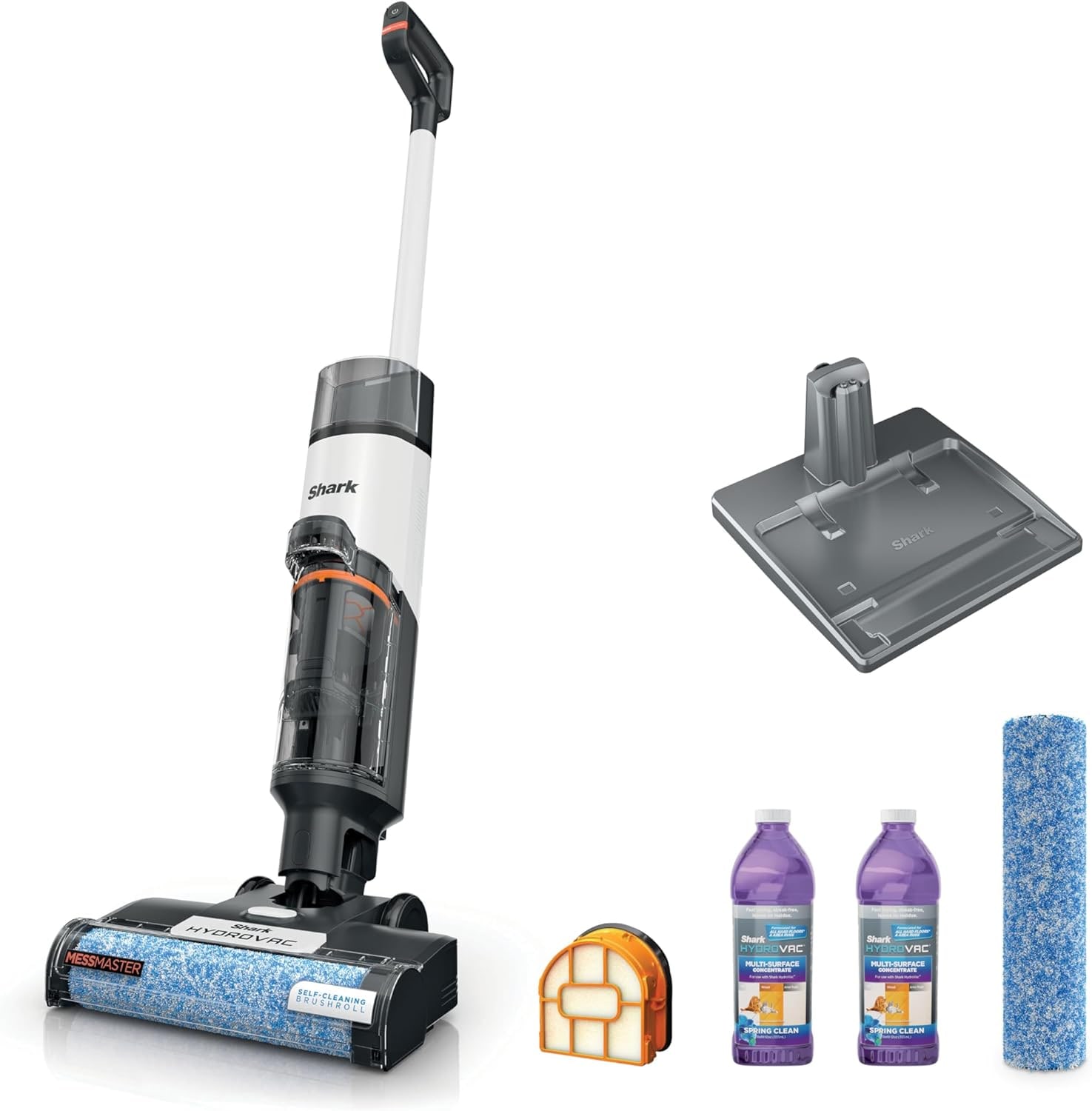
Shark
Buyers who value a short ordinary selection routine and straightforward base placement.
The setup account shows upright parking and base placement, with one historical unexpected tank-empty indication and manual tank-and-roller care.
Reasons to choose it
- Upright parking and foot-assisted recline shown in setup.
- Straightforward return to the base is demonstrated.
- Tank and roller removal are accessible in the shown routine.
Tradeoffs to know
- One historical first setup showed a clean-tank-empty indication while the tank was not empty.
- That single event does not establish recurrence, cause or a defect rate.
- Rinsing and drying relevant parts remain after dock care.
Think twice if: You expect self-clean to remove the need for rinsing and drying or every initial session to be interruption-free.
Further reading
Ratings
Editorial score 7.7
Steering, carry and placement9
The purchased, affiliate-disclosed AW261 setup shows upright parking, foot-assisted recline and placement on the charging base. These support ordinary placement rather than stair carrying or measured steering effort.
Controls and mode selection7
The short operating selection is tempered by one historical first-setup clean-tank-empty indication while the tank was not empty. A charge prerequisite also appeared, but that condition alone does not explain the grade. The event establishes no recurrence or defect rate.
Tank, roller and post-use care7
The setup shows tank and roller access and retains rinsing and drying relevant parts, including a filter when wet. Dock care does not replace those manual tasks.
Sources & further reading
youtube.com review
youtube.com review
youtube.com review
cdn.awsusor0.fds.api.mi-img.com product information
cdn.awsusor0.fds.api.mi-img.com product information
youtube.com review
youtube.com review
youtube.com review
youtube.com review
youtube.com review
Keep reading
Something changed? Help us keep this useful.
Send a correction →