Shure MV7+ Review (2026): The USB Mic That Rewards Close Talkers
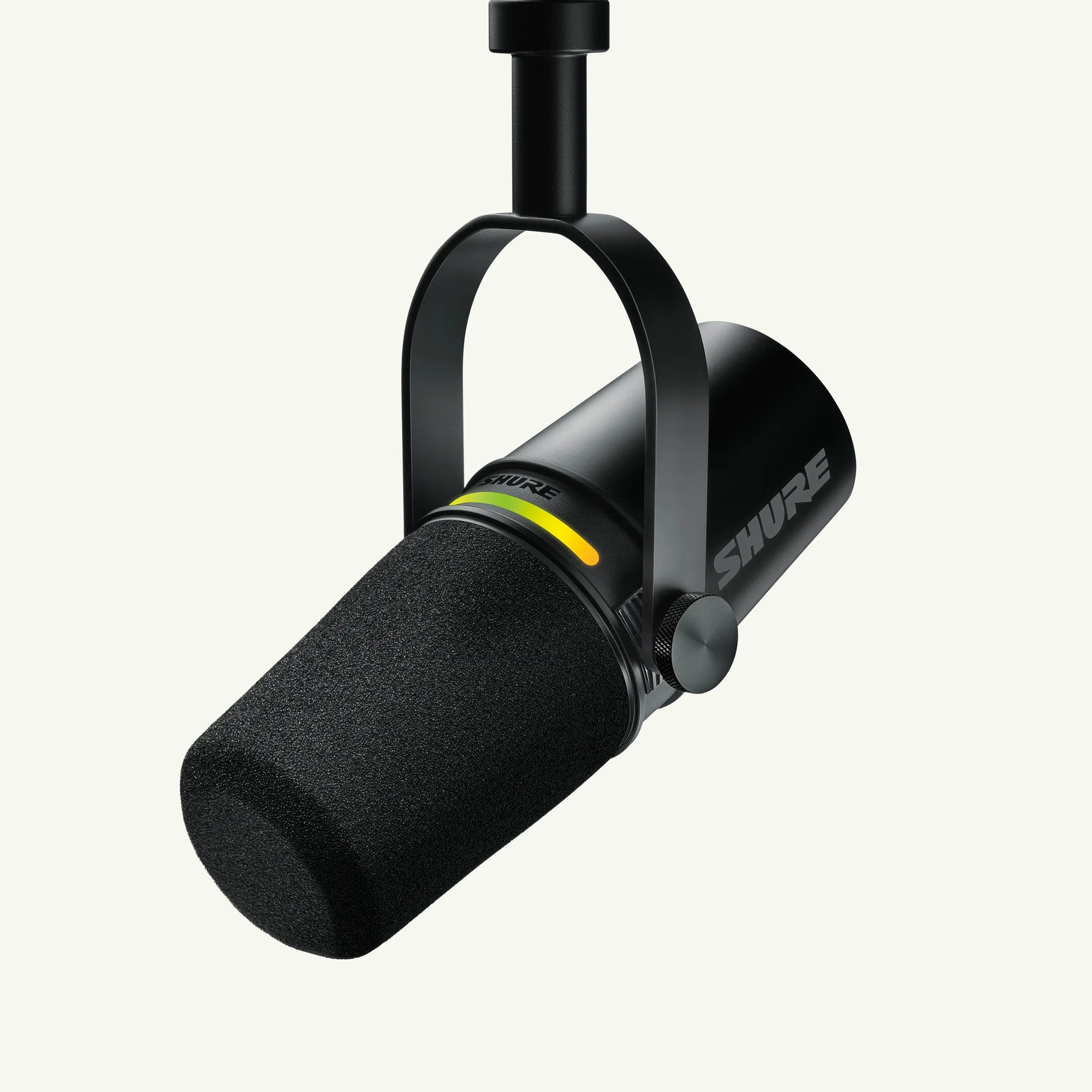
The MV7+ is the premium USB/XLR Shure for people who want a focused podcast-style voice from a normal room—as long as they keep it close and use the software lightly.
The Shure MV7+ is the safest overall USB microphone in this group for creators, streamers, podcasters, and meeting-heavy workers who want close-talk voice focus without building a studio first.
MSRP
—
Amazon
$299
at writing · 2026-05-14
Buyer fit
A premium dynamic USB/XLR mic with strong voice focus, useful DSP, and better noisy-room odds than most condensers; price and mounting discipline are the catches.
MSRP
—
Amazon
$299
at writing · 2026-05-14
Score breakdown
How this product scored
Same rubric, but focused on one product so the reasons behind the score stay readable.
Speech sound quality
Excellent close-talk voice focus for speech, especially with the longer windscreen and Shure processing, as long as you work the mic like a podcast mic instead of parking it across the desk.
Room and desk-noise rejection
One of the safest mics in this set for imperfect rooms because the dynamic capsule, close placement, denoiser, and pop-control tools all reduce common desk-recording mistakes.
Controls and monitoring
Strong controls and monitoring: USB-C, XLR, headphone monitoring, touch mute, LED metering, and app gain options give beginners and tinkerers more ways to stay out of trouble.
Software and USB setup
The app is useful rather than decorative, but the best results still ask you to learn gain, limiter, tone, denoiser, and USB-only processing behavior.
Mounting and desk fit
The yoke mount and standard threading are practical, but the base kit/stand situation and desk thumps mean a boom arm or better isolation is part of the real setup for many buyers.
Use-case flexibility
USB now, XLR later is the big win: it can start as a simple computer mic and later move into an interface setup, though the DSP advantages mostly live on the USB side.
Reliability and support
Shure build quality evidence is strong, with metal body/yoke notes and broad review coverage, but the evidence is still stronger on early reviews than years-long owner durability.
Evidence confidence
High source confidence for identity, features, voice tests, and comparisons; weaker for deep long-term owner/support patterns, so the reliability caveat stays visible.
Quick Verdict
Shure is the name many buyers know from podcast studios and broadcast desks, and the MV7+ is its friendlier USB/XLR version for people who are not ready to build a full audio chain. The promise is tempting: get a focused, close-talk voice from a normal room, with USB-C, headphone monitoring, touch mute, app help, and XLR for later. The regret check is just as simple: will you actually keep it close to your mouth? If yes, this is the USB mic in this group I would trust first in an imperfect room. If it sits beside your monitor while the keyboard clacks underneath it, the MV7+ cannot beat physics for you.
That is why it ranked #1 in our Best USB Microphones in 2026 guide as the Best overall pick. The parent ranking gives it an 8/10 overall because it solves the problems that make many USB mics feel disappointing after week one: too much room noise, plosives, weak gain habits, no monitoring, and no path beyond USB. PCMag’s review sums up the upgrade package as “a built-in pop filter, automatic gain control, and real-time noise reduction” (source). Those are not flashy extras; they are the boring protections most desk-recording buyers only appreciate after a bad recording.
The current shopping caveat: the kept product is Shure MV7+ / ASIN B0CTJ8BSWN, captured in an Amazon availability check at $299 on 2026-05-14T22:14:12Z. Refresh the live listing for seller, condition, bundle, and price before checkout. Use the product link to check current availability, and buying through it helps support KB4UB.
Score Breakdown
Overall score: 8/10. The MV7+ earns the top slot because it combines a forgiving dynamic capsule, close-talk voice focus, USB-C, XLR, headphone monitoring, touch mute, LED metering, and Shure’s MOTIV Mix tools. It does not get a 9 or 10 overall because price, stand/isolation needs, and app learning still matter.
- Speech sound quality: 9/10 — The voice lane is the whole point. The MV7+ is built for podcast-style speech, and the review evidence repeatedly checks close placement, tone, plosives, and room behavior.
- Room and desk-noise rejection: 9/10 — It is not magic, but it gives noisy-room buyers better odds than most USB condensers. One transcript deliberately tests typing and says, “now I am typing on a keyboard with Gator on Blue switches to see how much of my voice versus how much of the keyboard it picks up” (source). That is the right test for real desks.
- Controls and monitoring: 9/10 — Touch mute, LED metering, headphone monitoring, gain options, and USB/XLR outputs all help you catch problems before a recording is ruined.
- Software and USB behavior: 7/10 — The app is powerful, but you get the most from it only if you are willing to set it up. One reviewer says, “I prefer to manually set the gain” (source), which is honest: auto tools help, but manual discipline still wins.
- Mounting and desk fit: 7/10 — The yoke is flexible and solid, but a boom arm or better isolation is part of the real cost if your desk moves.
- Use-case flexibility: 9/10 — USB now, XLR later is the practical future-proofing.
- Reliability and support: 7/10 — Build evidence is good, but long-term owner/support patterns are thinner than voice-test coverage.
- Evidence confidence: 8/10 — The available coverage has strong formal-review and YouTube evidence plus exact commerce identity, but not a huge owner-forum base.
What Feels Great Right Away
The MV7+ feels good right away because it does not ask a beginner to assemble a full audio chain before sounding serious. You can plug in over USB-C, monitor through the headphone jack, mute from the mic, and use Shure’s app to control gain, tone, compression, limiter, denoising, voice isolation, and pop behavior. That is a lot of protection for someone who knows they want better voice but does not want to start with an interface, preamp, and XLR-only setup.
The hardware evidence also supports the premium feel. In one review transcript, the reviewer says “this thing feels really well put together,” then points to the metal body, metal mesh grille, metal yoke parts, and standard 5/8-inch threading (source). That is exactly what you want from a mic that may live on a boom arm next to a keyboard for years.
The other immediate win is plosive control. The MV7+ has a longer windscreen than the old MV7, and a reviewer notes that the bigger windscreen “does help reduce those plosives versus the original MV7” (source). You still need good mouth angle and distance, but this is one of the rare upgrades that addresses a boring, common annoyance instead of only changing the connector.
Setup and Daily Use Notes
The best daily setup is close, slightly off-axis, and preferably on a boom arm. Think a few inches from your mouth, aimed toward the corner of your lips, not a foot away beside your keyboard. That is where the dynamic capsule and Shure processing earn their keep. If you treat it like a conference speakerphone, you lose the advantage you paid for.
The MOTIV Mix app is not just a vanity panel. The source material points to auto leveling, manual gain, tone controls, limiter, compression, real-time denoiser, and voice isolation. For meetings, streaming, or podcasting, the useful starting recipe is conservative: set gain so normal speech does not clip, use the limiter, keep compression light, and only push denoising as far as your room needs. The transcript that says “light compression and the limiter turned on will be your best friend” is a bit casual, but the advice is directionally right for USB use (source).
The app caveat is that the best Shure features live on the USB side. If you buy the MV7+ only to run XLR into an interface forever, the value case changes. One review transcript warns that “when you move over to XLR you don't get any of the features” (source). That does not make XLR bad; it just means the MV7+ is most compelling when you actually want both paths.
What Gets Annoying
The first annoyance is cost. At the captured $299 Amazon availability check, the MV7+ is not a casual upgrade. Samson’s Q2U gives you a cheaper dynamic USB/XLR path, and Sennheiser’s Profile is friendlier if your room is quiet and you mainly want obvious physical controls. The Shure still makes sense when you want the full bundle: close-talk forgiveness, software help, monitoring, better pop control, and later XLR flexibility.
The second annoyance is desk noise. Dynamic does not mean immune. If the mic is clamped to a wobbly desk and you hammer the keyboard, thumps can still travel through the arm or stand. The source material includes tap and resonance testing, which is the boring-but-important reminder that a premium mic still needs a decent mount. Worth knowing before checkout, not a reason to panic.
The third annoyance is that Shure gives you enough settings to help yourself or overcook yourself. Auto gain, tone, denoising, compression, limiter, reverb, and pop tools are useful, but stacking them aggressively can make speech sound processed. If you hate touching audio settings at all, the simpler Sennheiser Profile may be the calmer choice even though it is less forgiving in noisy rooms.
Reliability, Build, and Ownership Reality
The reliability picture is reassuring but not perfect. The available coverage has strong build-quality language, formal review coverage, and brand confidence, but it is not dominated by years of owner-forum follow-up. That is why the reliability/support score stays at 7/10, not higher.
What we can say with confidence: the MV7+ hardware does not read as flimsy in the evidence. The official/product-review lane points to the move from micro-USB on the older MV7 to USB-C here, and SoundGuys notes that the podcast kit includes “a lengthy 3m USB-C cable” while the previous model used a USB-A to micro-USB cable (source). PCMag also says, “We like its quality construction, flexible XLR/USB-C outputs, and customizable LED sound meter” (source).
What I would still watch: USB-C port/cable handling, boom-arm strain, app/firmware behavior, and how much denoising you actually use. The safe ownership move is boring: route the cable with slack, mount the mic close but not in your typing path, save a clean preset, and do one test recording before important calls.
How It Compares
Against the Sennheiser Profile USB, the Shure is the safer noisy-room and future-XLR pick; the Sennheiser is the simpler condenser for a quieter desk. Against the Samson Q2U, the Shure is much more polished, but the Samson is the value gut-check: if you only need a cheap close dynamic mic, the Q2U is sensible.
Against the Elgato Wave:3, the choice is room and workflow. Elgato makes more sense if Wave Link routing is central to your streaming setup. Shure makes more sense if the mic itself needs to protect your voice in an untreated room. Against the RØDE NT-USB+, AT2020USB-X, HyperX QuadCast 2 S, and Blue Yeti, the big difference is that those are condenser-style desk mics first. They can sound open and detailed, but they are usually less forgiving when the room, fan, keyboard, or wall reflections get loud.
That comparison is why the MV7+ leads the full ranking instead of merely winning a premium slot. See the rest of the shortlist in Best USB Microphones in 2026.
Who Should Buy It
Buy the Shure MV7+ if you record podcasts, stream, make videos, spend a lot of time in calls, or just want your voice to sound more intentional from a room that is not a studio. It is especially easy to recommend if you want USB today but like the idea of moving to XLR later.
Also buy it if you know small setup details will bother you later: no monitoring, unreliable mute feedback, plosives, hard-to-control gain, or a mic that hears too much of the room. PCMag puts the use-case neatly: “Podcasters and musicians alike will find the MV7+ a capable recording partner for home and studio sessions” (source). That is a fair lane, with one extra KB4UB caveat: it is best when you can place it like a close vocal mic.
For the full ranking and cheaper/simpler alternatives, go back to Best USB Microphones in 2026.
Who Should Skip It
Skip the MV7+ if you want the mic to disappear across the desk. A far-away Shure dynamic is still a far-away mic, and a cheaper webcam/headset setup may be less frustrating for casual calls.
Skip it if $299 makes you wince and you do not care about Shure’s app tools or XLR future. The Samson Q2U is the budget dynamic escape hatch. Skip it if your room is quiet, your desk is simple, and you prefer obvious hardware knobs over software controls; the Sennheiser Profile is probably easier to live with. And skip it if you are buying XLR-only from day one and do not want the USB processing layer. At that point, compare it against dedicated XLR microphones instead of treating the MV7+ as a cheaper SM7B.
Tell us what this page missed
These pages get better when real buyer complaints make it back into the scoring model. If something important is underweighted, say it.
Rate this review
Give it a score from 1-10 and tell us what to improve.
0/4000 characters