
The recommendation
Choose the OXO 12 when both serving arrangements have a real role and their matching and clearing steps suit your household.
Grades at a glance
| Product | Overall | Filling and carafe handling | Ordinary control selection | Basket and routine care access |
|---|---|---|---|---|
| OXO Brew 12-Cup Coffee Maker With Podless Single-Serve Function | 8.0 | 8.0 | 8.0 | 8.0 |
Does it fit your life?
The buyer it suits
The OXO Brew 12-Cup Coffee Maker With Podless Single-Serve Function makes most sense for a household that wants to move between a carafe and a small serving setup. Its appeal is the choice of physical arrangements. The corresponding chore is preparing the right basket, choosing the matching batch range, and managing the vessel and drip tray. Buy it because those changes are useful to you, rather than assuming that one machine serving two routines removes the work of switching between them.
Our ordinary-use assessment is 8/10. Filling and carafe handling, ordinary control selection, and basket care each receive the same category grade. That even result reflects a balanced arrangement: accessible parts and a clear dial coexist with threaded lid alignment, separate batch selection, and care after using the small basket. No single category overwhelms the others in the buying decision.
The purchase is easiest to justify when the two arrangements have named users or regular occasions. One person might use the carafe for a shared morning, while another wants a mug at a different time. In that case, look closely at the basket change, range selection, and tray. If the smaller setup has no clear place in your routine, compare the OXO 9 or Ninja CE251 before giving much weight to the extra configuration.
Go to the family comparison, filling and lid handling, switching modes, care, or alternatives.
Filling and the carafe lid
Just A Dad's exact-model demonstration shows the large fill opening and explains the threaded carafe-lid alignment, around 0:43 and 2:51. Those are two different interactions: getting water into the reservoir, and returning the lid correctly to the carafe. The hands-on review gives a useful view of both. A generous opening can make the filling target clear without eliminating the separate attention needed at the lid.
For a buyer, the lid detail matters because it is a repeated hand movement. Imagine taking the lid off, setting it down, and threading it back into position before placing the carafe. If you dislike any need to line up a lid, give that interaction more attention than a broad description of “easy filling.” It may be a small step, but it belongs to the routine every time you use that arrangement.
Filling and carafe handling receive 8/10. The reviewer finds the carafe pours well in the demonstration, while also showing that the single-serve arrangement continues dripping after the mug is removed around 9:27. The same review therefore supports an appealing carafe-handling observation with a specific small-basket reservation. Treat the two arrangements separately when deciding how the machine will fit your counter.
If a mug is your usual vessel, consider what happens immediately after you move it away. The drip tray belongs in that mental picture, along with where you will take the mug and when you will return to clear the machine. The reported dripping is a useful reason to inspect that area. It is not sensible to infer that the carafe and mug arrangements behave identically merely because they share the same brewer.
Think about a change from a mug back to the carafe. The unused vessel needs a place to wait, the basket must suit the next preparation, and the carafe lid needs its own alignment check. With a spacious counter, those may be easy movements to accommodate. On a crowded counter, the temporary home for the spare arrangement could be the deciding detail. Include it in the purchase decision alongside the space occupied by the brewer itself.
Selection has two parts
The dial offers brew now, clean, clock, and later choices, followed by a separate batch-range selection. Just A Dad demonstrates the sequence around 3:35–4:18 and explains the small-basket selection around 8:37. In the control demonstration, the user must match the small-basket setting manually. The range selection does not decide how much water the user has put in the reservoir.
We give ordinary control selection 8/10. The panel organizes the actions, but switching the physical setup requires a matching decision on the controls. A buyer who enjoys using one dial may find the sequence reasonable. Someone who expects the brewer to infer the arrangement from the vessel will need to adjust that expectation. Preparing the basket and selecting the range are parts of the same task.
Think through a morning when a different person last used the machine. Before you start, you need to notice which basket is in place and whether you are preparing the carafe or a smaller vessel. The right buying question is whether you are comfortable making that check. The machine's flexibility is a benefit when everyone using it understands the relationship between the physical setup and the dial choices.
The dial’s action choice and range choice deserve separate attention. “Brew now” describes what you want to do; the range needs to agree with the physical arrangement. Clock and later-start choices introduce another reason to use the same control. A buyer who enjoys a single focal point may prefer that organization. A buyer who wants a distinct labeled button for each ordinary task should compare the Ninja’s layout before deciding that a dial will feel easier.
For someone who usually makes the same batch arrangement, the ordinary sequence may become familiar. The reason to choose this model over a simpler arrangement is what happens on the days you want to change it. Ask whether those changes are frequent enough to justify having both baskets and their corresponding selection steps in your routine. There is little value in configuring for a hypothetical habit you do not expect to develop.
Care includes the small basket
The demonstration shows removable brew-head access, handled baskets, and the drip tray, with the smaller setup discussed around 7:47–8:37. It also shows the care implications of small-basket drips and separately discusses washing the carafe around 11:21 and 13:43. These component and care observations make the cleanup task more specific than simply removing one filter after use.
Basket and routine care access receive 8/10. Handles and removable parts make the areas approachable, while the multiple arrangements add things to keep track of. It is useful to imagine the machine after a mug session and after a carafe session separately. The basket, tray, and vessel involved are not necessarily the same collection of items in both cases, so the clearing sequence deserves its own attention.
The small-basket drips make the tray especially relevant. If you are the kind of user who takes a mug away and immediately leaves the kitchen, consider whether you will remember to return and clear that area. This is a fit question, not a prediction about your habits. The machine's design gives you access to the tray; your chosen arrangement needs to leave room and time in the routine to deal with it.
For the carafe, consider where it will be washed and how you will keep the lid with it. The threaded lid is involved in both preparation and clearing, so a sensible landing place can make the complete sequence easier to understand. We would avoid choosing on a broad expectation that every removable part shares the same washing method. Treat the carafe and the baskets as distinct items when you plan your care routine.
A useful way to organize the alternative baskets is by the setup you expect to use next. If the smaller arrangement is tomorrow's plan, leave the parts together in a way that makes that intention obvious to the next user. If the carafe arrangement is the household default, make that equally clear. This is optional household advice grounded in the presence of separate baskets and settings, not a requirement to use a particular storage accessory.
What the balanced score means
| Ordinary task | Editorial score | Main consideration |
|---|---|---|
| Filling and carafe handling | 8/10 | Large opening, threaded lid, small-setup drips |
| Ordinary control selection | 8/10 | Dial action plus batch-range match |
| Basket and routine care access | 8/10 | Accessible parts across two arrangements |
| Overall ordinary-use assessment | 8/10 | Useful configuration choices with repeated checks |
The equal category scores do not mean every movement is equally easy. They mean each category contains a useful feature and a meaningful qualification. Filling has a large opening alongside lid alignment; controls combine a structured dial with separate range selection; care combines accessible parts with multiple arrangements. Read the practical description beside the number to see which qualification is most relevant to you.
This model is a good illustration of why the overall should not make the decision on its own. A household that uses both configurations may value the switching routine because it enables the exact tasks it wants. A household that uses only a carafe may see the same routine as an extra consideration. The score describes ordinary interaction; your intended configuration determines which parts of that interaction deserve the most attention.
Compare the routine you will use
The OXO Brew 9-Cup is the most direct alternative for a buyer who likes a dial and primarily wants a carafe routine. Its hands-on review shows a large fill opening, comfortable reported carafe handling, and removable care parts, while also showing the learning involved in clock and delay actions. Compare those specific movements with the 12-Cup's switching task.
The Ninja CE251 is worth considering if your central annoyance is filling. Its exact-model demonstration shows a handled removable water reservoir and directly labeled buttons. That is a different organizing principle: simplify the trip to the sink and use dedicated selections. If that addresses your daily task better than changing between vessels, it may be the more convincing fit.
The Technivorm KBGV Select provides the alternative centered on very few ordinary control choices. In the seller demonstration, half/full selection and a start switch are clear, with basket alignment remaining a physical task. Consider it when you want a short panel sequence and do not expect to gain much from the OXO 12's small-serving arrangement.
Keep the vessel decision ahead of the panel decision. If you want a carafe almost every time, compare the OXO 9’s filling and care movements with this model’s lid and baskets. If you want the tank to travel to the sink, start with the Ninja. If you want the fewest ordinary selections, start with the KBGV. Return to the OXO 12 when changing the serving arrangement is the benefit that those other priorities do not address for you.
The occasional-user question
Try describing a change of setup in four decisions: which vessel, which basket, which range, and which parts need clearing afterward. That is a useful shopping comparison with the OXO 9’s carafe routine or the Ninja’s removable-tank routine. The OXO 12 makes sense when your answer includes a real need for the alternate arrangement and a willingness to handle its parts. Its flexibility should save you from an unsuitable serving routine, rather than simply adding another basket you rarely choose.
OXO Brew 12-Cup Coffee Maker With Podless Single-Serve Function
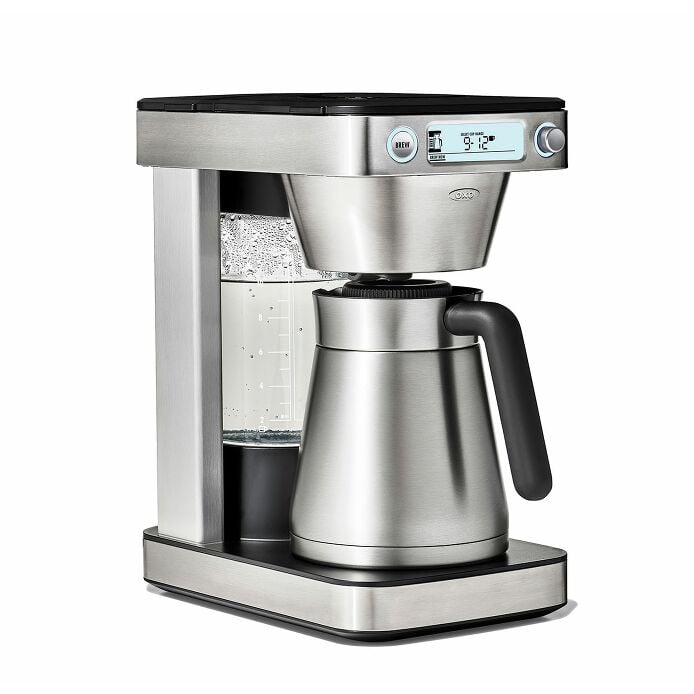
OXO
Households with a real need to change between carafe and smaller-serving setups.
A separate smaller-serving arrangement adds useful configuration choices alongside basket, range, lid, and tray chores.
Reasons to choose it
- Large fill opening is demonstrated.
- Handled baskets and removable head provide access.
- Dial organizes ordinary actions and range selection.
Tradeoffs to know
- Threaded carafe lid needs alignment.
- Small-basket setting must be selected manually.
- Small-setup dripping adds tray attention.
Think twice if: You dislike matching a physical basket to a range setting or organizing spare components.
Published specifications
- Model
- OXO Brew 12-Cup Coffee Maker With Podless Single-Serve Function
- Review focus
- Filling, ordinary controls, and basket care access
Further reading
Ratings
Editorial score 8
Filling and carafe handling8
The large opening and favorable demonstrated carafe pour are balanced by threaded lid alignment and small-setup dripping.
Ordinary control selection8
The dial selects an action and a separate batch range; the small basket must be matched manually and does not meter tank water.
Basket and routine care access8
Handled baskets, removable head, and tray provide access, with small-basket drips and separate carafe care adding tasks.
Sources & further reading
User reports at youtube.com
User reports at youtube.com
youtube.com review
youtube.com product page
Keep reading
Something changed? Help us keep this useful.
Send a correction →