Goal Zero Yeti 700 Review (2026): Rugged Small Power, Not 1kWh Muscle
The Yeti 700 is light, outdoor-friendly, and easy to pack for modest loads, but its 677Wh battery, 600W inverter, high current price, and Yeti variant confusion deserve a pause before checkout.
Goal Zero Yeti 700 is the smaller rugged pick in our portable power station ranking: good for camping, tailgating, CPAP/router backup, phones, laptops, lights, and small cooking moments, but not the station to buy for appliance-level 1kWh jobs.
MSRP
—
Amazon
$699.95
at writing · 2026-05-06
Buyer fit
Goal Zero is the smaller rugged control point, not a 1kWh rival. It is easy to move and outdoor-friendly, but the 677Wh/600W ceiling and high current price mean it belongs only if portability, IPX4-style design, and Goal Zero support matter more than appliance-level output.
MSRP
—
Amazon
$699.95
at writing · 2026-05-06
Score breakdown
How this product scored
Same rubric, but focused on one product so the reasons behind the score stay readable.
Usable runtime
The 677Wh rating and measured delivered-capacity results fit modest loads, not long appliance backup.
Load handling
600W continuous / 1000W surge is the obvious limitation in a set full of 1500W to 2600W units.
Recharge speed
Default charging and 200W solar input are workable for camping/tailgating, not especially fast or flexible for a broad backup pick.
Noise & thermals
The smaller inverter/capacity class helps livability, and the signal set did not show the same fan concern volume as BLUETTI or EcoFlow.
Controls
App support and straightforward controls are positives, though the controls have a few small setup quirks.
Portability
At about 20.3 lb with rugged/outdoor positioning, it is the easiest product here to move and pack.
Service
Goal Zero LLC seller posture and the brand’s outdoor/support identity help, but early defect/service complaints keep the score measured.
Backup fit
It can be a camping/CPAP/router backup box, but it is not expandable and is too small for many appliance expectations.
Quick Verdict
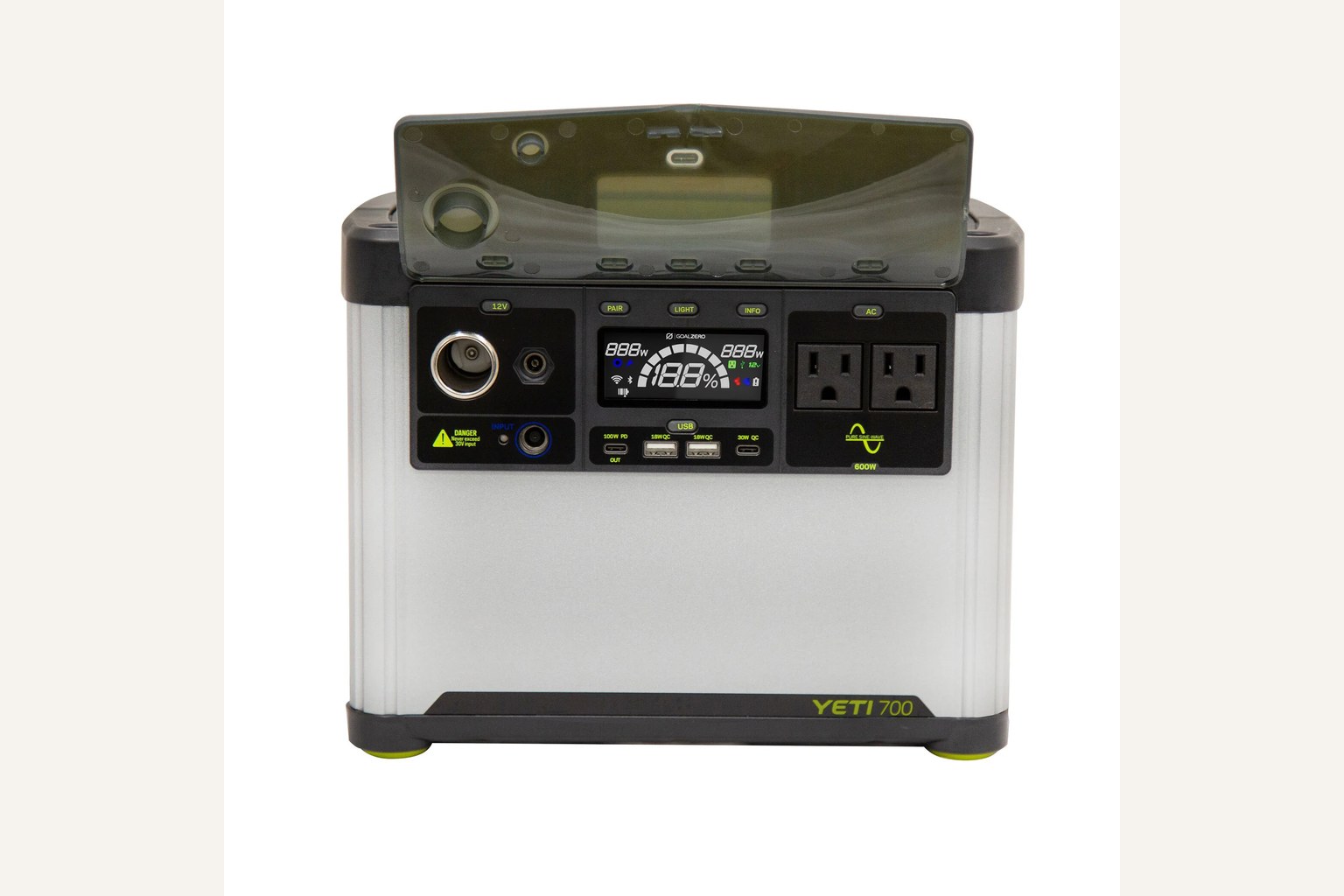
The Goal Zero Yeti 700 is the portable power station to look at when a 30 lb 1kWh box already sounds like too much. It is not trying to beat Anker, DJI, EcoFlow, Jackery, or BLUETTI at raw appliance backup. It is trying to be the easier outdoor box: 677Wh of LFP battery, 600W continuous AC output, 1000W surge, app support, a fold-flat handle, port covers, IPX4 water resistance, and about 20–21 lb to carry.
That is why it ranks #6 in our Best Portable Power Stations in 2026 guide as the Best rugged smaller pick, with a 6.5/10 score. Sixth place sounds harsh until you remember the comparison set: most rivals here are 1kWh-class stations with much bigger inverters. The Yeti 700 is the “do you actually need that much?” check.
The useful pre-buy question is not whether Goal Zero is a familiar outdoor brand. It is whether your real loads fit the box. OutdoorGearLab put it cleanly: the Yeti 700 “isn't the most powerful or capable power station on the market,” but its “lightweight, simple design works well for those with modest power needs.” That is the whole review in one sentence.
Use the product links to check today’s exact price, seller, condition, ASIN, Yeti 700 style tile, return terms, and availability. At writing, ASIN B0CRCVKNHR was new and in stock at $699.95 from Goal Zero LLC, but that price made the value case harder because several larger stations were cheaper on sale.
Score Breakdown
- Usable runtime: 6.6/10. The 677Wh rating fits phones, laptops, lights, routers, CPAP-style modest loads, small TVs, and short camping chores. OutdoorGearLab measured 560Wh delivered over AC, so do not mentally spend all 677Wh.
- Load handling: 5.3/10. This is the blunt limit. The two AC outlets share 600W continuous / 1000W surge, which is tiny next to the 1500W–2600W stations higher in the ranking.
- Recharge speed: 5.8/10. Wall charging is fine for this size, with roughly 2 hours in faster mode, but 200W solar input and slower car charging keep it from feeling broadly flexible.
- Noise and thermals: 7.2/10. The smaller inverter helps. The available reviews did not show the same fan anxiety as EcoFlow or BLUETTI, though fans still appear under heavier loads.
- Controls: 7.1/10. The display, app, and front controls are useful. The back-side power button, unlabeled button cluster, and cloud login for firmware are the small annoyances.
- Portability: 8.6/10. This is the win. Around 20.3 lb, compact dimensions, a collapsible handle, and outdoor covers make it much easier to move and pack than the 1kWh crowd.
- Service: 7.0/10. Goal Zero LLC seller evidence and 5-year warranty positioning help, but the review base is smaller and early defect/service chatter keeps the confidence measured.
- Backup fit: 5.8/10. It can be a router, CPAP, light, laptop, and camping backup box. It is not expandable and should not be treated like a whole-appliance outage plan.
What Feels Great After Setup
The best part of the Yeti 700 is how undramatic it is to move. A 20-ish lb power station is still not a toy, but it is much easier to hand to someone, put in a car, slide under a camping table, or carry outside than the heavier utility boxes. If your actual use is tailgating, a weekend campsite, backyard lights, camera batteries, routers, laptops, or keeping a CPAP-style setup alive for a limited window, that lighter body matters more than a spec-sheet victory.
The rugged touches are also the reason to want Goal Zero instead of a cheaper-looking battery cube. One hands-on reviewer liked that the Yeti lineup includes a true grounding lug, then noted the covers: Goal Zero used “a pretty significant rubber cover on the front of the device” and the station has an “ipx4 rating” for splash resistance. That does not make it waterproof. It does mean the product is better matched to rain-splashed camping, muddy tailgates, and gear-bin life than a purely indoor-looking station.
Small-load usefulness is real. In testing, a reviewer boiled water with a small kettle and said it “took about 10% of the battery power” to do it. That is the kind of camping convenience buyers actually feel: hot water, lights, charged phones, maybe a small meal, then back in the car. Not heroic. Useful.
Goal Zero also deserves credit for moving the compact Yeti line to LFP batteries. The packet and official/listing evidence point to 4000+ cycles, which makes the long-term ownership story much better than older lead-acid Yeti memories.
Daily-Use Quirks You Notice Quickly
The protective front flap is both the Yeti 700’s charm and its most obvious “hmm.” It helps sell the outdoor story, and one reviewer liked that the display remains readable through the door. But it also covers almost everything at once. If you only want one USB-C port, one 12V port, or one AC plug, you are opening the whole front panel rather than a small individual cover.
That same reviewer was gentle but clear about it: “maybe the next generation of go Zero Yeti products I recommend that these covers are individually assigned.” Fair. The current design is good at protecting the face between uses; it is less elegant when you are actively using only one port in messy weather.
The controls are another small learning curve. One transcript says the front has six buttons and “I have no idea what they do,” then calls the back-side power button the “only true gripe.” The app pairing itself looked painless — “problem solved” after tapping the pair button — and direct Bluetooth connection is available without creating an account. But firmware updates required cloud connection in that test, which means login/Wi-Fi/privacy decisions can show up after setup.
None of this is a dealbreaker if you want a rugged compact box. It is exactly the kind of thing worth knowing before you buy, because outdoor gear gets judged by how calm it feels when your hands are full.
The Limits That Can Make It the Wrong Buy
The 600W inverter is the hard stop. Goal Zero can run plenty of small devices, but it is not a “maybe it will handle everything” station. OutdoorGearLab’s warning is direct: with “only 600 running watts and a surge capacity of 1000 watts,” it struggles against similarly sized units with higher output, and coffee makers or portable electric stoves will be difficult.
The hands-on load test lines up with that. A small toaster oven around 515W was called a win. But when the reviewer combined loads and jumped to roughly 750W, “the AC inverter did pop off” after about 30 seconds. That is not a failure; that is the product doing what its rating says. The regret comes if you buy it expecting 1kWh-class appliance behavior.
The outlet layout can also pinch. OutdoorGearLab lists “Only 2 AC outlets” as a reason to avoid it and notes that the limited space between them can mean you effectively use one outlet when plugs are bulky. In a camping bin, that may be fine. In a home outage setup with router brick, lamp, charger, and other wall warts, it gets annoying fast.
The price is the final caveat. At the $699.95 price we saw, the Yeti 700 cost more than several larger sale-priced rivals in the parent guide. That does not make it bad; ruggedness, support, and portability have value. But you should buy those values on purpose, not because the Goal Zero name made the watt-hours disappear from your brain.
How It Compares With the 1kWh Picks
Anker SOLIX C1000 Gen 2 is the better default for most people because it gives you 1024Wh, 2000W output, fast charging, manageable weight, and fewer painful caveats. If your question is “what should I buy before storm season?” start there.
DJI Power 1000 V2 is the quiet high-output runner-up. It is heavier and has accessory catches, but its 2600W AC output makes the Yeti 700 feel tiny if you need tools, appliances, or studio gear. EcoFlow DELTA 3 Plus is the expansion-and-solar pick, but fan/heat notes make it less relaxing indoors. Jackery Explorer 1000 v2 is the simple lighter 1kWh option, still far above Goal Zero on output. BLUETTI AC180 is bigger and heavier, with more stored energy and a utility feel.
Goal Zero’s advantage is narrower and honest: it is easier to carry, more outdoor-shaped, and less intimidating for modest jobs. OutdoorGearLab says it is “highly portable for camping and off-grid trips,” with a handle that folds flat and a plastic cover over the display and ports. That is the lane.
For the full score grid, product order, and tradeoffs, go back to Best Portable Power Stations in 2026.
Who Should Buy It — and Who Should Skip It
Buy the Goal Zero Yeti 700 if:
- you want a compact outdoor power station for camping, tailgating, backyard lights, devices, laptops, camera gear, a router, or modest CPAP-style backup
- carrying a 30-plus-pound 1kWh box sounds like the part you will hate most
- IPX4 water resistance, protective covers, and a rugged handle matter in your use
- you already like Goal Zero gear and value the Goal Zero LLC seller listing we saw
- your real loads fit comfortably under 600W continuous output
Skip it if:
- you want to run coffee makers, induction plates, heaters, power tools, larger fridges, or several high-draw devices
- you want expansion batteries or a bigger home-backup path
- you care most about watt-hours per dollar
- two AC outlets will not be enough
- the live price is close to or above stronger 1kWh stations
Before checkout, confirm the exact Yeti 700 ASIN B0CRCVKNHR and avoid mixing it with Yeti 300/500 style tiles or technical-table leftovers. One Amazon technical section appeared to borrow Yeti 300 specs, so trust the product title, style selection, and current listing details more than a stray row.
Bottom line: the Goal Zero Yeti 700 is good when you buy it as the rugged small pick. It is disappointing only when you ask it to be the cheaper, lighter version of a much bigger station.
Tell us what this page missed
These pages get better when real buyer complaints make it back into the scoring model. If something important is underweighted, say it.
Rate this review
Give it a score from 1-10 and tell us what to improve.
0/4000 characters