Eve Room Review (2026): Great Apple Home Sensor, Narrow Air Monitor
A closer look at Eve Room as an Apple Home VOC, temperature, and humidity monitor: what feels useful, what it misses, setup/calibration quirks, Thread/home-hub needs, Micro-USB charging, and the exact Amazon listing caveat to recheck.
Eve Room is the Apple-home specialist in our air-quality monitor ranking. It is useful for VOC, temperature, and humidity trends plus local Apple Home automations, but it is not a PM2.5, CO2, radon, carbon monoxide, or broad diagnostic monitor.
MSRP
—
Amazon
$109.95
at writing · 2026-05-18
Buyer fit
Best for Apple homes: the privacy-leaning HomeKit VOC, temperature, and humidity sensor for Apple automations.
MSRP
—
Amazon
$109.95
at writing · 2026-05-18
Score breakdown
How this product scored
Same rubric, but focused on one product so the reasons behind the score stay readable.
Sensor coverage and fit
Eve Room scored 4.8 for sensor coverage and fit based on repeated source themes around Apple Home/Thread privacy posture, VOC/temp/humidity display, strong Eve graphs, calibration friction, micro-USB, and no PM/CO2 coverage.
Reading trust and calibration
Eve Room scored 6.9 for reading trust and calibration based on repeated source themes around Apple Home/Thread privacy posture, VOC/temp/humidity display, strong Eve graphs, calibration friction, micro-USB, and no PM/CO2 coverage.
Display, alerts, and actionability
Eve Room scored 7.4 for display, alerts, and actionability based on repeated source themes around Apple Home/Thread privacy posture, VOC/temp/humidity display, strong Eve graphs, calibration friction, micro-USB, and no PM/CO2 coverage.
App, history, and data access
Eve Room scored 7.5 for app, history, and data access based on repeated source themes around Apple Home/Thread privacy posture, VOC/temp/humidity display, strong Eve graphs, calibration friction, micro-USB, and no PM/CO2 coverage.
Setup, power, and placement
Eve Room scored 7.5 for setup, power, and placement based on repeated source themes around Apple Home/Thread privacy posture, VOC/temp/humidity display, strong Eve graphs, calibration friction, micro-USB, and no PM/CO2 coverage.
Reliability, support, and caveats
Eve Room scored 6.8 for reliability, support, and caveats based on repeated source themes around Apple Home/Thread privacy posture, VOC/temp/humidity display, strong Eve graphs, calibration friction, micro-USB, and no PM/CO2 coverage.
Before You Buy
Eve Room is the kind of air monitor that can either feel quietly perfect or oddly disappointing, depending on why you are buying it. If you want an Apple Home sensor that watches VOC-based air quality, temperature, and humidity, then triggers a purifier, fan, humidifier, or ventilation habit, it has a real lane. If you expect it to warn you about wildfire smoke, cooking particles, stale-air CO2, radon, carbon monoxide, or a formaldehyde-specific problem, it is the wrong tool.
That is why Eve Room lands as the Best for Apple homes pick, not near the top of our broader best air quality monitors ranking. Airthings, Qingping, Aranet, IQAir, and Temtop cover more pollutant questions for many buyers. Eve Room is narrower, but it also does one thing those broader picks do not: it fits neatly into a privacy-leaning Apple Home setup with a tiny e-ink display and local-feeling automations.
At the Amazon check used for this article, ASIN B09L58NQG2 was $109.95, sold by Eve Systems, shipped from Amazon, and marked “Only 5 left in stock - order soon.” Recheck price, seller, stock, and return window before buying; using the product links also helps support KB4UB.
Quick Verdict
Eve Room is a good buy for a very specific home: iPhone or iPad users who already think in Apple Home scenes and want VOC, temperature, and humidity trends to nudge everyday behavior. Official Eve copy calls it a sensor for “Temperature, humidity & air quality (VOC),” with “Bluetooth & Thread” and “Highest data privacy.” The Amazon listing is even more direct about the privacy pitch: “No Eve cloud, no registration, no tracking.”
The rating matches that narrow strength: 6.7/10 overall in the full comparison. It scores well for display/actionability, app history, and setup flexibility, but the sensor-coverage score is only 4.8/10 because it does not measure PM2.5, CO2, radon, carbon monoxide, or formaldehyde as a separate reading. A YouTube hands-on transcript makes the practical limit clear: Eve Room “won't pick up all particulate matter in the air like smog or dust” because the sensor is designed for VOCs.
So the verdict is simple: buy it for Apple Home VOC/comfort automations and a nice little room display. Do not buy it as your only air-quality monitor unless VOC, temperature, and humidity are truly the only readings you need.
Score Breakdown
Eve Room’s score is not a punishment for being focused. It is a reminder that focus has to match the room. Sensor coverage is the weak point at 4.8/10 because many air-quality shoppers are really trying to understand smoke, dust, CO2 ventilation, radon, or multiple pollutants at once. Eve Room does not cover those.
Reading trust and calibration came in at 6.9/10. The best support is for temperature and humidity credibility: Eve lists typical accuracy of ±0.3°C / ±0.54°F and ±3% humidity, and one hands-on source praised two units for reading close together. VOC trust is more contextual: VOC spikes can be useful, but cleaners, aerosols, candles, cooking vapors, paint, and new products can dominate the reading.
The brighter spots are daily use. Display, alerts, and actionability scored 7.4/10 because the 200 x 200 e-ink display and Apple Home scenes make the readings easy to notice. App/history scored 7.5/10 because Eve says its app shows graphs by “hours, days, weeks, months, and years.” Setup/power also scored 7.5/10, helped by the rechargeable design, but pulled down by calibration time, Micro-USB, and Apple home-hub requirements for remote automation.
What Feels Great Right Away
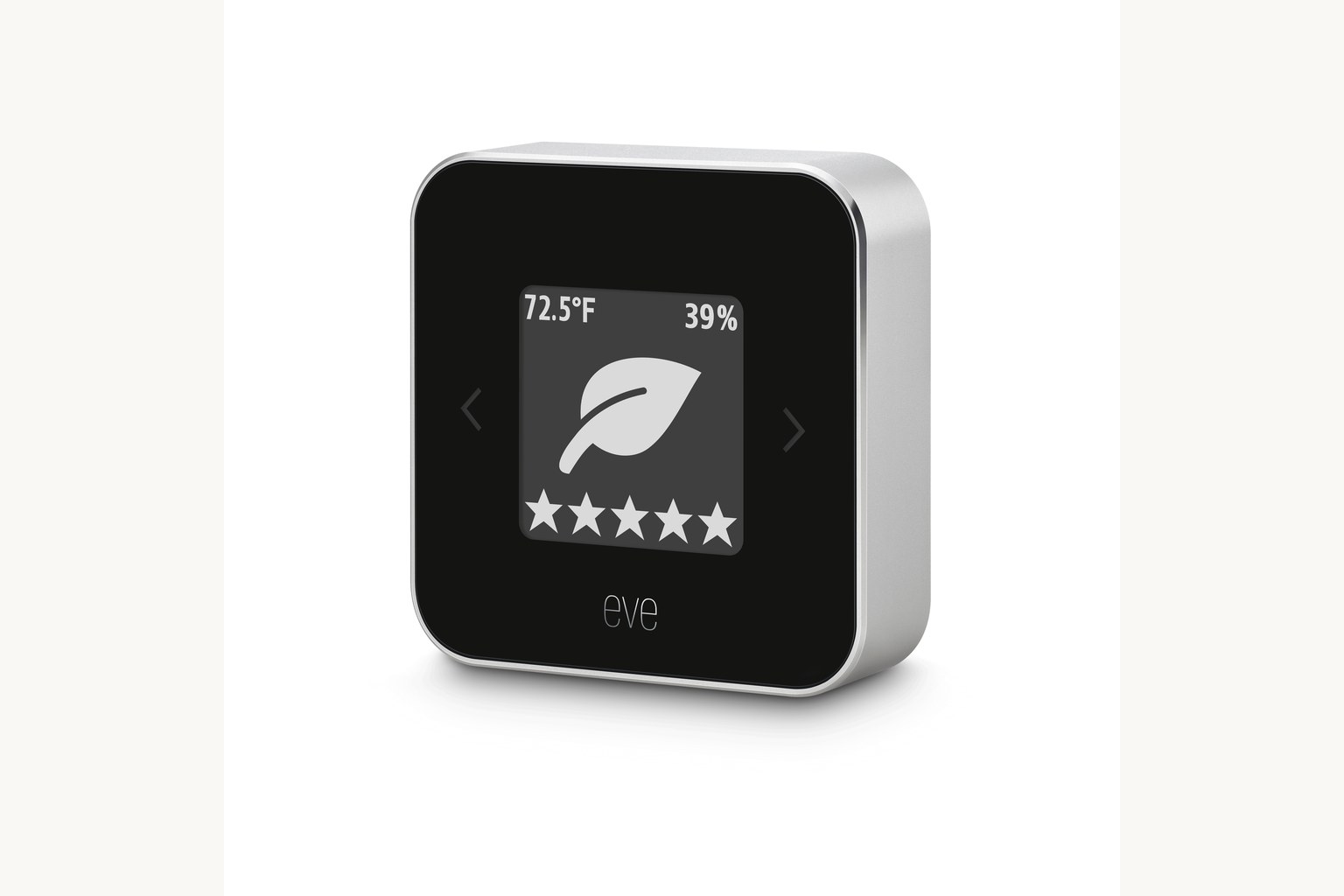
The nicest part of Eve Room is that it does not look or behave like a little lab instrument. It is a small square sensor with a high-contrast e-ink display that can sit on a desk, nightstand, nursery shelf, or office cabinet and show air quality, temperature, and humidity without asking you to open an app. Official specs list an E-ink: 200 x 200 pixels display, and the product images show the same compact square device with air-quality stars, temperature, humidity, and Eve branding.
The other immediate win is how natural it can feel inside Apple Home. Eve’s official guidance says it can turn on an air purifier, humidifier, fan, or connected device through an Apple TV or HomePod home hub “Exactly when needed, and only when necessary.” That is the little bit of magic here: a room starts smelling like cleaner, a VOC reading drops, and a purifier or fan routine can respond without you staring at a dashboard.
The app also matters. Eve says the Eve app “distills all measurements into detailed graphs,” so you can connect routine moments—opened windows, cleaning, painting, cooking—with the air-quality dip that followed. That is more useful than a lonely warning light.
Setup and Daily Use Details
Setup is familiar if you have added HomeKit accessories before: use the Eve app, add the accessory to Apple Home, and let it join over Bluetooth or Thread. Eve says Thread support can make the smart home network “more responsive, robust, and increases its reach,” but it also notes the extra requirement: you need a HomePod mini or compatible Apple TV 4K for Thread, and remote/automatic HomeKit control requires an Apple TV or HomePod home hub. Android and Alexa-first homes should look elsewhere.
The detail that may surprise people is calibration. A hands-on transcript says Eve presents the next step casually, but “it is pretty time consuming”: leave the Eve Room in the target room for half a day, then move it to well-ventilated/pristine air for about 30 minutes. That is not hard, but it is more involved than peeling a tab and trusting the first number.
Power is mostly convenient. Eve says the integrated battery lasts “six weeks or more of wireless power,” and the device can be left plugged in. The catch is the charging port: official specs list Micro USB, not USB-C, and the box includes a USB charging cable rather than a power adapter.
What Gets Annoying
The first annoyance is the sensor list. Eve Room can make an air-quality graph feel reassuring, but the air-quality reading is VOC-based. If a humidifier, wildfire smoke, frying pan, dusty room, or crowded bedroom is your real concern, the reading may miss the problem you care about most. PM2.5 monitors watch smoke and fine particles. CO2 meters help with ventilation. Radon monitors answer a different home-safety question. Eve Room is not secretly doing those jobs.
The second annoyance is that VOC spikes need interpretation. Eve’s own page says air quality is rated from one to five stars and “Your goal is to stay above three stars.” That is easy to understand, but a drop still needs context. Cleaning products, candles, aerosols, cooking, paint, new furniture, nail polish remover, and poor ventilation can all push the reading around. The useful action may be opening a window or moving a polluting product, not assuming the whole room is permanently bad.
Finally, the available source material is thinner than it is for some bigger-name monitors in this category. The record is strongest on official specs, Amazon identity, and YouTube walkthroughs, but weaker on independent lab accuracy, long-term owner/forum reports, warranty detail, and replaceable sensor information.
How It Compares
Eve Room sits below the broader monitors because it answers fewer air questions, not because it lacks a reason to exist. Airthings View Plus 2960 is the better choice if you want the widest picture, especially radon plus PM, CO2, VOC, humidity, temperature, and pressure. Qingping Air Quality Monitor Gen 2 is better if you want a bigger room display with CO2 and PM trends. Aranet4 Home is the clean pick if ventilation and CO2 are the whole point. IQAir AirVisual Pro is stronger for people who want PM2.5, CO2, outdoor comparison, forecasts, and deeper history.
Eve Room makes more sense than those if the home is already Apple-centered and the use case is comfort plus VOC behavior: cleaning day, candles, a painting project, a stuffy office, a nursery, or a bedroom where humidity and temperature routines matter. Compared with the Amazon Smart Air Quality Monitor, Eve is less Alexa-friendly but more appealing for buyers who want no Eve cloud, no registration, and a local Apple Home fit. Compared with GoveeLife, Eve is not the cheap PM trend pick; it is the nicer Apple VOC/comfort sensor.
Who Should Buy It
Buy Eve Room if you already use Apple Home and want one small sensor to make a room more responsive. It is a good fit for people who care about VOC-heavy moments—cleaning, cooking, aerosols, candles, paint, hobby supplies, new products in a room—plus temperature and humidity routines. It also fits buyers who like local-looking devices, e-ink screens, and the idea of a HomePod or Apple TV quietly switching a purifier, fan, humidifier, or scene.
Skip it if you are trying to solve a broader air mystery. Wildfire smoke and cooking particles need PM2.5. Stale bedrooms, offices, classrooms, and meeting rooms need CO2. Radon risk needs a radon monitor. Carbon monoxide needs a certified CO alarm, not an air-quality gadget. Android and Alexa-first buyers should not force this into their homes just because the hardware is attractive.
At $109.95 in the captured new Amazon listing, Eve Room is not a cheap sensor for what it measures. It earns its place only when Apple Home integration, privacy posture, VOC trends, and comfort automations are the reason you are buying.
Bottom Line
Eve Room is a good Apple sensor and a limited air monitor. That distinction protects you from regret. If you want to know when a cleaner, candle, cooking session, paint project, or stuffy room has changed the VOC/comfort picture, then its e-ink display, Eve graphs, rechargeable design, and Apple Home automations can feel genuinely helpful. If you want one monitor to explain smoke, dust, ventilation, radon, and chemical events together, buy something broader from the full ranking instead.
The best version of this purchase is intentional: Apple Home household, VOC/temperature/humidity focus, acceptance of half-day calibration, Micro-USB charging, and a live listing recheck before checkout. In that lane, Eve Room makes sense. Outside it, the missing PM2.5 and CO2 readings will probably bother you fast.
Feature breakdown
Full feature list
Grouped feature details are expandable so buyers can go deep when they want, without turning the whole review into a spec landfill.
Full feature list
7 features
+
Full feature list
7 features
Power
Integrated rechargeable battery, 6+ weeks per official specs
Display
200 x 200 e-ink
Sensors
VOC, temperature, humidity
Connectivity
Bluetooth and Thread for Apple Home/HomeKit
Charging Port
Micro USB
Does Not Measure
PM2.5, PM10, CO2, radon, carbon monoxide, formaldehyde-specific reading
Home Hub Required For Remote Automation
Apple TV or HomePod
Tell us what this page missed
These pages get better when real buyer complaints make it back into the scoring model. If something important is underweighted, say it.
Rate this review
Give it a score from 1-10 and tell us what to improve.
0/4000 characters