
The recommendation
The Encore ESP is an appealing choice for a direct control routine and accessible burrs, provided its light plastic housing suits your expectations.
Grades at a glance
| Product | Overall | Filling and handling | Control selection | Bin and burr access |
|---|---|---|---|---|
| Baratza Encore ESP Coffee Grinder ZCG495BLK, Black | 8.5 | 8.0 | 8.5 | 9.0 |
Does it fit your life?
A direct kind of interaction
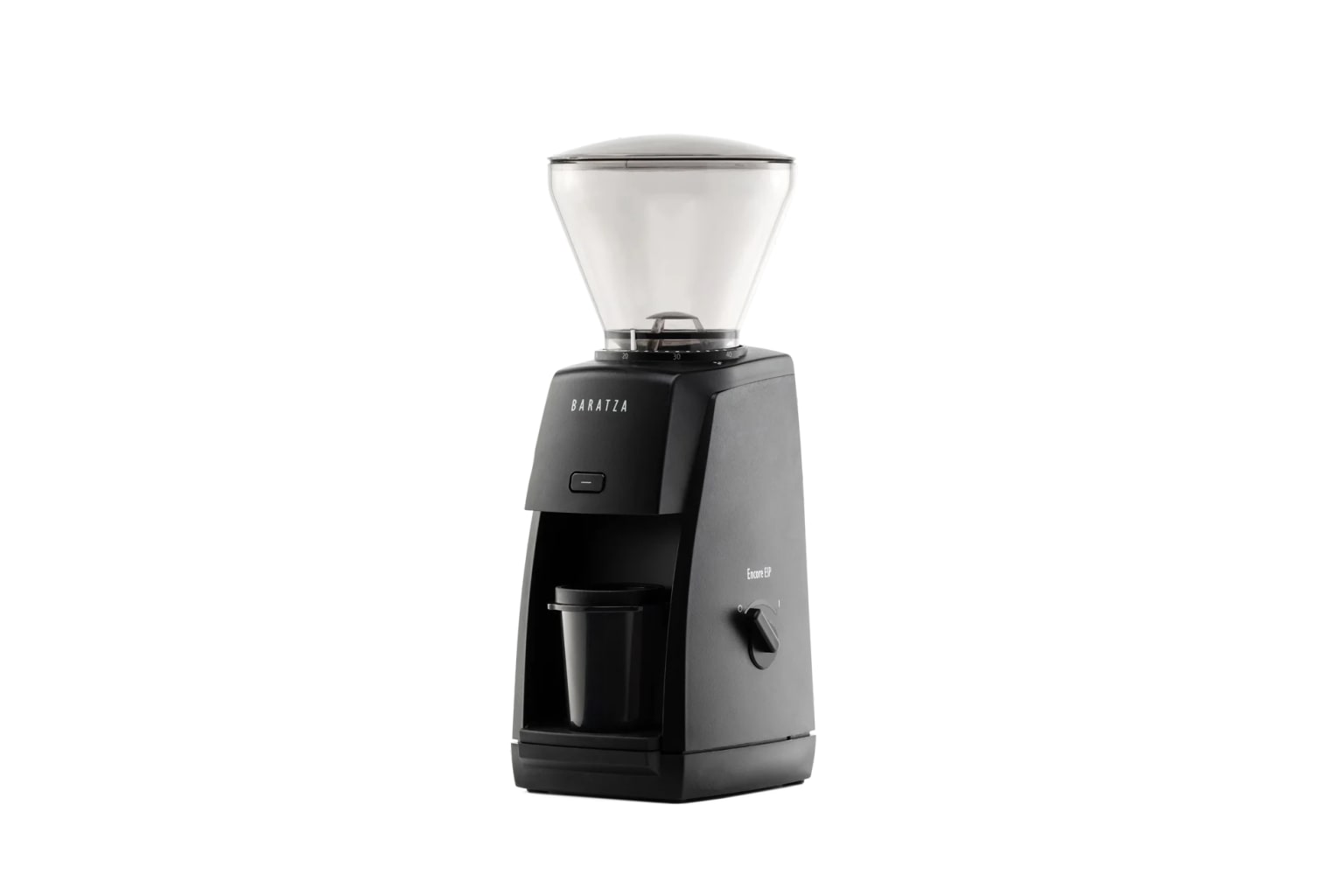
The Encore ESP has a clear case for buyers who want the controls to be understandable at a glance. The cited demonstration uses a pulse button and a numbered hopper, with no layered digital interface to interpret. The appeal is the relationship between an action and its control: select a position on the hopper and use the button.
That directness is worth considering separately from any claims about the coffee it produces. If your current frustration is an interface with several modes or adjustment references, the Encore ESP offers a useful alternative. If you specifically want a digital time readout, the Virtuoso+ deserves a closer look instead. The choice here is about how you prefer to interact with the appliance.
Light housing, with a clear tradeoff
In the cited presentation, the Encore ESP is described as small, very light and made of plastic. A lighter body can be appealing if you expect to move the grinder rather than leave it in one permanent position. The tradeoff is the feel of that housing. If you associate a satisfying appliance with a heavier exterior, this is a point to consider before purchase.
Plastic construction on its own does not tell us how long the grinder will last. We have not used the housing observation to make a reliability prediction. Treat it as a handling preference: would you rather have something light to reposition, or does substantial weight matter more to how you want the grinder to feel?
The demonstration also shows a catch bin arrangement. When comparing product photos, look at the receiver as part of the whole interaction, rather than concentrating only on the hopper and controls. You will handle the grounds receiver regularly, so its place in your routine deserves the same attention as the button.
The receiver arrangement is worth checking against the included accessories too. In the demonstration, the presenter removes a small cup holder and changes to the catch bin. That means the lower area should be evaluated in the configuration you intend to use, rather than from a single product photograph. Confirm which receiver and holder the listing includes if that swap is important to you. The presence of an arrangement in the demonstration establishes the handling idea, not the contents of every later retail package.
A button and a numbered hopper
The reviewer demonstrates the front pulse button and uses the hopper’s numbered positions as a reference. For a buyer, this makes the control scheme easy to describe without learning a separate screen. A position you intend to revisit can be written down directly. That is a practical convenience if you prefer a visible physical reference to multiple nested adjustments.
The direct button also keeps the action obvious. It should not be read as a promise about the amount of grounds produced by a particular press or duration. This review evaluates the control interaction; it does not establish an output measurement. If you want to compare interfaces, focus on whether this direct action is preferable to setting a displayed time or navigating an additional adjustment ring.
The Opus provides the clearest contrast. Its secondary internal adjustment adds another setting to understand. Breville offers several visible references, but also an additional cup/shot control that its reviewer found unnecessary. The Encore ESP’s appeal is that the basic interaction described here asks for less explanation.
The numbered hopper and pulse button also do different jobs. The hopper gives you a position to recognize; the button is the action you use to operate the grinder. Keeping that distinction clear makes the interface easier to explain to someone else. A short note can identify the selected hopper position without pretending that the same number answers how long to press the button. If you like each visible control to have a distinct purpose, this separation is a meaningful part of the Encore ESP's appeal.
A shared routine can still need communication. If another person moves the hopper, its visible marking gives you a place to check before the next use. The convenience is being able to inspect that physical reference directly. It is not an automatic return to your previous choice. Buyers who expect a screen to show a selected duration should compare the Virtuoso+ before deciding that the Encore's simpler layout is sufficient.
Tool-free does not mean no steps
The burr-access demonstration is the Encore ESP’s strongest maintenance convenience in this guide. The reviewer removes the hopper and shows access to the outer and inner burrs without a separate tool. That gives a buyer a concrete reason to consider it when disassembly is an anticipated chore.
There are still parts to handle and align. The presentation shows a washer, the inner-burr fastening and alignment marks during reassembly. Removing the need to fetch a tool does not remove the need to follow the model’s instructions and put the parts back correctly. If you dislike any disassembly, weigh the actual sequence rather than relying on the phrase tool-free alone.
Our favorable access assessment concerns reaching and removing the parts shown. It does not establish how thoroughly any cleaning method works, how often cleaning will be required in your use, or how much material remains inside. Those questions need different information. For this buying decision, the supported benefit is a more approachable route to the burrs.
For the occasional disassembly task, the small parts deserve as much attention as the lack of a tool. The review shows a washer being replaced and marked parts being lined up again. Think about whether you are happy to set parts out in order and consult the instructions when putting them back. That is a better guide to the likely chore than counting only how many things lift out. Someone who is comfortable with an orderly sequence may value this access highly; someone who wants care to consist only of taking out a bin should recognize that it is a different task.
Which alternative changes the routine?
OXO is the closest alternative if access is the priority. Its demonstration shows a locking removable hopper and a removable upper burr. Compare those visible access points with the Encore ESP’s more extensive tool-free demonstration. Both give you a concrete disassembly interaction to consider, rather than an assumption based on appearance.
The Virtuoso+ changes the controls more than the basic counter-based format. Its backlit timer makes a selected duration visible, while the cited presenter found returning through fine reverse increments slower than expected. Choose between the direct pulse action and the timer interaction according to what you want to operate each day.
The J-Ultra makes a bigger change: it puts the physical work in your hands. Its magnetic cup can be pleasant to handle, but that does not replace the Encore ESP’s demonstrated burr access. If the reason you are considering the Encore is to simplify maintenance access, do not treat a convenient catch cup as an equivalent feature.
Who should put it on the shortlist?
Shortlist the Encore ESP when the pulse button, numbered selection and tool-free access solve the chores you actually want to simplify. Its light housing is the main handling reservation here. That is enough for a meaningful purchase preference without turning the review into a claim about taste, speed, noise or lifespan.
The source presentation concerns the Encore ESP model. It does not verify every later revision or accessory bundle offered under a retailer listing. Confirm the model name and included parts when buying. Our recommendation is limited to the handling, control selection and physical access described above.
Baratza Encore ESP Coffee Grinder ZCG495BLK, Black
Baratza
Direct controls and tool-free burr access
The Encore ESP offers a direct pulse button, numbered hopper selection and demonstrated tool-free burr access. Here is how those choices affect everyday handling.
Reasons to choose it
- Direct pulse button
- Numbered hopper selection
- Demonstrated tool-free burr access
Tradeoffs to know
- Light plastic housing may feel less substantial than you want
- Disassembly still involves alignment and reassembly
Think twice if: A light plastic housing would disappoint you
Further reading
Ratings
Editorial score 8.5
Filling and handling8
Light body eases moving; plastic housing is a handling compromise.
Control selection8.5
Direct pulse button and numbered hopper selection provide ordinary controls.
Sources & further reading
youtube.com review
youtube.com review
youtube.com review
youtube.com review
youtube.com review
youtube.com review
Keep reading
Something changed? Help us keep this useful.
Send a correction →