Audio-Technica AT2020USB-X Review (2026): Studio Name, Setup Caveats
A familiar USB-C Audio-Technica condenser with clear voice potential, headphone monitoring, and touch mute—if your room, pop filter, and mount are ready for it.
The Audio-Technica AT2020USB-X is a credible USB-C condenser for buyers who want the familiar AT2020 lane, but noisy rooms, plosives, desk shocks, and variant confusion matter before checkout.
MSRP
—
Amazon
$169
at writing · 2026-05-14
Buyer fit
A recognizable USB-C studio-condenser pick with decent voice promise; evidence depth and room sensitivity keep it below clearer recommendations.
MSRP
—
Amazon
$169
at writing · 2026-05-14
Score breakdown
How this product scored
Same rubric, but focused on one product so the reasons behind the score stay readable.
Speech sound quality
Clear, balanced speech is the main reason to consider the AT2020USB-X; it is strongest when close placement and a quiet room let the condenser detail help instead of expose the space.
Room and desk-noise rejection
Room and desk-noise rejection is the weak spot: reviewer tests point to room reflections, background noise, low-end rumble, desk shocks, and keyboard pickup as real fit risks.
Controls and monitoring
Headphone monitoring, mix control, headphone volume, and touch mute are useful, but the control layout is less confidence-building than the Sennheiser Profile and lacks practical on-mic gain.
Software and USB setup
Mostly plug-and-play USB-C setup is a strength for buyers who do not want an app-first mic or audio interface.
Mounting and desk fit
The included stand can start you off, but a stable arm, pop filter, and careful cable/mount handling are the better daily setup.
Use-case flexibility
Best for solo voice, voiceover, creator work, and calls in calmer rooms; weaker for noisy desks, multi-person capture, and future XLR upgrades.
Reliability and support
Hands-on build comments are positive, but the evidence set has limited long-term owner/support coverage for ports, controls, and durability patterns.
Evidence confidence
Exact-product YouTube evidence and Amazon identity are useful, but official/formal detail and owner-community depth are thinner than stronger picks.
Quick Verdict
If the AT2020 name is what pulled you toward the Audio-Technica AT2020USB-X, the promise is easy to understand: familiar studio-condenser flavor without buying an audio interface. The catch is just as important. This mic only feels like the smart move when your room, desk, and mounting plan let it behave like a close studio mic instead of an expensive room microphone.
That is why it landed #7 in our Best USB Microphones in 2026 guide as the Best familiar studio sound pick, not as the safest recommendation. The parent score is still a respectable 7/10 because the AT2020USB-X can deliver clear, balanced speech, USB-C, headphone monitoring, touch mute, and the familiar side-address condenser feel. It loses ground to the Shure MV7+, Samson Q2U, and simpler desk mics because it is more exposed to room tone, desk bumps, plosives, and variant confusion.
One reviewer said the mic has a “really nicely balanced full sound,” but immediately added that it “would definitely benefit from a pop filter” (source). That is the whole review in miniature: good voice potential, but not a magic box. At our price check, the exact Amazon item checked was ASIN B0B823S1NR, recorded as available-new at $169.00 on 2026-05-14T22:14:12Z. Check today’s seller, condition, bundle, and price before checkout; using the product link helps support KB4UB.
Score Breakdown
Overall score: 7/10. The AT2020USB-X is a credible USB-C condenser with a recognizable studio-mic identity. It does not climb higher because the category has clearer choices for noisy rooms, simpler controls, streamer routing, and budget dynamic use.
- Speech sound quality: 8/10 — This is the strongest reason to consider it. Multiple clips frame the mic as clear and natural when placed correctly, and the AT2020 family name gives buyers an understandable reference point.
- Room and desk-noise rejection: 5/10 — This is the main warning. It is a cardioid condenser, so it can still hear fans, reflections, keyboard noise, and low-end rumble. One reviewer called it “a bit more susceptible to room tone Reflections and background noise” (source).
- Controls and monitoring: 6/10 — Headphone monitoring, a mix dial, headphone volume, and touch mute are useful. The missing practical gain knob keeps it behind the Sennheiser Profile for day-to-day control confidence.
- Software and USB setup: 8/10 — Mostly plug-and-play USB-C is a plus if you do not want an app-first mic.
- Mounting and desk fit: 6/10 — The included stand gets you started, but the better setup is a real arm, stable placement, and likely a pop filter.
- Use-case flexibility: 6/10 — Good for solo speech, voiceover, and content work in calmer rooms; weaker for noisy desks, shared rooms, or future XLR plans.
- Reliability and support: 6/10 — Build impressions are positive, but the evidence is light on long-term owner/support coverage.
- Evidence confidence: 6/10 — The exact-product YouTube evidence is useful, but official/formal and long-term owner coverage are thinner than several rivals.
What Feels Great Right Away
The AT2020USB-X immediately makes sense to a certain kind of buyer: you want the familiar Audio-Technica studio look, you do not want RGB, and you do not want to learn an audio interface just to sound better on calls, podcasts, or voiceovers. It looks like a real microphone without trying to be a little broadcast spaceship.
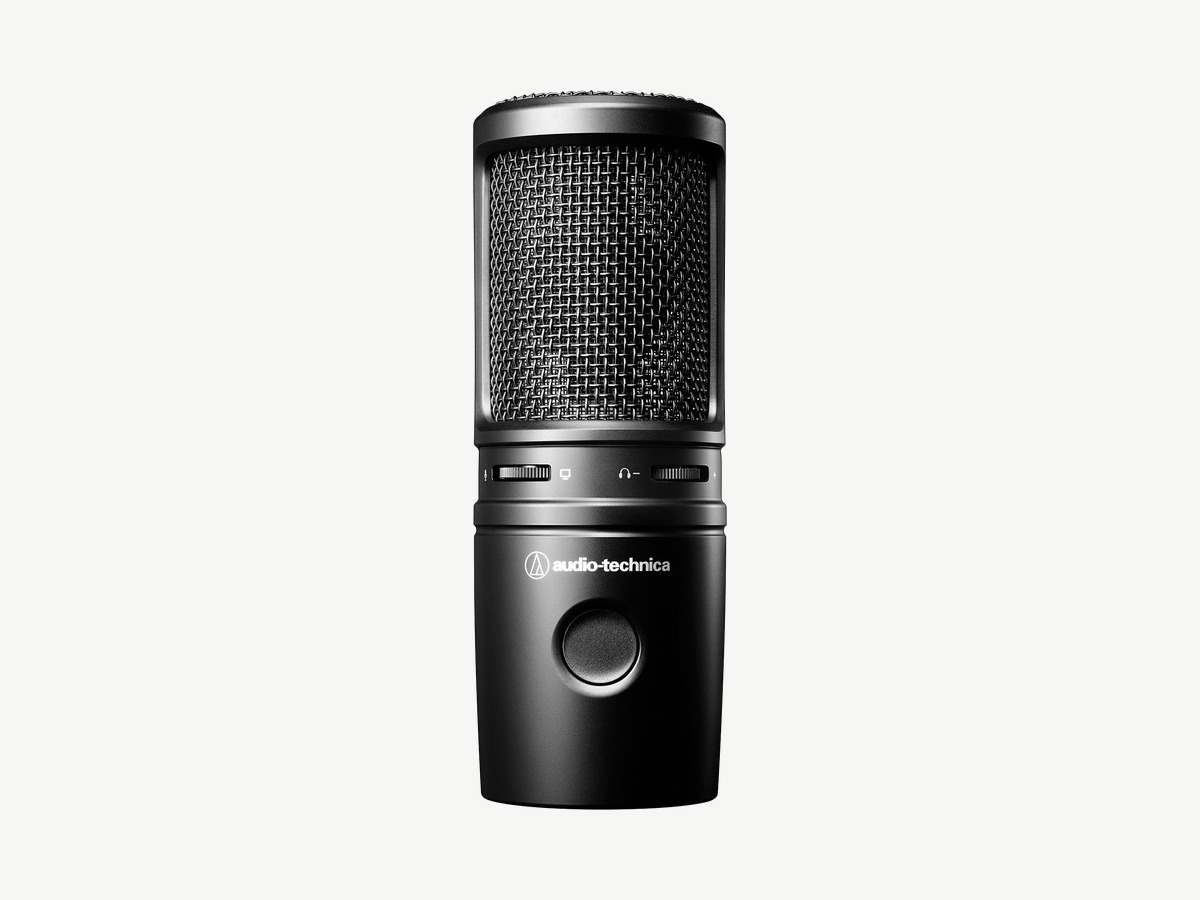
The hardware evidence is encouraging. In one hands-on review, the reviewer said, “I have zero complaints” about build quality and called out an “all metal body” plus a metal mesh grille with minimal give (source). The same excerpt notes the mix dial for blending computer playback and zero-latency monitoring, headphone volume, touch mute, a rear headphone jack, quarter-inch threading, and USB-C. That is a useful everyday control set even if it is not as obvious as the Sennheiser Profile’s front-panel gain layout.
The other immediate win is simple compatibility. The included USB-C-to-USB-A cable and USB-A-to-USB-C adapter show the product is meant to land on ordinary desks, not just polished creator rigs. Another reviewer says the USB-C port makes it “plug and play” and that you “simply plug this into any computer of yours and it’s ready to go” (source). For someone upgrading from a laptop, webcam, or cheap wireless mic, that can feel like relief.
Setup and Daily Use Notes
The safest daily setup is close, controlled, and boring: put the AT2020USB-X on a stable arm or stand, keep it around six inches from your mouth, aim it slightly off-axis, monitor with headphones, and do one test recording before important work. If you leave it 9–12 inches away on a desk stand while typing, you are asking a sensitive condenser to make a normal desk sound like a treated booth.
The best review evidence includes the tests buyers should want before checkout: plosives, distance, typing, treated versus untreated room, desk taps, boom-arm taps, body taps, and mute-button noise. One transcript walks through the real placement problem: “now I am typing on a keyboard” to compare voice against keyboard pickup, then switches from a treated room to a “completely untreated room” (source). That matters more than a polished sample in silence.
Plan for a pop filter if your speech has hard P sounds. One setup clip says the pop filter made “maybe a minimal difference,” but later says it “really eliminates those” P and S blasts when placed close (source). Also watch the physical cable/mount layout: another review notes the USB-C port is close to the metal mounting area, which “can be a bit annoying if you plan to move this mic around a lot” (source).
What Gets Annoying
The first annoyance is that the AT2020USB-X can sound more honest than forgiving. That is great when your room is quiet and your placement is disciplined. It is less great when the mic is hearing wall reflections, air conditioning, street rumble, or desk shocks. The harshest review excerpt calls it “a bit on the noisy side,” “more susceptible to room tone Reflections and background noise,” and says it “wasn't great at rejecting shocks” (source).
The second annoyance is control tradeoff. You get monitoring and mix controls, but this is not the easy front-knob experience of the Sennheiser Profile, the streamer software lane of Elgato Wave:3, or the Shure MV7+ safety net of close dynamic capture plus app processing. If you want the mic to solve your room for you, the AT2020USB-X is the wrong kind of tool.
The third annoyance is product-family bleed. AT2020, AT2020USB+, AT2020USB-X, AT2020USB-XP, AT2040USB, and bundles can get mixed together in search results and reviews. The exact Amazon item checked here is AT2020USB-X / B0B823S1NR. If the listing drifts to a bundle, renewed unit, wrong variant, or the XP version, treat that as a different buying decision.
How It Compares With the Other USB Mics
Compared with the Shure MV7+, the AT2020USB-X is cheaper and more familiar as a studio-style condenser, but the Shure is the safer pick in imperfect rooms. If keyboard noise, fan noise, or untreated walls are already a worry, start with Shure or the Samson Q2U instead. Those dynamic mics reward close talking and usually punish room noise less.
Compared with the Sennheiser Profile USB, the AT2020USB-X has the Audio-Technica studio-family appeal, while the Sennheiser is easier to control under pressure. The Profile’s gain/mute/mix/headphone layout is the friendlier everyday experience for most quiet-room buyers. Compared with the RØDE NT-USB+, both are clean-room condenser choices; RØDE feels more polished as a modern USB mic package, while Audio-Technica wins mainly if you specifically want the AT2020 lane.
Compared with Elgato Wave:3, the AT2020USB-X is less tied to software routing. That is good if you want simple capture, bad if your streaming setup depends on Wave Link. Compared with HyperX QuadCast 2 S and Blue Yeti, the Audio-Technica is less flashy and more focused, but it still shares the classic condenser problem: placement and room behavior matter more than the spec sheet suggests.
For the full category ranking, see Best USB Microphones in 2026.
Who Should Buy It
Buy the Audio-Technica AT2020USB-X if you want a familiar studio-condenser-style USB mic, your room is reasonably quiet, and you are willing to handle normal mic discipline: close placement, sensible gain, pop control, and a stable stand or arm. It is especially easy to understand for voiceover, creator work, podcasting, and work calls where you want a clear, straightforward voice sound without gamer styling or a software mixer.
Skip it if your desk is noisy, your keyboard is loud, your mic has to sit far away, or you want dynamic rejection. Skip it if you expect the box to include the final mount/pop/shock answer. And skip it if the only reason you are buying is the AT2020 name; the USB-X is a specific USB condenser with its own tradeoffs, not a universal shortcut to studio sound.
Bottom line: the AT2020USB-X is a good buy for the right quiet-room Audio-Technica fan. It is not the USB mic I would use to rescue a messy bedroom, busy desk, or untreated office. That is why it belongs in the shortlist, but below the cleaner category recommendations.
Tell us what this page missed
These pages get better when real buyer complaints make it back into the scoring model. If something important is underweighted, say it.
Rate this review
Give it a score from 1-10 and tell us what to improve.
0/4000 characters