VIOFO A229 Pro Review (2026): The Dash Cam I’d Start With First
A single-product deep dive for drivers who want serious front/rear evidence without turning the whole purchase into a cloud subscription project.
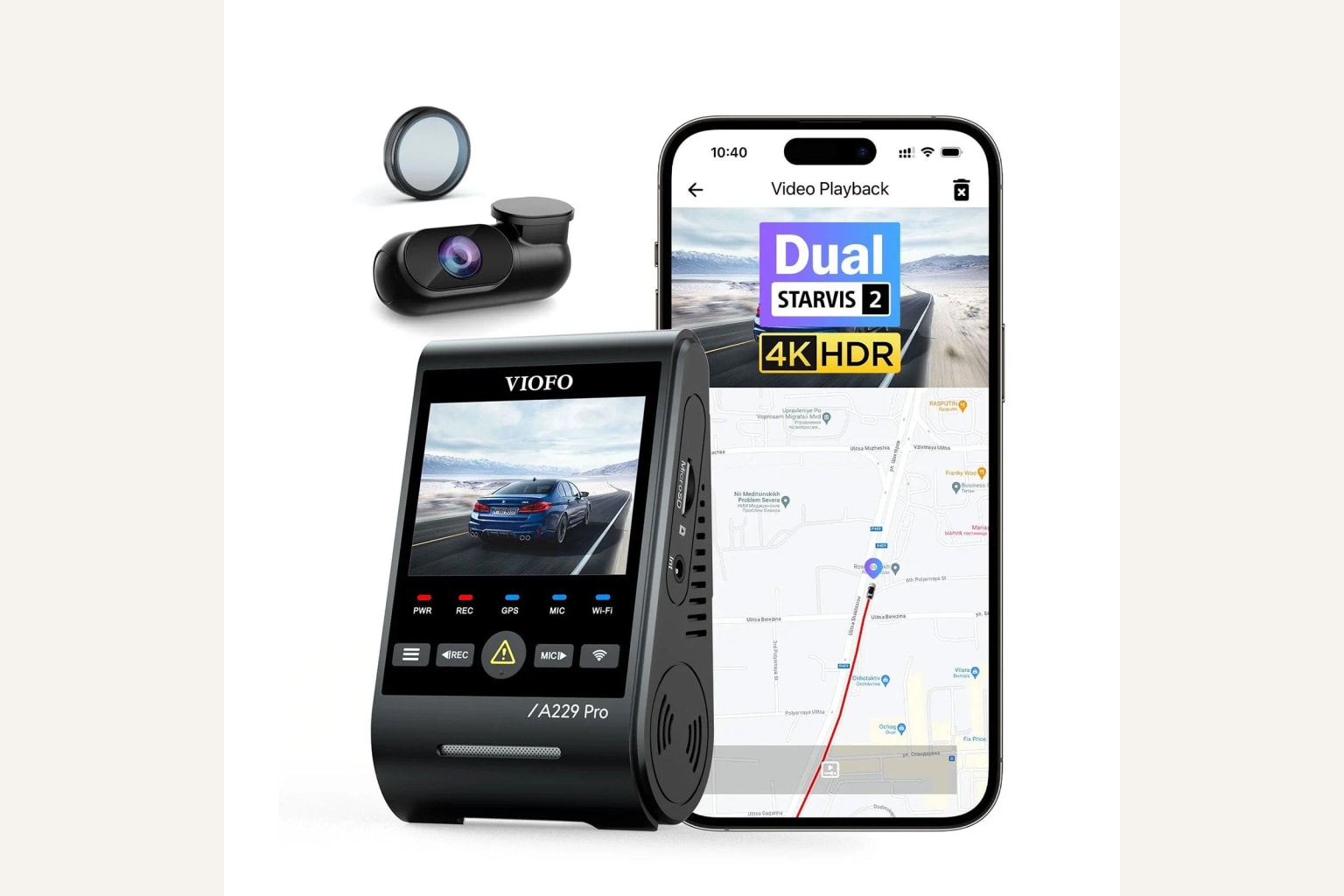
The A229 Pro is the best default dash cam here because it puts the money where most drivers need it: sharp front/rear evidence, strong night/HDR handling, GPS, Wi-Fi, and heat-aware hardware.
MSRP
$359.99
Amazon
$299.99
at writing · 2026-05-04
Buyer fit
The strongest default for most evidence-first buyers: 4K front, 2K rear, STARVIS 2 on both channels, HDR, GPS, 5GHz Wi-Fi, and a supercapacitor design. It earns the top slot because the source pile keeps circling back to plate detail, glare control, and useful front/rear coverage, while the main caveats are manageable ones: hardwire-kit parking, card choice, firmware/app patience, and VIOFO’s maze of nearby variants.
MSRP
$359.99
Amazon
$299.99
at writing · 2026-05-04
Score breakdown
How this product scored
Same rubric, but focused on one product so the reasons behind the score stay readable.
Incident evidence quality
4K front plus 2K rear footage gives the strongest default evidence posture, and reviewer comparisons repeatedly emphasize readable detail rather than just headline resolution.
Night, HDR, and glare control
STARVIS 2 sensors on both main channels and simultaneous HDR are directly aimed at headlights, reflective plates, tunnels, and glare, which are the moments cheap dash cams often waste.
Reliability, heat, and storage
The supercapacitor and high-endurance-card guidance are strong signs, with source text explicitly warning that dash cams need heat-tolerant cards for loop recording.
Parking, installation, and power
Parking mode is useful but not plug-and-play; the hardwire kit and cable routing need to be part of the purchase decision.
App, retrieval, and controls
5GHz Wi-Fi, a screen, voice prompts, and a conventional card-based setup keep retrieval manageable, but this is still an app-and-SD-card product rather than a managed cloud system.
Coverage and form-factor fit
The reviewed 2-channel setup covers the most common front/rear incident need without forcing cabin recording into every car.
Long-term ownership and support
VIOFO has a strong enthusiast footprint and accessory ecosystem, but the many A229 variants make exact bundle matching important.
Quick Verdict
VIOFO is a dash-cam-focused brand that has become popular with drivers who care more about usable footage than showroom polish. The A229 Pro is its evidence-first flagship pitch: front/rear coverage, STARVIS 2 sensors, HDR, GPS, 5GHz Wi‑Fi, and a capacitor design meant for windshield heat.
The VIOFO A229 Pro is the dash cam I would start with for most drivers because it spends its complexity in the right places: useful front/rear footage, modern low-light sensors, HDR, GPS, 5GHz Wi-Fi, and a supercapacitor that makes sense in windshield heat. It is not trying to be a social app, a car alarm, or a tiny hidden puck. It is trying to give you a clip that still matters after the adrenaline wears off.
The detail worth catching before checkout is variant and accessory confusion. A reviewer’s night-footage takeaway was that the STARVIS 2 sensor is a “game changer,” which is exactly why this model wins — but only if you buy the correct kit, use a high-endurance card, and budget for the hardwire setup if parking mode matters. Use the product links on this page to check current price, availability, and the exact bundle before you buy.
Score Breakdown
- Incident evidence quality: 9/10. 4K front plus 2K rear footage gives the strongest default evidence posture, and reviewer comparisons repeatedly emphasize readable detail rather than just headline resolution.
- Night, HDR, and glare control: 9/10. STARVIS 2 sensors on both main channels and simultaneous HDR are directly aimed at headlights, reflective plates, tunnels, and glare, which are the moments cheap dash cams often waste.
- Reliability, heat, and storage: 8/10. The supercapacitor and high-endurance-card guidance are strong signs, with source text explicitly warning that dash cams need heat-tolerant cards for loop recording.
- Parking, installation, and power: 7/10. Parking mode is useful but not plug-and-play; the hardwire kit and cable routing need to be part of the purchase decision.
- App, retrieval, and controls: 7/10. 5GHz Wi-Fi, a screen, voice prompts, and a conventional card-based setup keep retrieval manageable, but this is still an app-and-SD-card product rather than a managed cloud system.
- Coverage and form-factor fit: 9/10. The reviewed 2-channel setup covers the most common front/rear incident need without forcing cabin recording into every car.
- Long-term ownership and support: 7/10. VIOFO has a strong enthusiast footprint and accessory ecosystem, but the many A229 variants make exact bundle matching important.
What Reviewers Liked
Reviewers keep circling the same practical strengths: 4K front footage, 2K rear coverage, STARVIS 2 sensors, HDR, GPS metadata, 5GHz Wi-Fi, voice prompts, and a supercapacitor instead of a tiny heat-stressed battery. The A229 Pro feels built around the ugly moment after a crash, not just the pretty demo clip before checkout.
That matters because dash-cam footage is only valuable if it survives real windshield life: heat, vibration, glare, loop recording, and the one panicked moment when someone needs the clip quickly.
What Gets Annoying
The annoying part is the A229 family tree. Main-only, two-channel, three-channel, Pro, Plus, Ultra, Tele, interior, and waterproof-rear variants can make the listing feel like a parts bin. Parking mode also needs the right hardwire kit, and the microSD card needs to be high-endurance because windshield heat and constant loop recording are not gentle.
This is not a reason to avoid VIOFO A229 Pro automatically. It is a reason to buy the right kit, budget for the right storage/power accessories, and not confuse a product-page feature label with a finished installed system.
How It Compares
Compared with the A119 Mini 2, the A229 Pro is less tiny but much more complete. Compared with Vantrue N4 Pro, it skips cabin coverage but feels cleaner for normal drivers. Compared with Thinkware U3000, it is less parking-obsessed and more sensible as a broad front/rear default.
The parent best-of ranking puts this in the Best overall lane. That is the right way to read the score: not as a universal personality test, but as a fit check against the problem you actually need solved.
Buyer Fit
Best for: drivers who want strong front/rear incident proof, better night and glare handling, GPS metadata, and a conventional camera-plus-card setup.
Skip if: you want cabin recording in the default kit, the smallest possible camera, or a fully managed parking/security system.
Bottom line: Buy the A229 Pro if you want strong front and rear incident proof with modern low-light sensors. Skip it if you need cabin recording by default, the tiniest possible camera, or a parking setup that is completely handled for you in one simple box.
For the full category ranking and alternatives, go back to Best Dash Cams in 2026.
Tell us what this page missed
These pages get better when real buyer complaints make it back into the scoring model. If something important is underweighted, say it.
Rate this review
Give it a score from 1-10 and tell us what to improve.
0/4000 characters