Qingping Air Quality Monitor Gen 2 Review (2026): The Room Display That Makes CO2 Hard to Ignore
A deeper look at Qingping Gen 2 for buyers weighing its color screen, CO2 and PM readings, short battery life, app history/export, eTVOC limits, and Gen 2 versus Lite confusion.
The Qingping Air Quality Monitor Gen 2 is the best room-display pick in our air quality monitor ranking because it makes CO2, PM, eTVOC, comfort, and noise trends easy to see at a glance, with caveats around battery life, setup, smart-home claims, and missing radon/formaldehyde sensors.
MSRP
—
Amazon
$149.99
at writing · 2026-05-18
Buyer fit
Best room display: the clearest everyday desk display for CO2, PM, eTVOC trends, humidity, temperature, and noise.
MSRP
—
Amazon
$149.99
at writing · 2026-05-18
Score breakdown
How this product scored
Same rubric, but focused on one product so the reasons behind the score stay readable.
Sensor coverage and fit
Qingping Air Quality Monitor Gen 2 scored 8.2 for sensor coverage and fit based on repeated source themes around large color screen, CO2/PM/eTVOC/noise readings, short battery, useful export/history, Gen 2 identity caveats, and app/setup rough edges.
Reading trust and calibration
Qingping Air Quality Monitor Gen 2 scored 7.5 for reading trust and calibration based on repeated source themes around large color screen, CO2/PM/eTVOC/noise readings, short battery, useful export/history, Gen 2 identity caveats, and app/setup rough edges.
Display, alerts, and actionability
Qingping Air Quality Monitor Gen 2 scored 8.8 for display, alerts, and actionability based on repeated source themes around large color screen, CO2/PM/eTVOC/noise readings, short battery, useful export/history, Gen 2 identity caveats, and app/setup rough edges.
App, history, and data access
Qingping Air Quality Monitor Gen 2 scored 7.4 for app, history, and data access based on repeated source themes around large color screen, CO2/PM/eTVOC/noise readings, short battery, useful export/history, Gen 2 identity caveats, and app/setup rough edges.
Setup, power, and placement
Qingping Air Quality Monitor Gen 2 scored 7.1 for setup, power, and placement based on repeated source themes around large color screen, CO2/PM/eTVOC/noise readings, short battery, useful export/history, Gen 2 identity caveats, and app/setup rough edges.
Reliability, support, and caveats
Qingping Air Quality Monitor Gen 2 scored 6.8 for reliability, support, and caveats based on repeated source themes around large color screen, CO2/PM/eTVOC/noise readings, short battery, useful export/history, Gen 2 identity caveats, and app/setup rough edges.
Before You Buy
The Qingping Air Quality Monitor Gen 2 is the air monitor you buy when you know you will actually look at the screen. It sits on a desk, nightstand, nursery shelf, or home-office cabinet and shows CO2, PM2.5/PM10, eTVOC, temperature, humidity, and noise without making every check feel like an app errand. That is why it ranked second in our best air quality monitors ranking: it is not the broadest monitor, but it is the most pleasant everyday room display in this group.
The regret check is simple. If you expect a long-life cordless monitor, a radon detector, a formaldehyde tester, or a privacy-minimal offline gadget, Qingping can disappoint fast. If you want a clear local screen that nudges you to open a window, run a purifier, or stop obsessing over a meaningless spike, it makes much more sense. Product links can help you recheck the exact B0CZ886B8N listing, current price, seller, color, coupon, and availability before checkout, and they help support KB4UB.
Quick Verdict
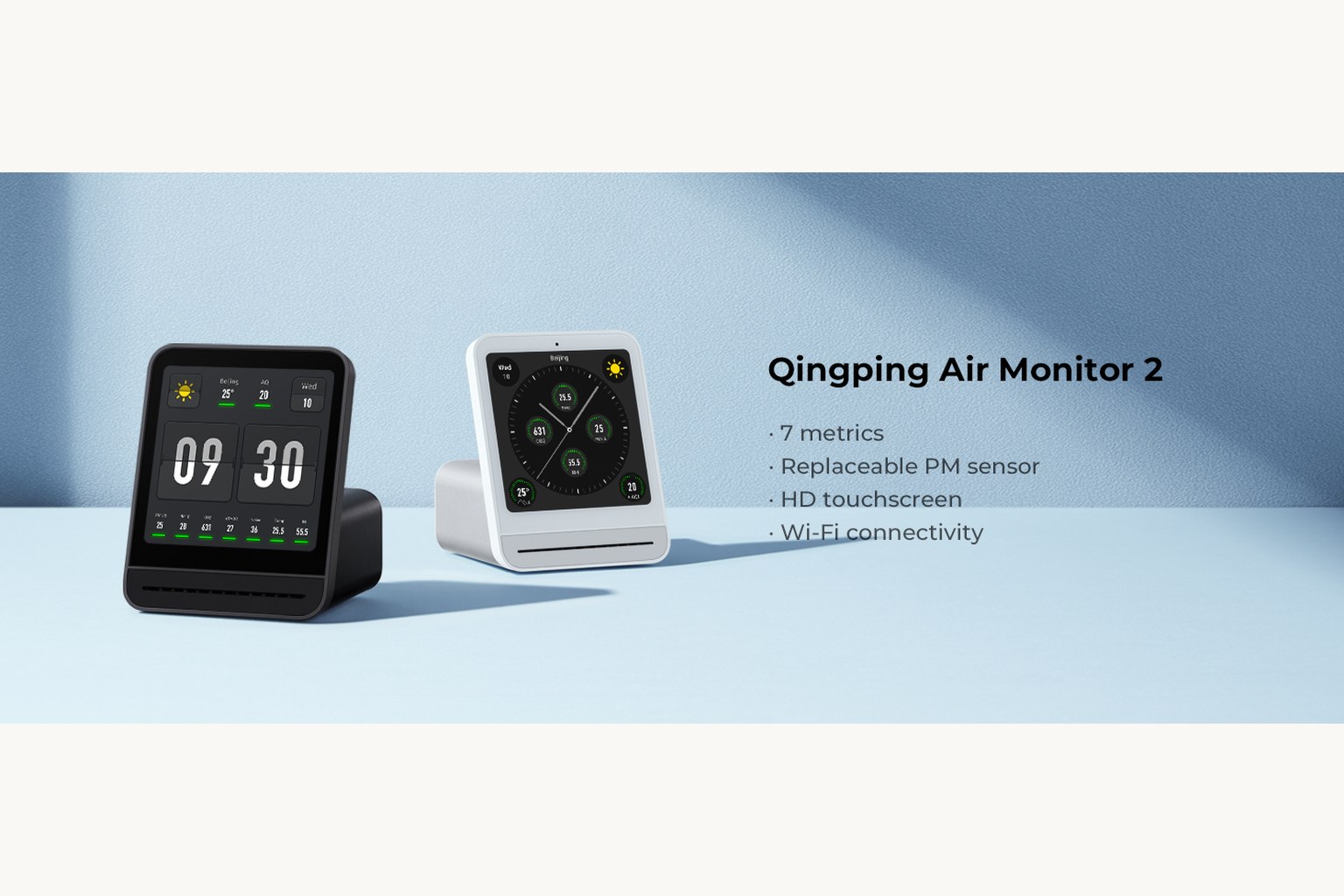
Qingping Gen 2 is the best room-display pick, not the best whole-home diagnostic monitor. The product is best judged as a display-forward device with PM2.5, PM10, CO2, eTVOC, temperature, humidity, and noise readings, plus Qingping+ app history/export. The Amazon listing describes it as providing "real-time monitoring of 7 metrics, including temperature, humidity, CO2, PM2.5, PM10, eTVOC and noise level." That is the right promise to judge it by.
At $149.99 in our saved Amazon price check, it is cheaper than Airthings View Plus and IQAir AirVisual Pro, broader than Aranet4's CO2-only focus, and easier to glance at than app-first budget devices. The tradeoff is that it does less than Airthings, has weaker community/owner coverage than the most proven specialists, and asks you to treat eTVOC and PM10 as helpful trend clues rather than lab-grade truth. Buy it for a room where the screen will change behavior. Skip it if the missing sensors are the reason you are shopping.
Score Breakdown
- Sensor coverage and fit: 8.2/10. The sensor mix is strong for everyday room checks: CO2 for ventilation, PM for smoke/cooking/dust trends, eTVOC for chemical-event clues, plus comfort and noise readings. It loses points for no radon and no formaldehyde-specific measurement.
- Reading trust and calibration: 7.5/10. Formal reviews point to a Sensirion-class CO2 sensor and decent real-room CO2 agreement, but PM10 and eTVOC need careful interpretation. The app also lacks the clearest official explanation of calibration behavior in the available material.
- Display, alerts, and actionability: 8.8/10. This is the reason to buy it. The large color touchscreen and per-metric indicators make the numbers easy to notice before you reach for your phone.
- App, history, and data access: 7.4/10. Qingping+ can show remote readings and 30-day history/export, which is useful, but setup and smart-home claims are less clean than the screen.
- Setup, power, and placement: 7.1/10. Wi-Fi support, USB-C power, and short battery portability are fine for a desk monitor. They are not a cordless lifestyle.
- Reliability, support, and caveats: 6.8/10. Current Amazon availability, Amazon support options, and replaceable PM-sensor design help. Fewer long-term owner reports, regional smart-home ambiguity, and Gen 2 versus Lite confusion keep the score modest.
What Feels Great Right Away
The screen is the immediate win. Qingping's listing calls it a "4'' IPS touchscreen with 254 PPI" and says each metric has a color indicator so you can understand room conditions "at a glance." That is not just a nicer spec; it changes whether the monitor becomes part of the room or another gadget you forget after setup.
In daily use, the value is not that Qingping tells you your air is secretly terrible every minute. It is that it can connect a feeling to a number. A closed office starts feeling heavy, and CO2 gives you a reason to ventilate. Cooking or a dusty task pushes PM upward, and the display makes the purifier's response visible. A nighttime humidity swing explains why the room feels off.
The Gen 2 hardware also feels more serious than the cheapest Amazon meters. One Gen 2 walkthrough calls it "one of the most feature packed smart air monitors" and specifically notes the larger display, added particulate sensor, and user-replaceable PM sensor. You do not need to love every smart feature for that basic screen-and-sensor upgrade to matter.
What Keeps Mattering After the First Week
After the novelty fades, Qingping's best long-term habit is turning invisible room changes into simple experiments. Open a window and watch CO2 fall. Run filtration during cooking and see whether particles settle. Move the unit away from a vent or humidifier and learn how placement changes the number. That kind of feedback is why a room display can beat a broader app-first monitor for some homes.
History also helps. The Amazon listing says the Qingping+ app lets you "check or export the historical data of the last 30 days," and formal reviews also mention Excel-style export or historical views. That matters if you want to compare a bedroom with doors open versus closed, or see whether a purifier change actually changed PM trends.
The maintenance story is better than most cheap monitors too, at least on paper. The listing says the "PM sensor connects to the body through contact points" behind a magnetic back cover, making it easy to replace. That does not guarantee replacement parts will be easy years from now, but it is still a more repair-aware design than sealed mystery meters.
The Annoyances to Know Before Buying
The biggest annoyance is power. Qingping looks portable, and it is portable for short checks, but the listing is blunt: "Please keep the product connected to USB power in daily use -- the product can work for up to 3 hours after fully charged." Video walkthroughs stretch that to roughly four hours in one context, but the practical answer is the same. Put it near power and treat battery use as temporary.
The second annoyance is interpretation. PM2.5 is useful for smoke, cooking, dust, and purifier checks, but low-cost PM10 can be estimated or less reliable. eTVOC is even easier to overread. It can flag changes from cleaners, candles, off-gassing, or cooking vapors, but it should not be treated as a precise chemical exposure report. Qingping can make trends visible; it cannot tell you every compound in the air.
The third annoyance is setup and model confusion. Greenwashing Index praised the Gen 2 after hands-on testing but also surfaced account creation, Wi-Fi setup, Bluetooth pairing, and app polish as downsides in testing. Search results can also mix Gen 2 with the older Qingping Air Monitor Lite, especially around HomeKit. Do not assume Lite, Xiaomi-region, Mi Home, or HomeKit claims apply to this B0CZ886B8N Gen 2 listing.
How It Compares
Airthings View Plus stays the best overall pick because it adds radon and a broader home-air picture. If radon is part of your worry, Qingping is not the substitute. It is the better pick only when a vivid local display for a specific room matters more than whole-home sensor breadth.
Aranet4 Home is the cleaner CO2 specialist. It is more focused, more portable on AA batteries, and easier to recommend for ventilation-only buyers who want a trusted CO2 number. Qingping wins when you also want PM trends, eTVOC clues, noise, and a richer screen.
IQAir AirVisual Pro is the data-heavy alternative with a larger established PM2.5/CO2 platform and outdoor/forecast context, but it costs more and feels older. Temtop M10+ is cheaper and quieter for some bedrooms, but we found fewer long-term reports for it. Amazon's monitor, Eve Room, and GoveeLife each make sense in narrower smart-home or budget lanes; none gives the same CO2/PM/color-screen balance as Qingping.
Who Should Buy It
Buy the Qingping Air Quality Monitor Gen 2 if you want a desk, bedroom, nursery, or home-office monitor that makes CO2 and particle trends easy to see without opening an app. It is especially appealing if you care about ventilation habits, cooking or wildfire-smoke PM spikes, humidity/temperature comfort, and a screen that works as a daily glance point.
Skip it if you need radon, formaldehyde-specific testing, a certified carbon-monoxide alarm, native Apple Home support, years of battery life, or offline-by-default monitoring. Also skip it if you are the kind of buyer who will treat every eTVOC or PM10 movement as a precise exposure reading.
Bottom line: Qingping Gen 2 is the room-display monitor I would shortlist when visibility is the thing that will make you act. It is not the broadest air-quality monitor, but it makes important room numbers hard to ignore. Recheck the current B0CZ886B8N listing and compare it with the full air-quality monitor ranking if radon, portability, or data depth might matter more.
Tell us what this page missed
These pages get better when real buyer complaints make it back into the scoring model. If something important is underweighted, say it.
Rate this review
Give it a score from 1-10 and tell us what to improve.
0/4000 characters