LG CineBeam Q Review (2026): Stylish 4K, Plug-In Reality
A closer look at LG’s design-forward CineBeam Q, including its compact 4K laser picture, rotating handle, no-battery catch, modest audio, and app checks before checkout.
The LG CineBeam Q is the stylish compact 4K choice in our portable-projector ranking. It earns its lane with a sharp RGB-laser image, automatic setup, and a rotating handle that actually helps placement, but its 500 ANSI-lumen class, no built-in battery, modest audio, and app-support checks make it a dark-room specialist rather than the safest all-around portable.
MSRP
$999.99
Amazon
$799.99
at writing · 2026-05-15
Buyer fit
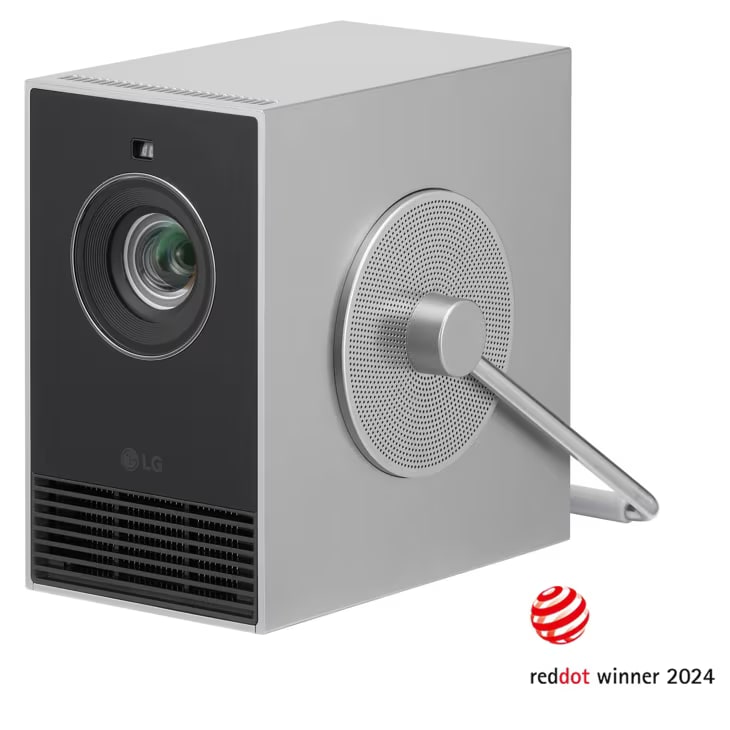
A design-forward compact 4K projector for dark rooms: attractive body, rotating handle/stand, RGB laser, auto setup, and a clean Amazon.com new snapshot.
MSRP
$999.99
Amazon
$799.99
at writing · 2026-05-15
Score breakdown
How this product scored
Same rubric, but focused on one product so the reasons behind the score stay readable.
Image quality and real brightness
LG CineBeam Q scores 8/10 for image quality and usable brightness after weighing its resolution, light output, and the room conditions where it actually makes sense.
Setup, focus, and placement
LG CineBeam Q scores 8/10 for setup, focus, and placement because its aiming tools, stand/cradle design, and autofocus behavior are central to how easy it feels after moving it.
Portability, power, and runtime
LG CineBeam Q scores 5/10 for portability, power, and runtime after balancing carry size against battery, plug-in, USB-C, or power-bank realities.
Streaming and app behavior
LG CineBeam Q scores 6/10 for streaming and app behavior based on built-in apps, casting, Netflix/DRM certainty, remote behavior, and how much extra gear buyers may need.
Fan noise, audio, and heat
LG CineBeam Q scores 6/10 for fan noise, audio, and heat after weighing speaker usefulness, external-audio needs, and small-projector limits.
Inputs and compatibility
LG CineBeam Q scores 7/10 for inputs and compatibility after checking HDMI/USB-C behavior, casting, laptop/console fit, and accessory needs.
Reliability and support
LG CineBeam Q scores 7/10 for reliability and support based on listing identity, seller/condition checks, warranty posture, and how much long-term owner detail is available.
Use-case fit
LG CineBeam Q scores 7/10 for use-case fit because it is easy to recommend for some rooms and buyer habits, but a mismatch for others.
Source confidence
LG CineBeam Q scores 7/10 for source confidence based on how well current listings, specs, formal reviews, transcripts, and owner/reviewer notes line up.
Before You Buy
LG’s CineBeam Q is the portable projector for people who care what the projector looks like when the movie is over. It is small, metal, 4K-class, and built around a rotating handle that makes it feel more like a design object than a gadget you hide in a drawer. The regret check is simple: will that compact 4K laser image and shelf-friendly body matter more to you than battery freedom, loud built-in audio, and bright-room punch?
That tradeoff is worth sorting out before checkout because the CineBeam Q can feel a little magical in the right room and a little compromised in the wrong one. Use this review as the deeper read after our best portable projectors ranking. Product links can help you recheck the exact HU710PB listing, current price, seller, app support, and availability, and they also help support KB4UB.
Quick Verdict
The LG CineBeam Q is ranked fifth in our portable-projector guide, but that number needs context. It is not fifth because it lacks charm. It is fifth because its strengths are specific: compact 4K UHD class projection, RGB laser color, auto focus and screen adjustment, webOS smart-projector features, a striking metal body, and a rotating handle that doubles as a stand. Its weaknesses are just as specific: 500 ANSI-lumen-class brightness, no built-in battery, modest audio, and streaming-app details that should be rechecked on the exact listing before you buy.
That makes it the stylish dark-room pick, not the safest all-around portable projector. Mike O'Brien’s review called the physical setup “really quite easy” and described the handle angle adjustment as a “smart idea” because it saves you from propping the projector up with random objects. Tech Spurt was just as direct about the main catch: because there is no internal battery, it is “not quite as portable as some other options.”
Buy it if you want a compact projector that can live in a bedroom, apartment, guest room, or design-conscious living space without looking like office gear. Skip it if your idea of portable means unplugged patio movies, daytime viewing, or one box that can handle picture and party audio by itself.
Score Breakdown
- Image quality and real brightness: 8/10. The 4K UHD/RGB-laser picture is the reason this projector exists. Expect crisp, colorful dark-room performance, but 500 ANSI-lumen-class output still needs controlled light.
- Setup, focus, and placement: 8/10. The rotating handle, auto focus, and auto keystone make room-to-room setup easier. One review described setting it down and having it “automatically Focus” and square the image.
- Portability, power, and runtime: 5/10. It is easy to carry, but it has no built-in battery. The Tech Chap summed up the catch as “not running on a battery.”
- Streaming and app behavior: 6/10. webOS, AirPlay, screen share, and major-app mentions are useful, but Netflix and regional app support should be verified on the exact listing before you make them a buying reason.
- Fan noise, audio, and heat: 6/10. Fan noise appears manageable, but the small speaker is the weak link. Tech Spurt called the audio “not exactly the most powerful audio output in the world.”
- Inputs and compatibility: 7/10. HDMI and USB/USB-C references help with laptops, consoles, and streaming devices, though exact port behavior should be rechecked against the manual or listing.
- Reliability and support: 7/10. The Amazon-new snapshot was clean, with Amazon.com as seller, but long-term owner coverage was thinner than reviewer/transcript evidence.
- Use-case fit: 7/10. It fits dark rooms, decor-friendly spaces, and compact 4K viewing well. It fits camping, bright rooms, and loud group use poorly.
- Buying-confidence check: 7/10. The broad direction is clear, but a few details — especially app support, exact ports, and long-term reliability — deserve one last check before publishing or buying.
What Feels Great After Setup
The CineBeam Q’s best ownership trick is that it feels like something you might actually leave out. Most portable projectors look like small appliances or camping gear. This one leans into the living-room-object idea: compact metal body, squared-off shape, integrated handle, and a design that looks intentional on a shelf. Tech Spurt called it “one of the most attractive efforts out there,” and that matters if the projector is going to move between a bedroom, coffee table, kitchen wall, and guest room instead of living in a closet.
The handle is more than decoration. Mike O'Brien pointed out that it is a “cool little handle,” then noted that rotating it down works as an angle adjustment so you are not stacking magazines under the front. Tech Spurt made the same point from a placement angle: the 360-degree handle can prop the projector up and help you find the angle you need. That is the kind of small physical convenience that keeps feeling useful after the first setup.
The image is the other reason to care. Review and transcript notes repeatedly point to sharp 4K-class detail, strong color, and a picture that feels more premium than cheaper 1080p mini projectors in the right lighting. The Tech Chap said the fun is having a “big screen in places you normally wouldn’t,” especially when auto keystone lets you aim at a random wall instead of treating setup like a permanent installation.
It is also more flexible than a bare projector. webOS, AirPlay 2, screen share, HDMI, USB-C, Bluetooth audio, and external speaker options all make it easier to use as a compact room-to-room screen when you have power nearby. Those details do not turn it into the best streaming box in the category, but they do make casual indoor use feel less cobbled together.
What Gets Annoying
The first annoyance is the word portable. The CineBeam Q is portable in the sense that it is small, light, and easy to carry from room to room. It is not portable in the Mars 3 Air or Halo+ sense, where you can rely on a built-in battery for a casual movie. Mike O'Brien’s transcript says it plainly: “this does not have a built-in battery.” Tech Spurt said you “will have to have it plugged in at all times” for it to operate. If you are picturing a cordless backyard movie, budget for a power station or choose a battery-equipped projector instead.
The second annoyance is brightness. Five hundred ANSI lumens can look satisfying in a dim room, especially with a smaller image, but it is still a compact-projector brightness level. Mike O'Brien noted that if the room is “really bright” with “strong glare,” a TV will be brighter and more glare resistant. That is not a fatal flaw for bedrooms, basements, apartments, or evening viewing. It is a real mismatch for daylight sports, bright living rooms, or a large outdoor screen before sunset.
The third annoyance is audio. The picture can feel premium; the built-in sound does not always keep up. Tech Spurt called the small 3W mono speaker “not exactly the most powerful audio output in the world,” while Mike O'Brien said a soundbar made “a huge difference.” This is a manageable flaw if you already own a Bluetooth speaker or soundbar. It is more frustrating if you wanted one tidy box for group movie night.
Finally, treat webOS app support as something to verify, not assume. Several transcripts mention Netflix, YouTube, Prime Video, Disney+, AirPlay, and screen sharing, but the app picture is not clean enough to make app completeness a selling point. Before buying, check the exact HU710PB listing and LG app support for the services you actually use.
How It Compares
The CineBeam Q is not trying to beat the Anker Nebula Mars 3 Air at being the easiest all-around portable projector. Mars 3 Air has the better casual-movie-night recipe: built-in battery, Google TV with licensed Netflix, stronger speaker evidence, and a lower price lane. If you want the safest default for family movie night, Mars 3 Air remains the starting point.
XGIMI Halo+ is the more traditional 1080p battery portable, while XGIMI MoGo 4 Laser is the more clever travel and ceiling-projection pick because of its stand. Both make more sense than LG if the projector will move often and power is uncertain. Nebula X1 goes the other direction: it is far brighter and more serious for backyard or transportable home-theater use, but it is expensive, larger, and AC-powered. If brightness is the entire reason you are shopping, X1 is the bigger step up.
The CineBeam Q earns its lane because it is the compact 4K design pick. Compared with Capsule 3, it has the sharper and more premium image story, but Capsule 3 is more mini-projector friendly because it has a battery and a can-style form. Compared with Samsung’s Freestyle 2nd Gen, LG is less of a Samsung TV-interface play and more of a stylish 4K laser projector for dark rooms. Compared with Aurzen ZIP, there is no real contest on image ambition; ZIP is for pocket carry and quick mirroring, not replacing a shelf-friendly 4K projector.
So the question is not whether LG is the “best” portable projector in a general sense. It is whether your real use case rewards design, 4K sharpness, and room-to-room placement more than battery, speakers, and daylight brightness.
Who Should Buy It
Buy the LG CineBeam Q if you want a compact 4K projector for a bedroom, apartment, guest room, basement, or living space where a permanent TV feels awkward and design matters. It is especially appealing if you watch mostly at night, like the idea of a projector that can stay visible on a shelf, and already have a Bluetooth speaker, soundbar, or simple external-audio plan.
Skip it if you need a true cordless projector, a bright backyard machine, loud built-in speakers, the lowest price per lumen, or a streaming platform you do not have to double-check. Also skip it if your room is bright most of the day. The 500 ANSI-lumen class can be lovely in controlled light, but it should not be asked to act like a TV.
Bottom line: the LG CineBeam Q is a charming dark-room lifestyle projector with real visual appeal and real limits. Recheck the exact B0FS9DLCTW / HU710PB listing, current seller, price, and app support before checkout, then compare it against the full portable projector ranking if battery or brightness sounds more important than style.
Tell us what this page missed
These pages get better when real buyer complaints make it back into the scoring model. If something important is underweighted, say it.
Rate this review
Give it a score from 1-10 and tell us what to improve.
0/4000 characters