
The recommendation
Shortlist the Flip 7 for attachment flexibility and direct controls, while resolving any essential one-cable desk requirement for your setup.
Grades at a glance
| Product | Overall | Carry and placement | Buttons and control selection | Connection and charging-port chores |
|---|---|---|---|---|
| JBL Flip 7 | 8.4 | 9.0 | 9.0 | 7.0 |
Does it fit your life?
Why this model deserves a closer look
The JBL Flip 7 is one of the strongest choices here for a buyer who wants carry options and identifiable physical controls. Smart Home Sounds demonstrates the push-lock attachment arrangement and describes raised playback controls. The attraction is a choice of attachment combined with playback controls you can find in their own area. Smart Home Sounds Flip 7 review.
SoundGuys adds two qualifications that deserve attention before purchase. Its reviewer anticipates misplacing whichever detachable piece is not being used, and reports that USB listening did not charge the speaker simultaneously in that historical setup. The first is an anticipated organization problem, not an observed accessory loss. The second concerns one reported connection routine, rather than a promise about every present device combination. SoundGuys Flip 7 review.
The resulting ordinary-use score is 8.4/10, with the strongest marks for carrying choices and button selection. If you want a speaker you can attach and then operate from its own controls, the Flip 7 belongs near the top of your shortlist. If a single USB connection is central to your desk plan, read the connector discussion before committing.
Choose your attachment before choosing your bag
Smart Home Sounds describes push-lock pieces that clip into the back of the Flip 7, with a fabric-loop arrangement and a small carabiner shown in its review sample. The mechanism gives the buying decision a practical shape: choose the attachment that suits the place you want to carry the speaker. The historical sample's accessory contents should not be treated as confirmation of a particular present seller bundle. Attachment demonstration.
Start with your actual bag rather than an imagined ideal trip. Where would you attach the speaker? Would you prefer to remove it completely before setting it down, or keep the attachment in place? Would it travel inside the bag during some parts of the journey? Those questions determine whether interchangeable pieces are useful to you. A choice of arrangements is valuable when it accommodates a real change in routine.
If you never attach a speaker to anything, the attachment system may be secondary. In that case, direct playback access could remain the better reason to choose the Flip 7. Conversely, if switching between carry arrangements is part of your plan, examine the engagement and release actions yourself. The favorable review describes a mechanism; it cannot establish your personal ease of using it while organizing a particular bag.
The spare piece needs a home
The SoundGuys reviewer says they expect to lose whichever piece is not attached. That phrasing matters. It is a prediction about their own habits, rather than an account of a missing accessory. It supports an ordinary organization caveat: an interchangeable arrangement leaves you responsible for the unused part. Accessory-management concern.
A sensible way to assess the tradeoff is to decide where the spare would live before choosing the speaker. If your bag has a regular accessory pocket, keeping the unused attachment there might fit your habits. If small detachable items usually disappear into several different drawers, a system with one favorite attachment left in place might be simpler. These are planning options whose usefulness depends on your own organization.
Do not let a hypothetical loss become a reason to disregard the useful choice. Equally, do not assume that a detachable system removes every carry chore. Its advantage is flexibility, while its cost is managing the alternative piece. The Flip 7 earns 9/10 for carrying and placement because the reported routine is direct and manageable, with this limited caveat retained. The score does not imply that its accessories are impossible to misplace or that a particular attachment will suit every carry point.
Operating the speaker after you set it down
The Smart Home Sounds review describes slightly raised volume controls and a playback button, with a separate backlit panel above them for power, Bluetooth, and the grouping control. SoundGuys likewise distinguishes the control strip from playback. This separation gives you a clear starting point when reaching for a routine action. It does not mean every button is illuminated. Raised playback controls, separate control strip.
For your own evaluation, put the speaker in the orientation you expect to use most. Imagine the hand movement from where you would be sitting or standing. Can you approach the playback area without turning the whole speaker? Is the connection strip easy to distinguish from the action you wanted? Those are more useful questions than whether the interface looks attractive in a close-up photograph.
A separation between connection controls and playback can be especially appealing if you often pause a track on the device itself. If you always use a phone, it may matter less. The favorable button score rewards the physical arrangement described by these reviewers. Your personal priority should depend on how often those buttons will save you a trip to the phone and whether you like their positions in your normal placement.
A short learning session is still worthwhile
The Flip 7's separated layout is most valuable when you know which actions you want on the speaker. SoundGuys distinguishes the raised playback controls from the strip containing power and connection functions. Start with pause and volume, then locate pairing. This gives you a small set of familiar actions before you spend time exploring functions you may rarely use. SoundGuys control layout.
For a shared space, think about who chooses the content and who merely needs to pause it. Those may be different people. Put the speaker in its likely position and let each person find the controls they expect to use. A layout that is clear when held close can be less convenient behind a laptop or among other belongings. You are choosing where the interface will live as well as the interface itself.
The 9/10 button-selection score reflects the raised playback area and dedicated strip. The practical reason to care about that score is repeated access: if you often reach over to pause, those distinct areas deserve attention. If your phone stays in your hand, attachment choice or the USB routine may decide the purchase instead. You do not need to use every button for the layout to be worthwhile; identify the few that would make a difference and judge them from a normal seated or standing position.
USB listening creates a separate planning question
SoundGuys reports that listening through USB did not charge the Flip 7 at the same time in its historical setup. This is the main reason the connector-chores mark sits below the carrying and control marks. A connector that accepts a cable does not, by itself, tell you which tasks can happen together. Historical USB listening account.
If you intend to use the speaker beside a computer, describe your plan as a sequence: connect the source, select the intended mode, listen, and later prepare the speaker for its next use. Would separating those tasks be acceptable? If your requirement is to leave one cable attached and forget about the arrangement, investigate your exact combination before relying on it. The historical observation gives you a question to resolve, rather than an answer for every current setup.
If you mainly use a wireless source and only approach the connector for charging, the reported USB-listening limitation may rarely affect your routine. That is why the 7/10 connection and charging-port score should be read alongside your intended use. A real extra chore can be a minor issue for one buyer and decisive for another. Avoid assuming that a favorable overall score means every possible connection routine is equally direct.
Compare with the Charge 6 by the work involved
The JBL Charge 6 takes a different approach to carry arrangements. SoundGuys describes its detachable handle being usable as a handle or loop. That is a useful comparison with the Flip 7's push-lock pieces because it focuses on what you hold and manage. Choose between them by the arrangement you want to repeat, rather than assuming one family name establishes the answer. Charge 6 carry account.
The Charge 6 also has a historical wired-mode gesture to consider: holding the playback button while inserting the USB-C cable. That differs from the Flip 7 observation about simultaneous USB listening and charging. They are separate reported chores, not interchangeable warnings. A buyer interested in wired use should investigate each procedure specifically rather than treating “USB-C” as a complete description. Charge 6 connection gesture.
If the Flip 7's attachment choices appeal to you but spare-part organization does not, compare the actual arrangement you would leave in place with the Charge 6 arrangement you would use. There is no obligation to switch attachments frequently simply because they are interchangeable. The better choice may be the one with a single preferred carry configuration and the controls you find easiest to approach after setting it down.
Compare with a fixed-loop alternative
The Soundcore Select 4 Go review offers another useful contrast. Pack Hacker describes its loop as fixed and explains using another carabiner or strap to attach it to some carry points. That is a different kind of accessory chore: supplying or organizing an additional attachment rather than managing the Flip 7's interchangeable pieces. Select 4 Go loop account.
A fixed loop may suit a buyer who already carries the right attachment. It may be less convenient for someone who expects to clip straight onto a closed point without organizing another item. For the Flip 7, the practical evaluation is whether the demonstrated attachment approach matches your bag and hands. These are ordinary handling preferences. They do not establish how either arrangement will behave in every use situation.
For a mixed routine, compare the transition from attached carrying to tabletop use. With your preferred attachment in place, decide where you would grip the speaker to remove it and where the spare would remain. Then place it beside the belongings you normally unpack. This makes the comparison about the whole arrival routine: the attachment might be convenient during the journey but need a little organization at the destination. If you would leave one piece installed most of the time, focus on that configuration rather than treating frequent swapping as a requirement.
A practical purchase walkthrough
Begin with the carry point you intend to use most often. Bring the bag or describe its attachment point precisely when evaluating the Flip 7. Ask to see how the demonstrated push-lock arrangement attaches and releases, and decide whether you would keep one piece installed or switch regularly. Confirm the seller's exact accessory contents separately from the historical review sample. Review-sample attachment choices.
Next, place the speaker as you would at home and find playback, volume, power, and pairing. Judge those actions from a normal position, rather than only while holding the speaker close to your face. The point is to establish whether the layout suits your habitual reach. Finally, if you need wired listening, make that a separate demonstration using the source arrangement you intend to rely on.
For buyers sharing the speaker, agree on where the unused attachment would live and which device will usually provide the source. These small decisions help you assess the purchase honestly: are you comfortable with the organization it asks for? You do not need a complicated routine, but you should be able to describe the simple one you expect. If the answer depends on a connection behavior that has not been demonstrated for your setup, keep that question open before buying.
Interpreting the result and choosing your next read
The Flip 7's 8.4/10 overall combines 9/10 for carrying and placement, 9/10 for buttons and control selection, and 7/10 for connection and charging-port chores. It is a strong fit for someone drawn to the reported attachment flexibility and distinct physical controls, with a more qualified recommendation for a desk routine built around USB listening.
Our recommendation is to shortlist it when carrying and direct operation are frequent parts of your day. Give more attention to alternatives if you dislike keeping track of small detachable pieces or if simultaneous tasks on one USB connection are essential. Those preferences are specific enough to investigate and useful enough to guide the purchase without pretending that an overall grade can choose for you.
Return to the seven-speaker comparison for all the options. The Charge 6 review explores another detachable carry arrangement; the Soundcore Boom 2 review examines a handle-led routine; and the Bose Flex second-generation review is useful if shortcut selection interests you more than interchangeable carry pieces.
JBL Flip 7
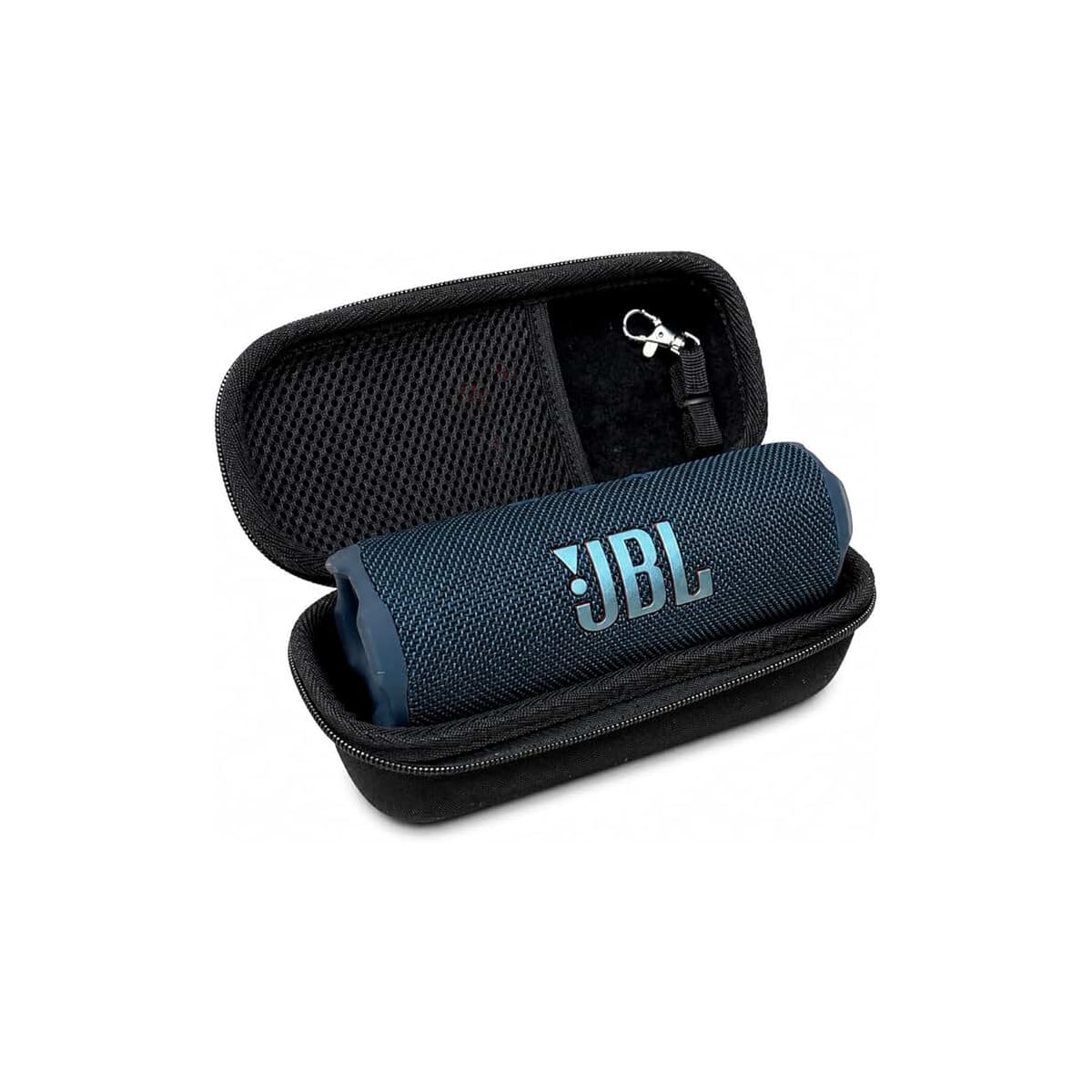
JBL
Buyers who want interchangeable carry arrangements and identifiable playback controls.
Push-lock carry pieces and separated physical controls are appealing, with spare-piece organization and a historical USB-listening caveat.
Reasons to choose it
- Push-lock attachment choices are demonstrated in the historical review.
- Raised playback controls have a separate power and pairing strip.
- Core physical controls are clearly distinguished in the reviews.
Tradeoffs to know
- Unused carry pieces need an organization plan.
- The accessory-loss comment is anticipation rather than an actual loss.
- SoundGuys reports USB listening did not charge the speaker simultaneously in its historical setup.
Think twice if: You dislike managing detachable pieces or require an unverified simultaneous USB listening and charging routine.
Published specifications
- Model
- JBL Flip 7
- Review focus
- Carrying, physical control selection, and connection chores
Further reading
Ratings
Editorial score 8.4
Carry and placement9
Push-lock carry choices give a direct routine; the unused-piece concern is anticipated loss, not a witnessed event.
Buttons and control selection9
Raised playback controls and a dedicated backlit strip separate common functions; this does not mean every button is illuminated.
Connection and charging-port chores7
The historical SoundGuys setup separates USB listening from charging, adding planning for that routine.
Sources & further reading
youtube.com review
youtube.com review
youtube.com review
youtube.com review
Keep reading
Something changed? Help us keep this useful.
Send a correction →