Jackery Explorer 1000 v2 Review (2026): Light 1kWh Backup, 1500W Ceiling
Jackery’s lighter 1070Wh LFP station is friendly for apartments, camping, routers, laptops, and modest appliances, but the 1500W inverter, no-expansion design, and Jackery-panel solar caveats decide the fit.
Jackery Explorer 1000 v2 is the simple lightweight 1kWh pick in our portable power station ranking: portable, familiar, quiet-positioned, and friendly for ordinary outage or camping loads, but less convincing for high-draw appliances or expandable home backup.
MSRP
$799
Amazon
$428.99
at writing · 2026-05-06
Buyer fit
Jackery is the easy-to-understand, easy-to-carry 1kWh-class pick. It gives up inverter headroom, expansion, and solar flexibility, but its lighter weight, simple screen/app, and quiet-positioned charging make it less intimidating for ordinary outage and camping use.
MSRP
$799
Amazon
$428.99
at writing · 2026-05-06
Score breakdown
How this product scored
Same rubric, but focused on one product so the reasons behind the score stay readable.
Usable runtime
The 1070Wh LFP capacity and reviewer runtime checks make it credible for a simple 1kWh station.
Load handling
1500W output is enough for many outage/camping loads but clearly below the Anker, EcoFlow, BLUETTI, and DJI headroom lanes.
Recharge speed
Emergency fast charging is useful, but Jackery’s own guidance treats it as an occasional mode and solar compatibility is fussier than the simple branding suggests.
Noise & thermals
Quiet/overnight charging claims and reviewer comments support indoor use, with less fan drama than the hotter-running rivals.
Controls
Jackery keeps the on-device screen simple while the app adds quiet mode, battery-saving settings, and emergency charging.
Portability
At about 23.8 lb, it is the easiest true 1kWh-class model here to carry.
Service
Five-year warranty and brand familiarity help; current US manual/SKU details and long-term v2 service chatter still deserve caution.
Backup fit
No expansion and a 400W solar ceiling make it more of a simple portable station than a scalable backup platform.
Quick Verdict
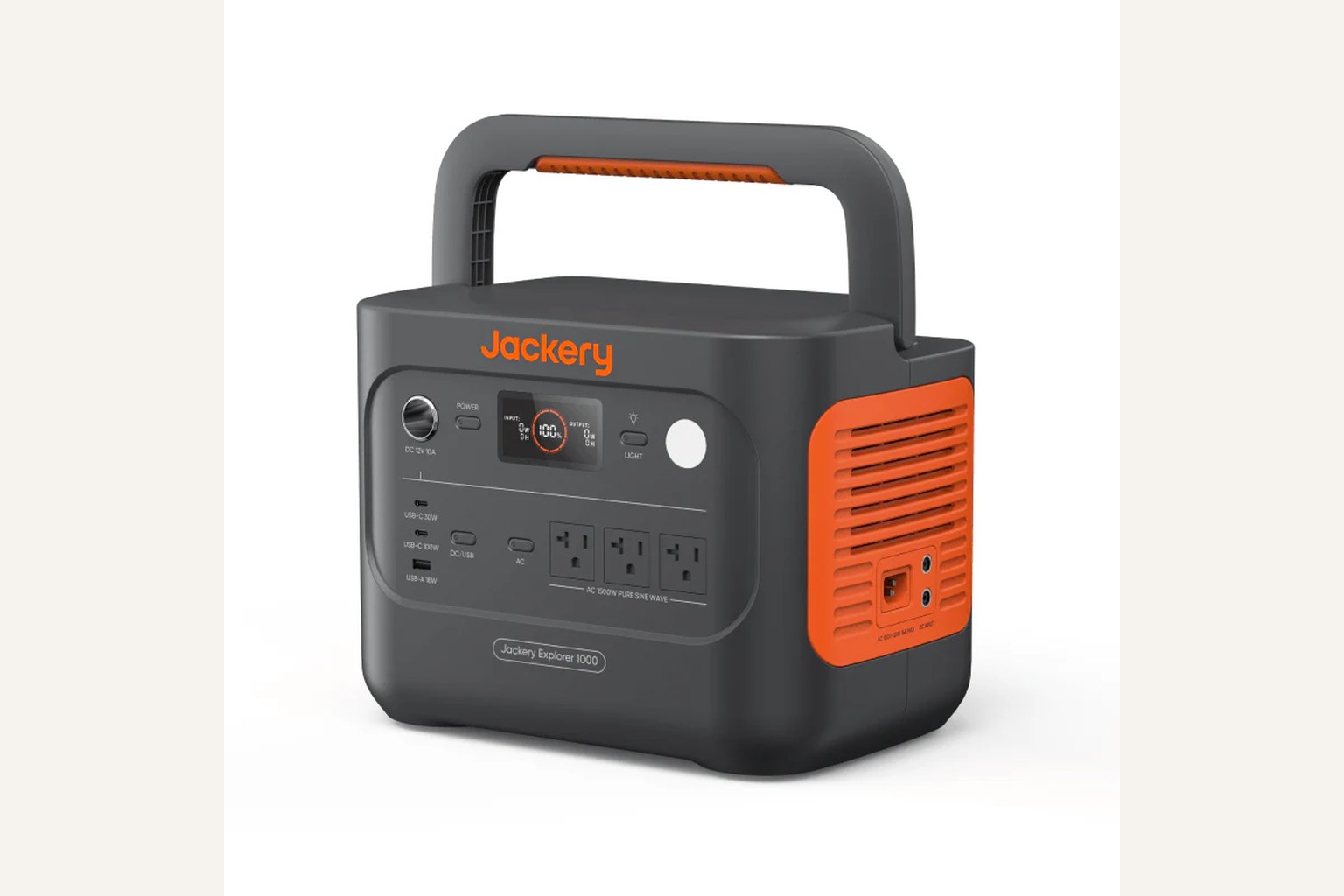
Jackery Explorer 1000 v2 is the portable power station for the buyer who does not want backup power to turn into a side project. It is the familiar orange-and-black 1070Wh LFP box you can imagine in an apartment closet, campsite, RV, car trunk, or storm-prep corner: 1500W AC output, 3000W surge, 100W USB-C, app-selectable charge modes, and a very carryable 23.8 lb body.
That is why it lands at #4 in our Best Portable Power Stations in 2026 guide as the Best simple lightweight 1kWh pick, with a 7.3/10 overall score. It is not trying to beat Anker’s 2000W default, DJI’s quiet 2600W AC flex, or EcoFlow’s expansion path. Its pitch is calmer: make ordinary backup and camping power easy to carry, easy to read, and hard to overthink.
The risk is buying the wrong kind of easy. A light 1kWh station can still disappoint if your real plan includes kettles, heaters, big tools, expansion batteries, or a solar setup built around non-Jackery panels. But for routers, laptops, lights, phones, cameras, small fans, and modest fridge support, Jackery gets a lot of the day-to-day stuff right. The Solar Lab said the screen is “pretty nice very simple and easy to look at,” and called Jackery’s app “really really good” because it stays clean and does not bury basic controls.
Before checkout, use the product links to verify today’s price, seller, coupon behavior, exact ASIN, and whether panels are included. At writing, the Amazon listing we checked was ASIN B0D7PPG25F at $428.99 from Jackery Inc., new/In Stock, with solar panel optional. KB4UB may earn from those links if this helps you dodge the wrong backup box.
Score Breakdown
- Usable runtime: 7.6/10. The 1070Wh LFP pack is credible for router/laptop/light/camping/fridge-short-run use, and the review packet includes a heavy-load efficiency estimate around 87.5%. Still, 1kWh is not a fridge-and-kettle-forever tank.
- Load handling: 7.1/10. 1500W continuous / 3000W surge is plenty for many basics, but it is the reason Jackery ranks below Anker, DJI, EcoFlow, and BLUETTI if you care about heavier appliances or tools.
- Recharge speed: 7.3/10. Standard charging is useful, and app-enabled emergency charging can get close to the 1-hour promise. Jackery’s own guidance treats that fastest mode as occasional, not your every-week battery-health habit.
- Noise & thermals: 7.8/10. Quiet/overnight charging claims and reviewer comments support indoor use. This is one reason Jackery feels calmer than the fan-fussier rivals.
- Controls: 7.9/10. The screen and physical buttons are easy, while the app adds charging modes, quiet charging, battery-saving settings, and remote inverter control.
- Portability: 8.8/10. This is the win. At about 23.8 lb, it is the easiest true 1kWh-class station in this group to carry.
- Service: 7.6/10. Jackery’s brand familiarity, LFP cycle-life claims, and 5-year warranty posture help. Current US-specific terms should still be checked.
- Backup fit: 6.3/10. EPS/pass-through behavior helps for some loads, but no expansion and a 400W solar ceiling make this a simple portable station, not a scalable home-backup platform.
That score is not lukewarm. It is specific: Jackery is good when simple and light matter more than maximum muscle.
What Feels Great After Setup
The first nice thing is the lack of drama. The front screen is readable, the physical AC/DC buttons are obvious, and the app seems to add useful settings instead of making basic operation feel locked behind a phone. The Solar Lab said Jackery’s app is “very clean,” and that it gives access to charging modes plus remote inverter control so “you don’t have to physically press the button.” That is a small convenience until the station is under a desk, in a tent, or across the room during an outage.
The port mix also fits the ordinary-buyer lane. The US Amazon listing pointed to three 120V AC outlets, two USB-C ports including one 100W port, USB-A, a 12V car socket, and a built-in light. The car socket and light sound boring on a product page. In real use, they are exactly the sort of boring that saves a trip to the junk drawer.
The light deserves the tiny celebration. The Solar Lab reviewer said, “honestly it’s been a long time since we’ve reviewed a small power station that still retains its light feature,” then called it “so handy to have” when carrying the station around and keeping one hand free. That is not a reason to buy a power station by itself. It is a reason the Jackery feels friendly when you are actually living with it.
Weight is the other daily win. BLUETTI gives you more battery. DJI gives you more AC output. EcoFlow gives you a better growth path. Jackery gives you a 1kWh-class box that more people will actually move without swearing. For camping, apartments, closets, car trunks, and quick storm prep, that matters.
Setup, Charging, and EPS Reality
Set the Explorer 1000 v2 up before you need it. Charge it from the wall, connect the Jackery app, find the quiet and emergency charge modes, turn outputs on and off from the front panel, then run the actual load you care about. A router and laptop are gentle. A fridge is different. A kettle, heater, or power tool is a whole other little beast.
The 1-hour charge headline needs context. In the Solar Lab transcript, the reviewer described normal charging at about 1000W, then said emergency charging “only stays on for the duration of one charge” and raises charge speed to about 1200W. That is useful if a storm is coming and the station is low. It is less cute as a weekly routine, because the same transcript says that faster mode is “technically bad for the battery’s Health,” which matches Jackery’s own guidance that normal charging is the longevity-friendly default.
Solar is another setup detail to price honestly. The station supports up to 400W solar input, but the Amazon listing says solar panel optional, and the research notes Jackery-panel compatibility caveats. Do not compare the Jackery’s station-only price against rivals with panel bundles or extra adapters already in the cart.
EPS/pass-through use also deserves a test, not faith. The manual describes switching within 20 ms and calls it a non-professional UPS function, not a 0 ms safety net. That can be fine for many routers, lights, and small office loads. For data servers, workstations, medical devices, or anything where a blip would be expensive or dangerous, test your exact setup while the return window is still open. Backup gear should prove itself when the lights are still on.
The Annoyances to Know Before Buying
The biggest limitation is output headroom. A 1500W continuous rating is not weak in isolation, but this group includes Anker at 2000W, DJI at 2600W, EcoFlow and BLUETTI at 1800W, and larger systems if you leave this shortlist. If your plan includes kettles, microwaves, heaters, power tools, or multiple heavy loads, Jackery is not the station I would stretch first.
The second limitation is expansion. The source transcript says it plainly: “this unit isn’t expandable.” The reviewer was fair about it — for camping, a station this size can make sense without expansion — but the buying decision changes if you want to grow from a weekend box into a larger outage setup. In that case, EcoFlow’s DELTA 3 Plus or another expandable lane deserves a harder look.
Solar is the fussy part hiding under a simple brand. The transcript criticizes Jackery for sticking with its connector approach after many others moved elsewhere, saying “you have to buy their panels” or adapter cables. That does not make solar impossible. It means you should build the full solar cart before deciding the station is cheaper or easier than a rival.
Documentation and listing clarity are the last little traps. The US Amazon listing showed three pure-sine AC outlets, while the accessible manual appeared region-oriented and listed a different outlet configuration. Core specs align, but the lesson is useful: check the exact ASIN, outlet layout, bundle, seller, coupon, and return terms instead of assuming every Explorer 1000 v2 page describes the same box in the same way.
How It Compares
Jackery is the easy-carry, easy-understand option — not the spec-sheet bully.
- Anker SOLIX C1000 Gen 2: Better default for most buyers. Anker gives you 2000W output, stronger all-around ranking, and a cleaner high-output posture. Jackery wins if you care more about simple carrying and familiar camping/outage use than appliance headroom.
- DJI Power 1000 V2: Better quiet high-output indoor pick. DJI is heavier and accessory-fussier, but its 2600W AC ceiling changes what it can run. Jackery is simpler and lighter.
- EcoFlow DELTA 3 Plus: Better expandable system pick. EcoFlow is the one to study if extra batteries, higher solar ceiling, and app-connected backup planning matter. Jackery is less ambitious and less intimidating.
- BLUETTI AC180: Better heavier utility pick. BLUETTI has more stored energy and 1800W output, but it is heavier and more utilitarian. Jackery is the easier tote.
- Goal Zero Yeti 700: Better smaller rugged pick. Goal Zero is not a 1kWh-class rival; choose it only if smaller and outdoor-rugged matter more than output.
For the full score grid, alternatives, and current product links, go back to Best Portable Power Stations in 2026.
Who Should Buy It — and Who Should Skip It
Buy the Jackery Explorer 1000 v2 if:
- you want a lighter 1kWh-class station for camping, apartments, RV weekends, car trips, and ordinary outage basics
- your main loads are routers, laptops, lights, phones, camera gear, small fans, modest appliances, or short fridge support
- a simple screen, clean app, physical buttons, 100W USB-C, car socket, and built-in light matter more than maximum inverter output
- you like the idea of emergency fast charging, but you are fine using normal charging most of the time
- you want a recognizable portable-power brand without building a multi-battery setup
Skip it if:
- you need 1800W-plus output for heavier appliances, tools, kettles, or multiple demanding loads
- you want expansion batteries or a larger home-backup path
- you want the least proprietary solar-panel route
- the current coupon, seller, return terms, or bundle contents look unclear
- a 20 ms non-professional EPS setup is not enough for your sensitive device
Bottom line: Jackery Explorer 1000 v2 is the calm, light, recognizable 1kWh station in this group. Buy it because you want ordinary backup power to be easy to carry and easy to understand. Do not buy it expecting the muscle of Anker, the quiet high-output headroom of DJI, or the expansion path of EcoFlow.
Tell us what this page missed
These pages get better when real buyer complaints make it back into the scoring model. If something important is underweighted, say it.
Rate this review
Give it a score from 1-10 and tell us what to improve.
0/4000 characters