
The recommendation
Choose it if you want an automatic option with a finish beep and a removable tray handle, and can check your accessory space alongside bottle height. Consider another layout if you are counting on squeezing in extra bottles beyond the instructed arrangement or need a documented universal fit.
Grades at a glance
| Product | Overall | Loading and rack flexibility | Cycle selection and feedback | Routine cleanup access |
|---|---|---|---|---|
| Dr. Brown’s All-in-One Sterilizer and Dryer | 8.0 | 8.0 | 8.0 | 8.0 |
Does it fit your life?
Our verdict
Dr. Brown's All-in-One Sterilizer and Dryer is the balanced option in this group for the handling features we can assess. The review shows tall and shorter bottles, an accessory tray with a handle that twists off, an automatic selection and start sequence with a finish beep, and baskets that lift away to expose the basin. There is no single standout feature that needs to carry the whole recommendation; the appeal is a straightforward combination of useful details.
The warning is about crowding. The reviewer experiments with packing in more bottles, then acknowledges the loss of room for accessories. That experiment is not a loading recommendation. If your real problem is organizing complete bottle sets, counting only upright bottle bodies can make the appliance look more spacious than the full load would be. Consider bottle height and all the accompanying pieces together, within the current instructed arrangement.
Loading and rack flexibility
Tall Dr. Brown's bottles and several shorter bottle examples appear in the demonstration. It is useful to see both because the lower basket has to accommodate more than a single silhouette. The examples support a workable mixed arrangement, though they do not establish that every bottle sharing a brand name or broad size description will fit.
The accessory tray handle twists off when clearance is needed. That is a small but concrete feature: a central protrusion can matter when arranging the space above the bottles, and the review shows a way it can be removed. Before buying, look at whether the handle or the tray itself would be the limiting part of your own arrangement.
The reviewer also shows why an ambitious bottle count can be misleading. Packing more bodies into the basket crowds the accessory space. We do not recommend extra-capacity loading. Instead, use the observation as a reminder to compare complete sets of pieces. A load that fits bottle bodies but leaves nowhere appropriate for their smaller components may not solve the organizational problem that prompted the purchase.
Cycle selection and feedback
The reviewer identifies sterilizing, drying, and automatic options, then shows turning the machine on, choosing automatic, and starting it. A finish beep signals completion in the demonstration. Those are useful steps to check if you want to run the combined process and hear when it finishes.
The controls are not presented here as a guarantee that anyone can use the machine without reading the instructions. The useful point is narrower: the source shows the choices, the start interaction, and audible completion feedback. That is enough to judge the basic navigation more confidently than a product photograph alone would allow.
The control score reflects the demonstrated steps for selecting automatic and starting the cycle, followed by audible completion feedback. If you are choosing on interface alone, check the current instructions for how each button selects the operation you expect to use. Also consider the location: a completion cue may be useful when you are nearby. Learn the current instructions before relying on those cues.
Routine cleanup access
The lid, accessory tray, and large basket lift off to expose the basin. That gives direct access through the top once the load area has been taken apart. The removable tray handle is another piece to account for when thinking about how the components will be handled during upkeep.
The demonstration also shows the underside filter. This keeps the maintenance picture from becoming “everything is reachable from above.” A buyer should consider both the easy removal of the upper pieces and whatever access the current instructions require underneath. The evidence does not establish an interval for replacing that filter.
The cleanup-access score reflects a practical, accessible layout with some separate components. It does not endorse the reviewer's water recommendations or supply a cleaning solution. When comparing appliances, distinguish the ease of reaching a basin from the amount or frequency of care it may need. Here, the removable layers are the well-supported advantage; maintenance frequency and long-term reliability remain separate purchase questions.
Which alternatives make sense?
Baby Brezza's Advanced model makes a useful comparison if you are worried about the space between bottles and accessories. Its demonstration shows a short bottle stopping a tray from sitting level and taller bottles requiring that layer to be omitted. Dr. Brown's demonstration instead highlights the removable tray handle and a range of bottle heights. Look at those different constraints before assuming that either brand's own bottles settle the fit question.
Papablic's Pro uses a reversible collar and shows a mixed bottle-and-pumping-parts load. Its six separable pieces provide access, while the reviewer finds the icon reference less convenient on the side of the appliance. Dr. Brown's demonstration shows the automatic selection and start sequence and a finish beep, useful details if you want a combined process with an audible completion cue. Papablic's collar may be more relevant if the height adjustment is the feature that could solve your layout problem. Neither source establishes universal compatibility.
Count complete sets rather than bottle bodies
The Dr. Brown's demonstration makes a useful distinction between fitting more bodies and fitting a useful complete load. When the reviewer crowds the basket, the accessory space becomes tighter. That is the part of the experiment to carry into a buying decision. A few apparent gaps between bottles are not necessarily spare capacity once the accompanying pieces are considered, and they are not permission to depart from the instructed arrangement.
Imagine comparing two layouts for the same collection. In one, the bodies fit neatly but the tray is crowded. In the other, the bodies are arranged less densely and the small components have appropriate room. The second may be more relevant to the organizational problem you are trying to solve, even if the first makes for a more impressive photograph. The review does not measure that tradeoff for your collection, so the current loading guidance needs to settle it.
The removable handle is a useful detail to inspect rather than a reason to assume the whole tray can clear any tall shape. A handle can be the obstruction in one arrangement while the height of the tray itself is the limit in another. Look at the bottle examples shown in the review, then compare your own items against the current diagram. The fact that a tall bottle from the same brand appears successfully is helpful context, not a guarantee about every branded bottle.
The automatic option offers another kind of convenience. The reviewer shows turning the machine on, selecting automatic, and starting it, then describes a completion beep. If you want to combine sterilizing and drying in one selection, compare that sequence with the operation you expect to use. Read the current instructions to learn the button meanings and steps; the demonstration does not establish a cycle duration for your own loads.
Taken together, these details make the All-in-One a balanced handling choice. Its attraction is the combination of bottle examples, a small clearance adjustment, an automatic option with completion feedback, and removable upper pieces. Choose it if that combination addresses your needs. If the plan depends on squeezing in additional bodies or treating a successful example as universal compatibility, resolve that assumption before buying.
Decide which inconvenience you would accept
Dr. Brown's All-in-One is an appealing shortlist choice if you want several ordinary conveniences together: an automatic option with a finish beep, a tray handle that can be removed, and upper pieces that lift away. The benefit is the combination. You do not need to be seeking a particular display style or an elaborate set of rack configurations for those details to matter; they relate directly to arranging, selecting, and taking the appliance apart for access.
Begin with the accessory tray when comparing it with your collection. The demonstration includes different bottle heights, but the crowding experiment shows why the space above them matters just as much. Count the accompanying pieces alongside the bodies. If a planned load only works by squeezing in extra bottles, it is a poor basis for the purchase. Work from the permitted arrangement for the current unit and make room for the complete set you intend to handle.
Look specifically at the tray handle. Its removable design is useful when that protrusion is the obstruction. It will not answer every question about height elsewhere in the basket. In a comparison photograph, identify whether the tight spot is the handle, the tray surface, or the lid. Those different problems can lead to different buying decisions even when two products both advertise removable parts.
If another adult will use the appliance, walk through the button meanings and start sequence together using the current instructions. The demonstration shows selecting automatic and starting it, followed by a finish beep. Consider whether an audible completion cue is useful where you would put the unit.
For upkeep, picture taking off the lid, tray, and basket, then setting them aside while reaching the basin. Also check what access the current instructions require for the underside filter. If those movements fit the available location, the All-in-One offers a coherent handling arrangement. Its case is strongest when that balanced set of features suits you, rather than when you are chasing the largest possible bottle count.
What to check before ordering
Confirm the current All-in-One Sterilizer and Dryer model and compare the listing with its loading diagram. The review concerns the named product family, with historical examples of tall and shorter bottles. A shared brand name does not confirm every bottle size, material, or later version. The most helpful answer is a current diagram showing the collection you want to arrange, including its small components.
Pay attention to how the accessory tray sits above those bodies. Check the handle shown in the current design and whether its removable arrangement matches the feature discussed here. If a seller's image uses a different tray or control panel, clarify the version before relying on the demonstration. This is particularly useful when tray clearance is the main reason you are comparing the All-in-One with another model.
Inspect the control panel and read the current start sequence. The demonstration identifies sterilizing, drying, and automatic options and shows the steps for selecting automatic and starting the cycle plus a completion beep. Decide whether those steps and feedback suit a shared household appliance. The historical run does not provide a timetable for your own loads, so base the interface decision on the selection steps and cues rather than an assumed finishing time.
Check the care instructions for the basin, removable upper pieces, and filter. The review shows access through the top after disassembly as well as a filter underneath. Those observations help you picture the handling; the current manual supplies the method and any replacement requirements. Make sure the location allows the relevant access, and account for the pieces you would set down while working.
Before paying, review the seller, supplied accessories, and return terms. If a fit detail remains unanswered, a clear route to resolving it is more useful than a higher capacity claim in a listing. The All-in-One earns its place through the removable tray handle, the automatic option with a finish beep, and accessible layers. Buy when those features match your complete collection and your space, with the instructed arrangement as the starting point.
What the score tells you
The overall shown here combines three handling judgments: loading and rack flexibility, cycle selection and feedback, and routine cleanup access. Read those alongside the reasons in the review. The total is useful for comparing this narrow set of conveniences, but the category that matches your main frustration may be more important to you than the overall order.
These are editorial judgments based on attributed demonstrations and reports. We have not personally tested these appliances. A useful view of a rack arrangement can support a handling assessment without establishing the outcome of a cycle or the experience of a large group of owners. The sources linked below let you inspect the demonstrations behind the specific observations.
A successful example load is evidence about that arrangement. It is not a universal fit list, and a visible progress indicator is evidence about feedback rather than what happened to every item inside. The same distinction applies to cleanup: removable parts show access, while long-term maintenance frequency and durability require different evidence.
Choose the All-in-One for the combination of an automatic option with a finish beep, the removable tray handle, and upper pieces that expose the basin. Confirm room for the small components as well as the bottle bodies. That complete arrangement matters more than a crowded example load or the appeal of matching the appliance brand to the bottles you already own.
Dr. Brown’s All-in-One Sterilizer and Dryer
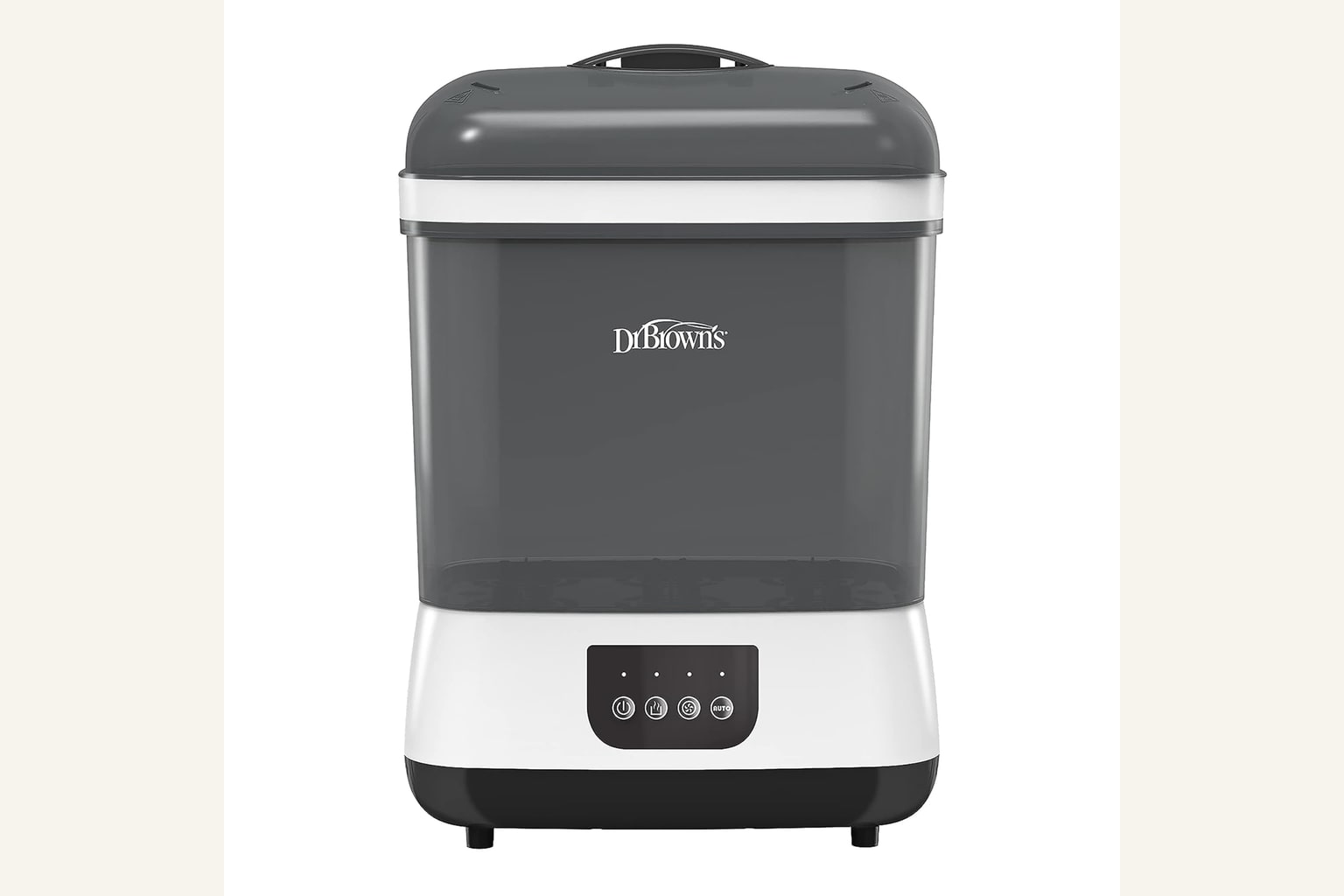
Dr.
You want an automatic option with a finish beep and a removable tray handle, and can check your accessory space alongside bottle height.
A balanced layout, with accessory room to watch
The takeaway
You want an automatic option with a finish beep and a removable tray handle, and can check your accessory space alongside bottle height.
Reasons to choose it
- A balanced layout, with accessory room to watch
Tradeoffs to know
- You are counting on squeezing in extra bottles beyond the instructed arrangement or need a documented universal fit.
Think twice if: You are counting on squeezing in extra bottles beyond the instructed arrangement or need a documented universal fit.
Further reading
Ratings
Editorial score 8
Loading and rack flexibility8
Tall and shorter bottles appear in the review, and the tray handle twists off for clearance. Accessory crowding makes the complete load more relevant than a bottle-body count.
Cycle selection and feedback8
The reviewer shows choosing automatic and starting the cycle, then describes a finish beep. These provide a concrete selection sequence and audible completion cue.
Routine cleanup access8
The lid, accessory tray, and large basket lift off to expose the basin, with separate filter access underneath.
Sources & further reading
youtube.com review
youtube.com review
youtube.com review
Keep reading
Something changed? Help us keep this useful.
Send a correction →