
The recommendation
Choose the Smart Grinder Pro if you like visible selection references and accessible removable parts, while accepting an extra cup/shot control that can complicate the interface.
Grades at a glance
| Product | Overall | Filling and handling | Control selection | Bin and burr access |
|---|---|---|---|---|
| Breville BCG820BSS Smart Grinder Pro | 8.5 | 9.0 | 7.5 | 9.0 |
Does it fit your life?
A grinder for people who like references
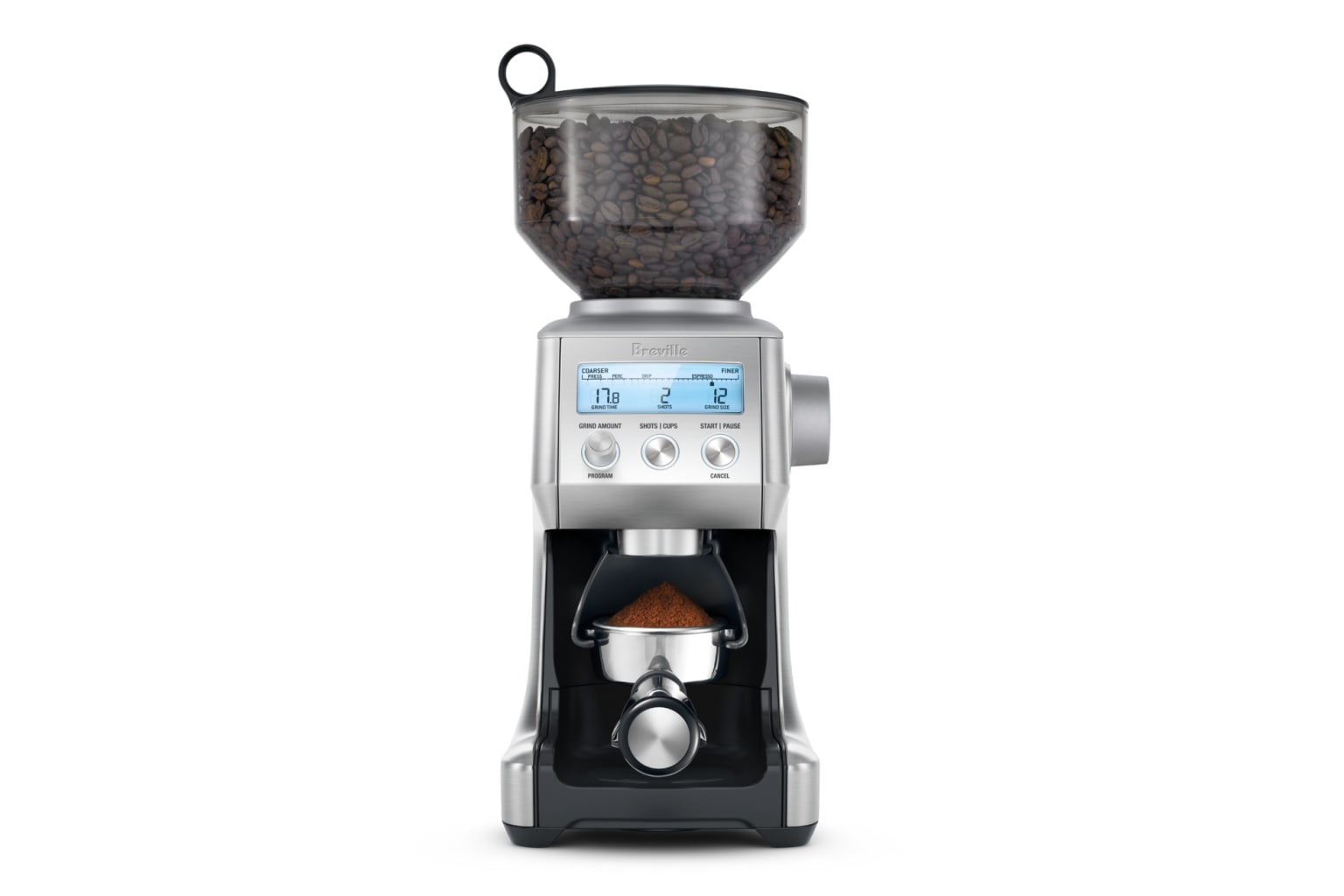
The Smart Grinder Pro’s interface gives you several ways to see a selection. The Alternative Brewing presentation points to a number on the display, a finer-to-coarser scale and a side adjustment dial. If you like checking a physical adjustment against a visible reference, that arrangement has a clear appeal.
It also creates the main buying tradeoff. More information and more controls can be helpful, but they can ask for more interpretation. The same reviewer finds the separate cup/shot control an unnecessary complication. This is therefore a good model to consider when you like a visible interface, and one to compare carefully when simplicity is your first priority.
A useful lid and a deliberate removal control
The reviewer likes the ring pull on the hopper lid. That is a small detail, but it belongs to an action you may repeat often: lifting the lid to add beans. A handle you can identify and grasp can matter more to day-to-day preference than a long list of specifications.
The presentation also describes an internal control that closes the hopper chute while unlocking the hopper from the body. That makes the removal interaction more specific than simply saying the hopper comes off. For buyers who expect to empty or change beans, the arrangement is a useful reason to look closely at this model.
Do not turn that favorable description into a guarantee of a mess-free kitchen. The supported point is the removal mechanism and the control it provides. A historical presentation does not establish the outcome of every future use. OXO offers the most direct comparison here because its locking hopper is also demonstrated as a removal convenience.
The ring pull and internal release solve different handling moments. The ring pull is the part to look at when considering opening the lid. The internal switch matters when you want the hopper itself off the body. If you seldom remove a hopper, the lid may be the detail you appreciate more often. If changing or emptying beans is central to your routine, inspect the removal mechanism closely. This distinction can help you choose between the Breville and OXO without treating every hopper feature as equally important.
Several ways to see your selection
The visible number, scale and side dial give the user reference points for ordinary adjustment. In the presentation, the reviewer particularly likes this arrangement. It can appeal if you prefer an interface that gives you several visual cues about where a selection sits.
The important question is whether those cues make sense together to you. A clearly displayed number may be useful for a note; a scale may make the direction of movement easier to recognize. Neither establishes a universal setting for your coffee, nor does it guarantee an output result. This review considers how the controls communicate a selection.
The display also presents time, and the interface includes a cup/shot selection that the reviewer describes as a multiplier. Their criticism is practical: another control for changing the amount can confuse a process that already has size and time adjustments. That reservation belongs beside the favorable comments about reference points.
If you tend to enjoy visible information and do not mind learning which control you want to use, the Breville may suit you. If overlapping selections make you hesitate, the Encore ESP’s direct pulse button is a more relevant starting point. The Virtuoso+ is another comparison if the display feature you chiefly want is a visible time setting.
It helps to distinguish several views of one adjustment from several independent adjustments. The displayed number, finer-to-coarser scale and side dial are references around the selection being made. The time and cup/shot controls add other choices to the routine. The reviewer's praise for the first group and criticism of the extra multiplier are therefore compatible: an interface can make one choice clear while making the overall sequence feel busier.
For a household sharing the grinder, agree on which information belongs in any setting note. A number from the display is more useful when everyone knows what it refers to. Writing down a time without noticing a separate cup/shot choice could leave another person uncertain about the intended setup. This is a reason to learn the labels together, rather than treating a large display as proof that a newcomer will immediately understand the machine.
Two areas of useful access
Once the hopper is removed, the cited presentation describes the upper burr assembly as straightforward to take out. That is a meaningful convenience if reaching the chamber is a chore you expect to perform. It gives the Breville a practical access case separate from its control features.
The reviewer also shows a removable lower section for cleaning access. This matters because reaching the upper chamber and dealing with the lower collection area are different tasks. A useful design can make both approachable, rather than asking you to treat all care as one vague category.
Our score concerns those physical access points. It does not establish cleaning effectiveness, a maintenance interval, or future repair costs. In particular, a removable assembly should not be used to predict how long the grinder will last. If you want a comparison based specifically on disassembly, read the Encore ESP’s tool-free demonstration and OXO’s removable-upper-burr description.
Look below the display too
The presentation describes a separate grounds bin with its own lid and also discusses receiver attachments. Those parts are easy to overlook when a display dominates the product photos. For a buying decision, the receiver you plan to handle should be part of the same mental walk-through as opening the hopper and making a selection.
Check the exact accessories included with the listing you are considering. Model-level demonstrations are useful for understanding a design, but they do not establish that every bundle contains the same parts. This is particularly relevant if one attachment is central to how you intend to use the grinder.
The accessible lower section is a reason to consider the collection area favorably. It is not a basis for promising that transferring grounds will always be clean or that the machine leaves a particular amount behind. Those outcomes are outside this review’s assessment.
The receiver choice can also affect which control you reach for. Alongside the front start/stop button, the presentation describes another activation point below the chute for use with a portafilter. This is an ordinary interaction detail to inspect if you expect to use that arrangement. Check the holder and receiver supplied with your intended package; the useful question is where your hands will go with those actual parts fitted. The demonstration is not a promise that an unspecified portafilter or replacement attachment will fit.
Choose the interface as a whole
The Smart Grinder Pro earns its shortlist place through the ring-pull lid, deliberate hopper removal, visible adjustment references and useful access points. The extra cup/shot selection is the main interface reservation. Evaluate those together rather than buying for the display and discovering later that you prefer fewer controls.
This review concerns physical handling, ordinary selection and access. It does not rank taste, extraction, speed, noise, repairs or reliability. The cited historical presentation is relevant to the model, with later revisions and exact accessory bundles to be checked against the listing you intend to buy.
Breville BCG820BSS Smart Grinder Pro
Breville
Visible selection references and useful removable parts
The Smart Grinder Pro’s lid, hopper removal and cleaning access have a clear appeal. Its display and overlapping controls need a closer look.
Reasons to choose it
- Ring-pull lid and hopper removal control
- Several visible adjustment references
- Removable upper burr and lower section
Tradeoffs to know
- Cup/shot multiplier adds another control to understand
- More references do not automatically mean less effort
Think twice if: You want the fewest overlapping controls
Further reading
Ratings
Editorial score 8.5
Control selection7.5
Multiple reference points help selection, but extra cup/shot multiplier adds complexity.
Bin and burr access9
Removable bottom section and upper burr give useful cleaning access.
Sources & further reading
youtube.com review
youtube.com review
youtube.com review
youtube.com review
Keep reading
Something changed? Help us keep this useful.
Send a correction →