BLUETTI AC180 Review (2026): Big Battery, Heavy Carry, Fan Caveats
The AC180 is the heavier utility pick in our portable power station ranking: 1152Wh storage, 1800W output, and fast charging, with weight, fan behavior, and Bluetooth-only controls to check before checkout.
BLUETTI AC180 makes sense if you want a sturdy utility box for camping, garage backup, fridge/freezer support, tools, or off-grid chores. It has more stored energy than the 1024Wh picks, but it is not the quietest, lightest, or most polished station here.
MSRP
$499
Amazon
$448.99
at writing · 2026-05-06
Buyer fit
BLUETTI gives the set its biggest battery and a sturdy 1800W utility lane, but it is heavier, more utilitarian, and more exposed to fan, app, and support caveats. It is appealing if you want capacity and output more than easy carrying.
MSRP
$499
Amazon
$448.99
at writing · 2026-05-06
Score breakdown
How this product scored
Same rubric, but focused on one product so the reasons behind the score stay readable.
Usable runtime
The 1152Wh battery gives the most stored energy here and repeated signals support real appliance/camping usefulness.
Load handling
1800W continuous / 2700W peak is strong enough for many household loads, though the outlet layout and exact title/spec details need care.
Recharge speed
0-80% in 45 minutes and 500W solar are useful, but fan noise and charging-mode behavior deserve attention.
Noise & thermals
BLUETTI community and owner signals make fan behavior a real caveat, especially in bypass/UPS or quiet-room use.
Controls
The screen and app are functional but more utilitarian than Anker, Jackery, DJI, or EcoFlow, with Bluetooth-only control limiting remote checks.
Portability
At about 35.3 lb, this is the heaviest kept product and the least pleasant to move around casually.
Service
Warranty coverage is acceptable, but owner/service chatter keeps confidence in the middle rather than the top tier.
Backup fit
UPS positioning and capacity are useful, but no expansion lane plus app and fan caveats narrow the fit.
Quick Verdict
BLUETTI AC180 is the portable power station to consider when the smaller 1kWh boxes feel a little too tidy and you would rather have more battery in the tank. In our Best Portable Power Stations in 2026 ranking, it finished #5 as the Best heavier utility pick with a 7.2/10 score. The role is clear: 1152Wh of LFP storage, 1800W continuous AC output, 2700W power-lifting/peak behavior for certain loads, 0-80% wall charging in about 45 minutes, 500W solar input, Bluetooth app control, and a 5-year warranty posture.
The thing to avoid is buying it like a grab-and-go camping toy and then meeting the 35.3 lb reality on stairs, in a small apartment, or beside a bed. BLUETTI is giving you the biggest battery in this shortlist, but the box wants a home base.
That makes the AC180 easier to like for garage shelves, fridge/freezer support, trailers, workbenches, and daytime outage use than for quiet bedroom UPS duty. The fan-cycling reports are not a universal verdict, but they are enough to make always-on, low-load backup buyers test it immediately.
Use the product links to recheck current price, seller, return terms, exact ASIN B0C1SMJTDT, and whether you are viewing the standalone AC180 rather than a solar bundle. At writing, the standalone Amazon listing was new/In Stock at $448.99 with Amazon.com shown in the combined shipper/seller field, but listings can change quickly. Those links may also support KB4UB.
Score Breakdown
- Usable runtime: 8.0/10. The 1152Wh battery gives BLUETTI the most stored energy in this kept set. It is still not magic under heaters, kettles, or big tools, but it gives you more room than the 1024Wh boxes.
- Load handling: 7.9/10. 1800W continuous output and 2700W power-lifting/peak behavior are useful for fridge/freezer backup, camping gear, worksite tools, and garage chores. The outlet-count copy needs care because official BLUETTI material and the Amazon title we saw did not describe it the same way.
- Recharge speed: 7.4/10. The 0-80% in 45 minutes claim is strong. Fan noise and charge-mode behavior are the parts to test while returns are still easy.
- Noise & thermals: 6.5/10. This is the real ownership caveat. Community reports raised fan cycling concerns in bypass/UPS use.
- Controls: 6.9/10. The screen and app are useful, but the app looks more utilitarian than polished and appeared Bluetooth-only in the specs we checked.
- Portability: 5.8/10. At about 35.3 lb, this is the heaviest kept product and the least casual carry.
- Service: 6.9/10. The warranty story is acceptable, but support chatter keeps confidence in the middle.
- Backup fit: 6.9/10. UPS positioning and capacity help. No expansion lane, fan caveats, and Bluetooth-only monitoring narrow the fit.
What Feels Great After Setup
The best part of the AC180 is that it feels like a real utility box, not a shiny spec trophy. If your plan is a garage freezer, campsite fridge, router, lights, laptop, tools, or a small off-grid work area, 1152Wh plus 1800W output gives you a useful middle ground: more stored energy than Anker, DJI, EcoFlow, or Jackery in this set, without jumping into a huge home-backup station.
One hands-on review showed the everyday appeal while running changing loads: “it'll adjust that time so it goes back up to 7.6 hours” and “it will jump in real time so depending on what you have plugged in it's going to let you know how much power you have.” That is the kind of display behavior people actually use. You plug in the thing that matters, watch the estimate change, and decide whether your plan is sane.
The AC180 also has a useful storm-prep rhythm if the fan behavior does not bother you: fast wall charge before bad weather, then enough capacity for practical essentials. The reviewer also called out solar while discharging, saying you can “continuously recharge this while you're discharging.” In real life, clouds, panel angle, and the 500W solar ceiling matter, but the basic pattern is useful for camping and daytime outage recovery.
The direct-store and Amazon details also keep the identity fairly clean: this review is about the standalone AC180, not the AC180P or a solar bundle. That matters because BLUETTI sells enough bundles and variants that a casual shopper can accidentally compare the wrong price.
Setup and Charging Reality
Setup is mostly straightforward: charge it, learn the front buttons, pair the BLUETTI app if you want more control, and test the exact appliances you care about. Do not save that test for the outage. A 1kWh-class station can look heroic on a product page and still disappoint if your real load is a space heater, kettle, old fridge compressor, or tool that surges harder than expected.
The wall-charge claim is one of the AC180’s strongest specs. BLUETTI and the Amazon listing point to 0-80% in 45 minutes with up to 1440W AC input, and the product page says a full charge is roughly two hours. That is fast enough to matter before a storm, before a camping trip, or between generator runs.
Solar is useful, but it is not the broadest or cleanest path in this comparison. The official ceiling is 500W. HOBOTECH is blunt about the cap: “there it is it hard caps you at 500 watts.” That is not bad; it is a boundary. If solar-first expansion is the plan, EcoFlow DELTA 3 Plus deserves a look even though it has its own fan and heat caveats.
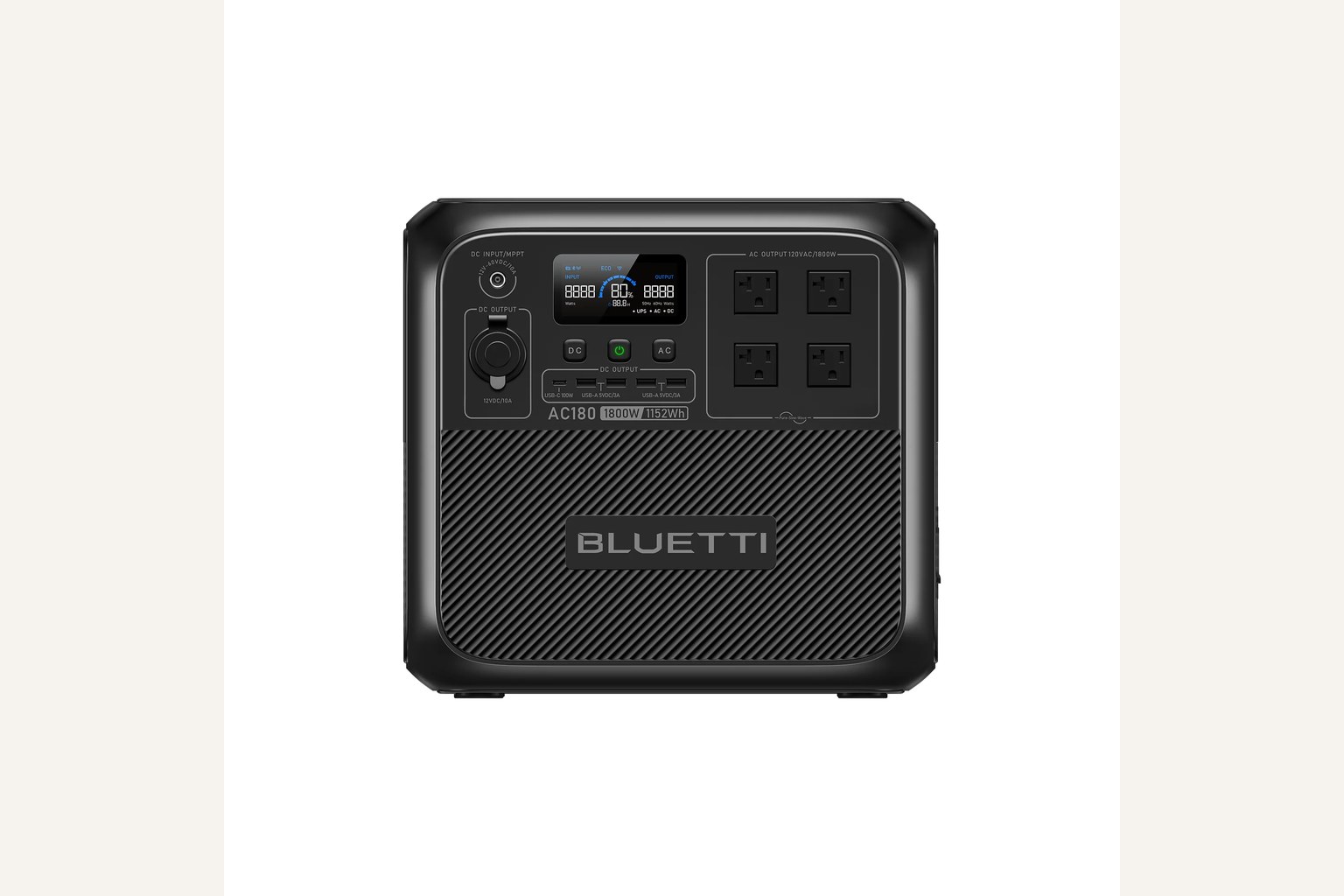
The unresolved nit is ports. BLUETTI’s official comparison specs list four 120V AC outlets totaling 1800W, while the Amazon title we saw mentioned two AC outlets. Before turning outlet count into your shopping checklist, verify the current product photos/manual for the ASIN you are buying.
What Gets Annoying
The first annoyance is obvious the moment you move it: 35.3 lb is not ridiculous for this much battery, but it changes the product. Anker is much easier to carry, Jackery is lighter and simpler, and even DJI feels more indoor-friendly. BLUETTI is happiest when it has a home base: garage shelf, closet floor, car camping bin, trailer, workbench, or a corner near the appliance it will back up.
The second annoyance is fan behavior. A BLUETTI community owner described the exact kind of surprise that makes backup gear stressful: “Battery is fully charged reading 100% constantly on display” but with “a small load of around 30Watts constant in bypass mode the fan on the AC180 comes on and off.” They even wrote that they would return two units “if this is how they function.” That is one owner thread, not a universal verdict, but it is enough to make bedroom, office, studio, and CPAP-adjacent buyers pause.
This caveat should be calibrated correctly. The AC180 is still a strong heavier utility pick for garages, fridges, camping, tools, and daytime outage use. Fan cycling is less tragic in a garage than beside your pillow. But if your plan is always-on UPS duty in a quiet room, test that mode immediately.
There is also a niche interference caveat. HOBOTECH’s transcript warned, “do not buy the AC 180 if you plan to rock out in your band or use it for a PA system or ham radio.” Most buyers will not care. Musicians, radio users, and audio people should care a lot.
How It Compares
The AC180 ranks below Anker because Anker is the easier default: lighter, still very powerful, strong charging, and fewer quiet-room caveats. If you want the least fussy first pick for a fridge/router/camping box, Anker SOLIX C1000 Gen 2 is where I would start.
DJI Power 1000 V2 is the better quiet high-output pick. Its 2600W AC claim and quietness are the reason it finished second, but its solar/car/DC setup leans on DJI SDC accessories and the Amazon buy box we saw carried seller/return caveats. Choose DJI if quiet indoor AC use matters more than accessory simplicity.
EcoFlow DELTA 3 Plus is the better expansion and solar-system lane. It is the one to price if you know you want extra batteries later. It ranked below DJI and Anker because fan, heat, and label/readability complaints were more concerning in reviews and owner reports.
Jackery Explorer 1000 v2 is easier to understand and easier to carry, but it gives up output and expansion. Goal Zero Yeti 700 is smaller and rugged, not a full 1kWh rival. BLUETTI sits in the middle as the big-capacity utility answer: more battery than the cleaner picks, less charm when you have to carry it.
For the full score grid, alternatives, and category-wide buying caveats, go back to Best Portable Power Stations in 2026.
Who Should Buy It
Best for: buyers who want more stored energy and strong 1800W output for garage backup, fridge/freezer support, camping, off-grid chores, tools, and a mostly stationary outage box.
Skip if: you need a lightweight station, quiet bedroom or office UPS behavior, Wi-Fi monitoring, expansion batteries, a premium-feeling app, or the cleanest solar-first setup.
Before checkout: use the product links to verify the exact BLUETTI AC180 listing, ASIN B0C1SMJTDT, current price, seller, condition, return path, bundle contents, and outlet count. At writing, the listing was a standalone new/In Stock AC180 at $448.99, but current retailer details matter more than our timestamp.
When it arrives: run the actual load you bought it for. Charge it from the wall, try silent/standard/turbo charging modes if available in the app, listen for fan cycling in the room where it will live, test UPS/pass-through behavior with non-critical gear first, and make sure the display/runtime estimate makes sense.
Bottom line: BLUETTI AC180 is a good heavier utility pick if you want capacity and output more than refinement. It is not the portable power station I would put beside a bed, but I would understand choosing it for a garage, fridge, campsite, trailer, or workbench.
Tell us what this page missed
These pages get better when real buyer complaints make it back into the scoring model. If something important is underweighted, say it.
Rate this review
Give it a score from 1-10 and tell us what to improve.
0/4000 characters