Aurzen ZIP Tri-Fold Review (2026): A Pocket Projector That Needs Real Darkness
A deeper look at Aurzen’s folding pico projector, including its 100 ANSI-lumen limit, native 720p image, short battery, screen-mirroring setup, dongle caveats, and where its tiny design actually makes sense.
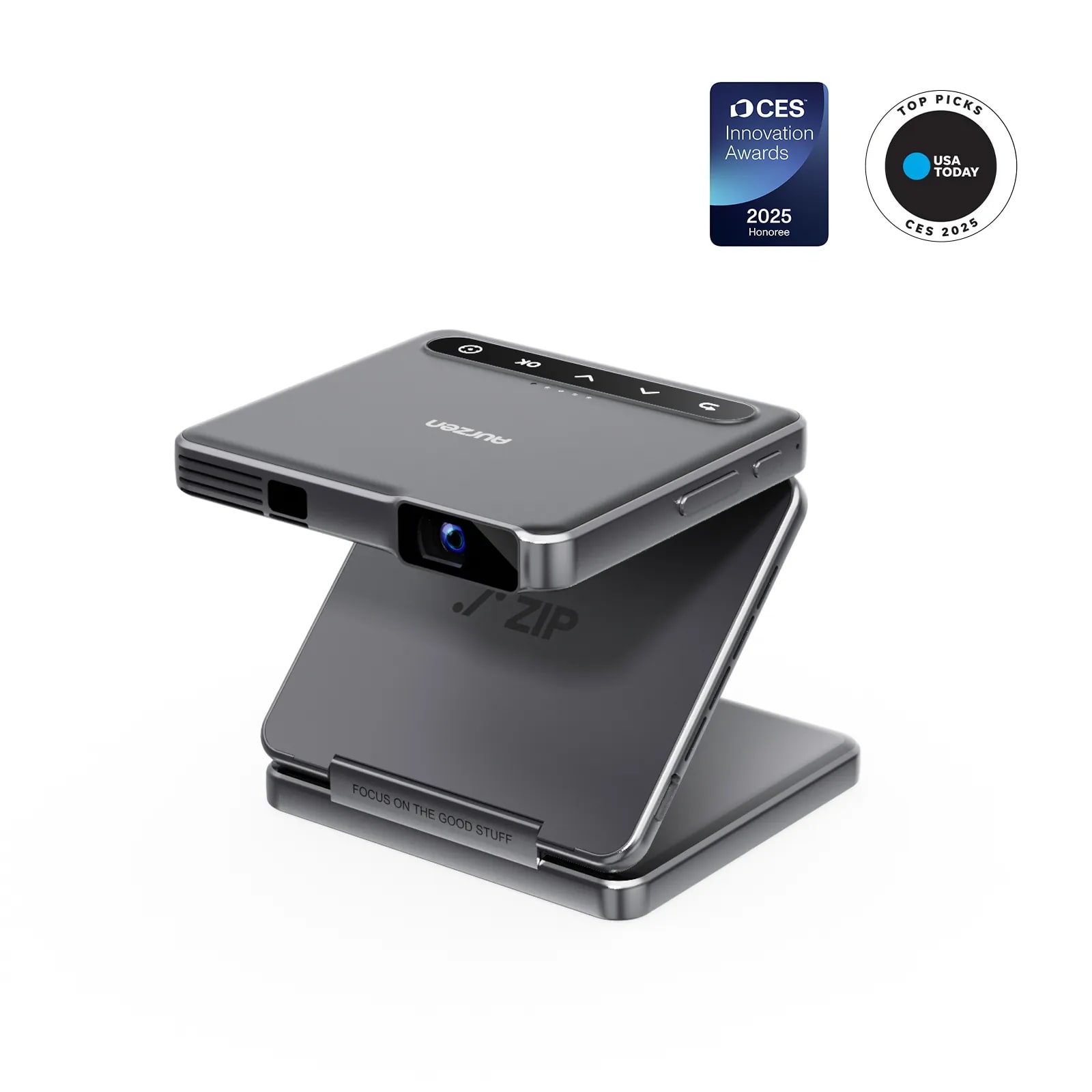
The Aurzen ZIP Tri-Fold is the pocket specialist in our portable-projector set. It is clever, genuinely tiny, and easier to aim than most pico projectors, but it belongs in dark rooms, hotel rooms, kids’ spaces, craft setups, and novelty phone-mirroring moments—not in the same expectations box as larger 1080p or 4K portable projectors.
MSRP
$399.99
Amazon
$289.99
at writing · 2026-05-15
Buyer fit
The tiny specialist: true pocket carry, folding stand, USB-C power-bank friendliness, and autofocus, but only 720p, 100 ANSI lumens, and short battery life.
MSRP
$399.99
Amazon
$289.99
at writing · 2026-05-15
Score breakdown
How this product scored
Same rubric, but focused on one product so the reasons behind the score stay readable.
Image quality and real brightness
Aurzen ZIP Tri-Fold Portable Pocket Projector scores 4/10 for image quality and usable brightness after weighing its resolution, light output, and the room conditions where it actually makes sense.
Setup, focus, and placement
Aurzen ZIP Tri-Fold Portable Pocket Projector scores 8/10 for setup, focus, and placement because its aiming tools, stand/cradle design, and autofocus behavior are central to how easy it feels after moving it.
Portability, power, and runtime
Aurzen ZIP Tri-Fold Portable Pocket Projector scores 7/10 for portability, power, and runtime after balancing carry size against battery, plug-in, USB-C, or power-bank realities.
Streaming and app behavior
Aurzen ZIP Tri-Fold Portable Pocket Projector scores 4/10 for streaming and app behavior based on built-in apps, casting, Netflix/DRM certainty, remote behavior, and how much extra gear buyers may need.
Fan noise, audio, and heat
Aurzen ZIP Tri-Fold Portable Pocket Projector scores 5/10 for fan noise, audio, and heat after weighing speaker usefulness, external-audio needs, and small-projector limits.
Inputs and compatibility
Aurzen ZIP Tri-Fold Portable Pocket Projector scores 5/10 for inputs and compatibility after checking HDMI/USB-C behavior, casting, laptop/console fit, and accessory needs.
Reliability and support
Aurzen ZIP Tri-Fold Portable Pocket Projector scores 5/10 for reliability and support based on listing identity, seller/condition checks, warranty posture, and how much long-term owner detail is available.
Use-case fit
Aurzen ZIP Tri-Fold Portable Pocket Projector scores 7/10 for use-case fit because it is easy to recommend for some rooms and buyer habits, but a mismatch for others.
Source confidence
Aurzen ZIP Tri-Fold Portable Pocket Projector scores 6/10 for source confidence based on how well current listings, specs, formal reviews, transcripts, and owner/reviewer notes line up.
Before You Buy
The Aurzen ZIP Tri-Fold is easy to want for emotional reasons before you think through the room. It folds, stands on its own, points at the ceiling, and makes the idea of a pocket movie screen feel real. The reason to keep reading is the part a checkout page cannot solve for you: 100 ANSI lumens still needs real darkness, native 720p has limits, and the projector does not behave like a normal smart TV with apps built in.
Use this review as a regret check before buying. If you want the full category map, start with our best portable projectors ranking; this page is the deeper Aurzen ZIP read. Product links can help you recheck the exact gray B0GMPS1PQK listing, current price, seller, condition, color variant, and availability, and they also help support KB4UB.
Quick Verdict
The ZIP Tri-Fold is the best pocket projector in this set because it is the only one that makes pocket carry feel like the whole point. The captured gray Amazon listing matched ASIN B0GMPS1PQK with a 100 ANSI-lumen DLP engine, native 720p resolution, Bluetooth 5.4, screen mirroring, ToF autofocus, USB-C power, and a 1.5-hour playtime claim. That mix earns it a place in the guide, but not a high-performance projector score.
One hands-on transcript summed up the charm with the line, “it folds. It's tiny. It fits in your pocket.” That is the correct frame. In a dark hotel room, bedroom, kid setup, craft area, sewing table, or quick ceiling-projection moment, it can feel genuinely useful. In a living room with lamps on, a backyard before full darkness, or a setup where Netflix needs to work without thought, it will feel like the small projector it is. Treat it as a clever pocket tool, not a secret replacement for Mars 3 Air, Halo+, MoGo 4 Laser, or any larger 1080p portable.
Score Breakdown
- Image quality and real brightness: 4/10. Native 720p and 100 ANSI lumens are acceptable for something this tiny, but they keep the ZIP in dark-room-only territory. The score rewards the novelty without pretending it can compete with 1080p and 4K picks.
- Setup, focus, and placement: 8/10. The tri-fold stand, ToF autofocus, and auto keystone are the best reasons to buy it. The physical aiming range solves problems most pico projectors create.
- Portability, power, and runtime: 7/10. It is genuinely pocketable and USB-C powered, but the internal battery is short enough that long movies need a plan.
- Streaming and app behavior: 4/10. There is no confirmed full smart-TV platform. Screen mirroring is simple, but DRM, app behavior, and dongle needs matter.
- Fan noise, audio, and heat: 5/10. The tiny built-in speakers can work for personal viewing, and Bluetooth helps, but this is not group audio.
- Inputs and compatibility: 5/10. Mirroring is central. HDMI use depends on the optional wireless dongle or adapters rather than a built-in HDMI port.
- Reliability and support: 5/10. Current Amazon-new signals looked clean, but long-term owner/forum detail was thin and many hands-on sources were sponsored or early coverage.
- Use-case fit: 7/10. It fits its narrow pocket-projector job well. It fits normal portable-movie-night expectations poorly.
What Feels Great After Setup
The physical design is the whole reason it works. Most tiny projectors still ask you to stack books, hunt for a mini tripod, or accept a crooked image. The ZIP’s Z-shaped body gives you the stand and tilt range in the object itself, which is why it makes more sense as a pocket utility than as a miniature version of a living-room projector. One TechDaily transcript described the stand as having “a full 180° of adjustment potential,” and that is the kind of feature you feel immediately when you aim it from a nightstand or low table.
The auto setup helps, too. Hands-on transcripts repeatedly mention autofocus and auto keystone, with one saying it will “auto adjust the picture” after small tilts and another noting, “it's that easy to operate and you are ready to go.” Those are small-projector wins. When you move the ZIP from wall to ceiling or rotate it for vertical video, less fiddling is exactly what keeps the toy-like idea from becoming annoying.
The other win is use-case flexibility. It can mirror a phone, project cartoons on a ceiling, throw a rough work slide on a wall, trace art or sewing patterns, or turn a hotel wall into a casual screen. For personal viewing, one transcript said the dual 1-watt speakers were “surprisingly capable for their size,” and Bluetooth gives you an escape hatch if the built-in audio is not enough. None of that makes it powerful; it makes it easy to play with.
What Gets Annoying
Brightness is the first hard limit. The ZIP sits in a 100 ANSI-lumen class, and TechDaily’s transcript adds the important owner translation: “you'll want a completely dark room to get the most out of it.” That is not a minor footnote. It is the difference between a fun bedroom ceiling projector and a disappointing backyard projector.
Battery is the second limit. Specs and multiple transcripts point to a 5,000 mAh battery and roughly 1 to 1.5 hours of use. One transcript says it is “good for between an hour and an hour and a half of continuous use,” while another warns that for full-length movies “you might have to plug this into like a power bank.” USB-C power is helpful, but it also means the clean pocket fantasy may turn into a cable-and-bank setup for longer viewing.
Streaming is the third limit. TechDaily put it plainly: the ZIP “doesn't actually have an operating system so to speak or any built-in streaming apps.” Screen mirroring can be fast and convenient, especially from a phone you already use, but Netflix, Disney, protected video, laptops, game consoles, and travel Wi-Fi can all change the experience. The optional wireless HDMI dongle can help, and one transcript says it can “bypass casting protocols for Netflix and Disney,” but that also means checking accessories, compatibility, and current bundle contents before buying.
How It Compares
Compared with Anker Nebula Mars 3 Air, the Aurzen ZIP is far smaller and easier to slip into a bag, but Mars 3 Air is the much better all-around movie-night projector. Mars 3 Air brings native 1080p, 400 ANSI-lumen-class brightness, Google TV/Netflix, stronger audio evidence, and a clearer family-room or patio-after-dark role.
XGIMI Halo+ is also a better pick if you want a proven 1080p battery projector. XGIMI MoGo 4 Laser is the more serious travel setup choice because its stand and 1080p laser picture make awkward placement easier without dropping to 720p/100-lumen expectations. Nebula X1 is not really a pocket competitor at all; it is a bright, expensive, AC-powered backyard machine. LG CineBeam Q is the stylish compact 4K option for shelf use, and Samsung Freestyle 2nd Gen is the darker-room smart-TV lifestyle pick. Capsule 3 is the closest “small” alternative, but it is still more of a self-contained can-style projector than a literal pocket gadget.
That leaves the ZIP with a narrow, honest job: choose it when tiny size and playful placement matter more than image quality, built-in apps, or battery length. If any of those bigger-projector traits are secretly your priority, move up the list.
Who Should Buy It
Buy the Aurzen ZIP Tri-Fold if you want a genuinely pocketable projector for dark bedrooms, hotel rooms, dorms, kids’ rooms, ceiling cartoons, travel novelty, art tracing, sewing/craft patterns, quick phone mirroring, or casual personal viewing where the fun is partly that the projector is so small.
Skip it if you need a main movie-night projector, ambient-light performance, backyard brightness, native 1080p or 4K sharpness, built-in streaming apps, reliable Netflix without extra checks, strong speakers, a built-in HDMI port, or a battery that confidently covers long movies on its own. Also skip it if the listing color or bundle changes and you have not verified the exact ASIN, seller, condition, price, and included accessories.
Bottom line: the ZIP Tri-Fold is a clever pocket projector with real limits. Recheck the current B0GMPS1PQK listing before checkout, then compare it against the full portable projector ranking if the 100-lumen brightness, no-apps setup, or short battery sounds like it would bother you.
Tell us what this page missed
These pages get better when real buyer complaints make it back into the scoring model. If something important is underweighted, say it.
Rate this review
Give it a score from 1-10 and tell us what to improve.
0/4000 characters