
The recommendation
Choose Aranet4 Home when CO₂ is the reading you want to carry and consult. Its high usability grade applies to that focused job.
Grades at a glance
| Product | Overall | Readout and useful interpretation | Setup and placement | Daily access and control |
|---|---|---|---|---|
| Aranet4 Home | 9.5 | 9.5 | 9.5 | 9.5 |
Does it fit your life?
A focused monitor with a clear job
Aranet4 Home is the most persuasive choice in this group when your main goal is portable, standalone CO₂ access. Its appeal comes from being easy to keep nearby and consult, rather than from offering the widest collection of pollutant readings. Two sustained-use accounts describe it as part of ordinary life: one family reports almost daily use over three years, while another reviewer describes four years of office and travel use across several units. Those are useful experiences about fit and convenience, with the duration and circumstances specific to each account.
Its usability grade is 9.5/10 overall, with 9.5 in each of our three categories: readout and useful interpretation, setup and placement, and daily access and control. The consistency reflects a focused task that the reports describe clearly. It does not establish superior measurement accuracy, a comprehensive account of room conditions or an ability to answer questions about particles and VOCs. Buy it because CO₂ is the reading you intend to use, and because carrying and checking the device fits your routine.
Start with the CO₂ question
A focused monitor is easiest to choose when you can describe the question without using the phrase air quality as a catch-all. You may want to follow the displayed CO₂ trend in an office at comparable times, or compare the information you see as you move between ordinary indoor settings. In that situation, a unit that is readily available can be more useful than a broader dashboard you rarely visit. The benefit is practical access to the relevant number.
CO₂ is not a complete inventory of what is in the air. Do not choose the Aranet because its high usability grade sounds like a promise to cover every reading listed by a larger monitor. Airthings View Plus and Qingping Gen 2 have different monitoring briefs. If particles, VOC trends or a specific additional reading are central to your decision, choose a product that explicitly includes that requirement and then judge whether its access method suits you.
An effective routine begins with observing the same displayed reading in context. Note where you are, roughly when you checked and what ordinary room use was taking place. That helps you distinguish your own comparisons from casual impressions. A number by itself does not identify every cause of a change, and this review does not supply clinical or exposure guidance. The buying question is whether the Aranet makes your chosen monitoring task manageable.
What the longer-use accounts actually say
In one video, a family says it has used its Aranet CO₂ monitor almost daily for three years. The presenter emphasizes light weight, portability, the ability to operate silently and use without a phone or Wi-Fi. They also report replacing the batteries once during that period. The useful evidence is the described habit: the monitor stayed easy enough to carry and check that the family continued to use it. The battery anecdote belongs to that particular unit and routine.
BreatheSafeAir's reviewer describes four years of consistent Aranet4 Home use and ownership of four monitors. One stayed in the office, while others accompanied travel through airports, commutes, shopping centers and several countries. That is another concrete account of the product's portable role. The four monitors all belong to one reviewer. Their travel account is useful for judging convenience, while leaving performance in other conditions untested.
A separate unboxing video discloses a unit supplied free for review and introduces its battery operation and e-ink display. The presenter plans to use it for a couple of weeks, but an intention at the start of a video is not evidence of completed use. That passage establishes the introduction and setup context. The stronger case for everyday convenience comes from the two explicit sustained-use accounts.
Standalone access reduces one kind of friction
The family account explicitly says the monitor can be used without connecting to Wi-Fi and without relying on the companion app. That is a major practical distinction if you want a reading available when your phone is elsewhere, your hands are occupied or you simply do not want another app session. The monitor's own display is the centerpiece of that routine. The same account says the app is available, but it is not required for the described standalone use.
This independence may be particularly attractive for shared spaces. A room display that can be read directly does not require the next person to find the right account or ask which phone configured it. That convenience follows directly from having the current reading on the device. If your actual need includes a particular history view, export format or remote arrangement, verify that workflow separately instead of assuming the straightforward screen covers it.
For a buyer who likes app dashboards, less phone dependence is still an option rather than a requirement to avoid the app. Think about the minimum task you want the hardware to complete on its own. If that is seeing the CO₂ reading at the moment you pick it up, the described routine fits well. If your minimum task is an unattended remote report, the evidence considered here does not establish that use.
Portability matters only if it serves your routine
The sustained-use reports make a good case for carrying the Aranet, but portability should solve a concrete problem. If the monitor will remain permanently on a desk, you may value easy access more than travel. If you plan to bring it between rooms, consider where it will sit while you are actually observing a reading. A device that disappears into a bag or is awkwardly placed is less convenient than its small size alone suggests.
Plan a consistent habit: bring it out, put it in a suitable location following its instructions and note the setting before comparing readings. Do not interpret the act of carrying it into a new room as an instant, complete assessment of that room. The value of a portable instrument still depends on understanding the displayed information and the conditions under which you looked at it. A short note about location makes later comparisons more useful.
The same logic applies at home. A monitor can be movable without needing to move constantly. If your central question concerns one work area, leaving it where you will see it may create a better habit than circulating it through the house. The BreatheSafeAir account, with one monitor kept in an office and others used for travel, illustrates distinct roles rather than a rule that every owner needs multiple units.
Quiet use and battery planning
The family video describes setting the Aranet to operate completely silently. That is useful evidence for someone who wants to consult a display discreetly or avoid audible interruptions. It is not a reason to assume that every operating mode is silent by default. During setup, learn the unit's available settings and select the behavior you actually want. A monitoring habit is easier to sustain when its interaction style fits the room.
Battery convenience is also supported by that family's account, but the reported single replacement over three years is not a universal runtime specification. Different settings and routines may change the ownership experience. The sensible buying implication is narrower: the presenter did not have to keep the monitor plugged in or charge it as part of their described daily use. That distinguishes the routine from a screen that normally lives beside a power cable.
Keep a practical power plan even for a device described as low-maintenance. Know how to recognize the unit's power status and follow its battery instructions. If it becomes part of your regular travel kit, include a check before you leave. Use the battery guidance for your unit rather than scheduling replacements from another household’s experience. The convenience is avoiding a constant cable in the reported use, rather than a promise that battery care disappears.
Reading the display without overreading the grade
The high readout grade reflects accessible CO₂ information in the sustained-use accounts. It does not mean the Aranet displays more kinds of information than its competitors. A narrower instrument can be easier to understand precisely because the buyer has chosen one principal monitoring role. That is useful design fit, but it becomes a limitation if the household expects the same object to answer unrelated particle or VOC questions.
When several people will consult the display, agree on what the number represents and what question you are following. A shared interpretation is more useful than a shared assumption that one favorable reading describes every aspect of the room. If one person wants CO₂ trends and another wants to watch particle changes, it may be better to acknowledge those as separate requirements before purchasing a monitor.
For comparisons over time, keep track of the setting as carefully as the reading. A morning at a quiet desk and an afternoon in a busy room are different observations. This is not a criticism of the device; it is the context that gives a portable monitor's information meaning. The reports make a convincing case that checking the Aranet can be easy, while the interpretation remains a task for the person using it.
Care and model checks
Buy the exact Aranet4 Home model described by the listing and keep its instructions available. Check the Home model name rather than relying on a listing that describes another Aranet device. The supplied-for-review unboxing is explicit about the Home model's battery-powered CO₂ role, while the longer-use accounts add the practical context. Those sources support this review without needing to turn retailer superlatives into product guarantees.
For routine care, follow the manufacturer's placement, cleaning and battery guidance. Keep the display accessible and avoid treating a convenient portable object as something that can be placed arbitrarily during a comparison. Neither a useful travel story nor a long ownership period establishes a cleaning regimen, calibration result or expected service life. The longer-use reports are valuable precisely as individual experiences, rather than as a substitute for instructions for your own unit.
If maintaining a larger data record is essential, confirm the app and data workflow before ordering. The standalone experience is the strongest part of the evidence, and that should remain the core purchase argument. Do not let enthusiasm for the hardware lead you to assume a particular spreadsheet export, unattended integration or other workflow that this review has not established.
Which alternative would change the decision?
Qingping Gen 2 is the more relevant comparison when you want several room readings and an interactive screen with on-device history. Its reported few-hour battery makes it a different portability proposition. Airthings View Plus is worth examining when its documented reading mix matters more than avoiding a phone. Its account and app setup may be entirely acceptable if the monitor will support a deliberate home monitoring routine.
IQAir AirVisual Pro appeals to someone who wants a more prominent multi-reading room dashboard. Amazon's monitor fits an Alexa-centered approach, but its own documentation explicitly says it does not measure CO₂. That difference rules it out as a substitute when CO₂ is the reason you are shopping. Choosing a product begins with the reading and access method; comparing grades comes after that match.
Buying verdict
Choose Aranet4 Home if a CO₂-focused, readily accessible monitor is what you will actually use. The two sustained-use accounts give unusually concrete reasons to value its standalone and portable routine, and the family report adds useful detail about silent operation and infrequent battery attention in that household. These are persuasive usability experiences, with the usual limits of individual reports.
Choose something broader if you need a wider reading set, or a different design if your main goal is a large room dashboard or a specific connected data workflow. Aranet's strongest quality is clarity of purpose. Its excellent usability grade makes sense when that purpose matches your own, and it should not distract from checking that match before purchase.
Aranet4 Home
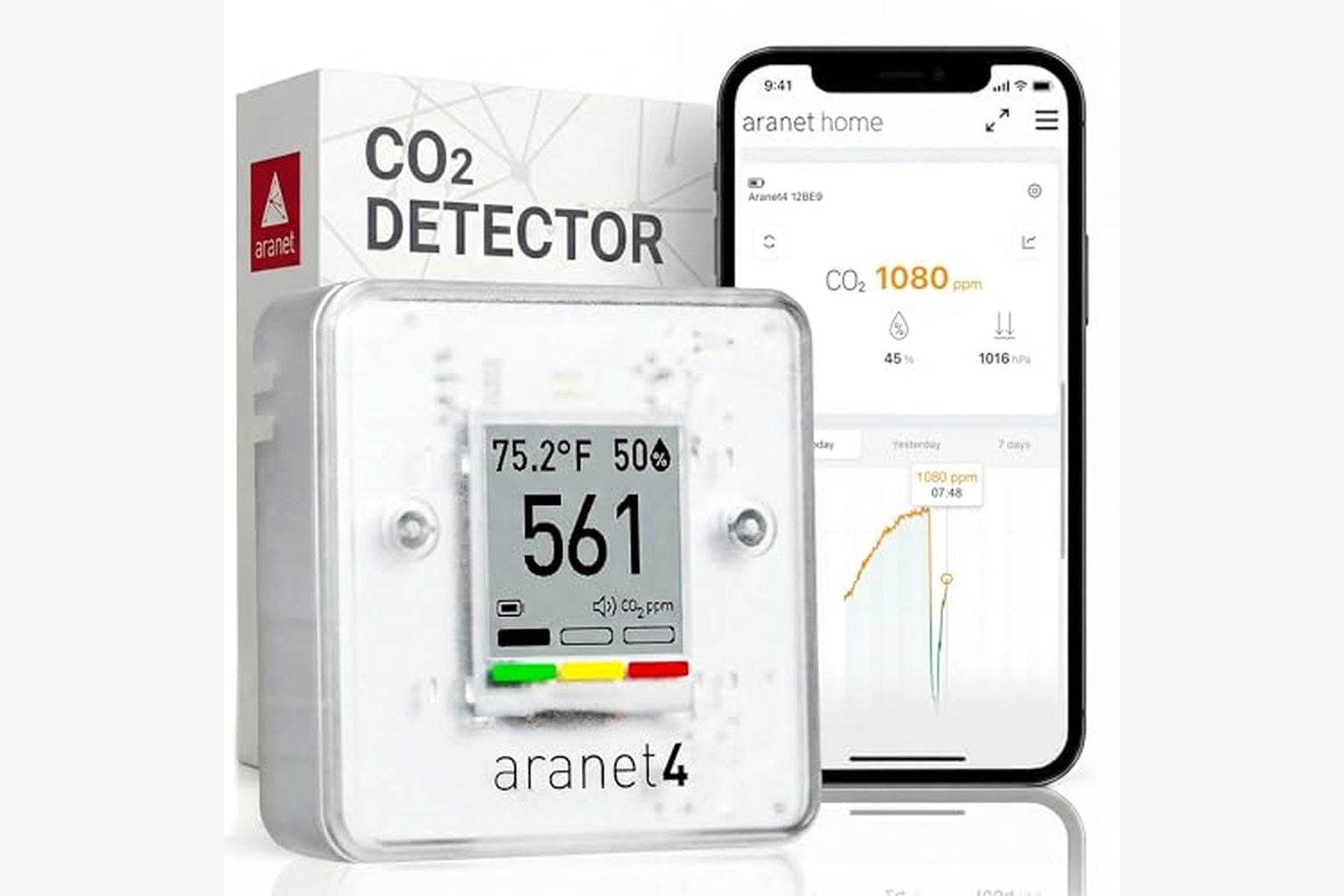
Aranet4
Portable, standalone access to CO₂ information, with little need to open a phone for a current reading.
Aranet4 Home has a focused role and concrete longer-use accounts. One family reports almost daily use over three years, emphasizing portable, silent and standalone operation. A separate reviewer describes four years across office and travel use with several units. These support an accessible CO₂ routine, rather than broader pollutant coverage or precision claims. One family’s battery replacement experience is individual context, and a gifted unboxing remains separate from the sustained-use accounts.
Reasons to choose it
- Sustained-use accounts describe convenient portability.
- One family explicitly uses it without phone or Wi-Fi.
- Silent operation is described in the family account.
Tradeoffs to know
- CO₂-focused recommendation does not meet a particle or VOC brief.
- Battery anecdotes cannot establish your replacement interval.
- Specific export or remote workflows need their own verification.
Think twice if: You need particle or VOC monitoring, a broad room dashboard or an unverified remote data workflow.
Published specifications
- Access described
- Device display without phone or Wi-Fi in a sustained-use account
- Principal monitoring role
- Portable standalone CO₂ access
Ratings
Editorial score 9.5
Readout and useful interpretation9.5
Two sustained-use accounts describe easy access to CO₂ information in office and portable use.
Setup and placement9.5
Battery-powered, portable operation and standalone use support flexible placement in the described role.
Daily access and control9.5
A family describes silent operation and current readings without a phone or Wi-Fi.
Sources & further reading
youtube.com review
airthings.com product information
pcmag.com review
breathesafeair.com review
airpurifierfirst.com review
youtube.com review
youtube.com review
breathesafeair.com review
youtube.com review
youtube.com review
youtube.com review
amazon.com product information
youtube.com review
youtube.com review
youtube.com review
Keep reading
Something changed? Help us keep this useful.
Send a correction →