Anker Nebula X1 Review (2026): Backyard Power, AC-Power Catch
Why the Nebula X1 is the premium backyard pick in our portable-projector ranking, where its automation feels special, and why AC power, weight, updates, and rainbow artifacts still matter.
The Anker Nebula X1 is a premium 4K-class triple-laser projector for buyers who want backyard-scale brightness and serious auto setup. It can be excellent for moveable home theater use, but it is expensive, heavy, AC-powered, and not the right cordless camping pick.
MSRP
$2,999
Amazon
$2,499
at writing · 2026-05-15
Buyer fit
The bright transportable option: 4K-class triple laser, 3500 ANSI lumens, serious auto alignment, Google TV/Netflix, and backyard-scale ambition at a very high price.
MSRP
$2,999
Amazon
$2,499
at writing · 2026-05-15
Score breakdown
How this product scored
Same rubric, but focused on one product so the reasons behind the score stay readable.
Image quality and real brightness
Anker Nebula X1 scores 9/10 for image quality and real brightness based on source material, product-specific review evidence, and current listing caveats.
Setup, focus, and placement
Anker Nebula X1 scores 9/10 for setup, focus, and placement based on source material, product-specific review evidence, and current listing caveats.
Portability, power, and runtime
Anker Nebula X1 scores 5/10 for portability, power, and runtime based on source material, product-specific review evidence, and current listing caveats.
Streaming and app behavior
Anker Nebula X1 scores 8/10 for streaming and app friction based on source material, product-specific review evidence, and current listing caveats.
Fan noise, audio, and heat
Anker Nebula X1 scores 8/10 for fan noise, audio, and heat based on source material, product-specific review evidence, and current listing caveats.
Inputs and compatibility
Anker Nebula X1 scores 8/10 for inputs and compatibility based on source material, product-specific review evidence, and current listing caveats.
Reliability and support
Anker Nebula X1 scores 7/10 for reliability and support based on source material, product-specific review evidence, and current listing caveats.
Use-case fit
Anker Nebula X1 scores 8/10 for use-case fit based on source material, product-specific review evidence, and current listing caveats.
Source confidence
Anker Nebula X1 scores 8/10 for evidence confidence based on source material, product-specific review evidence, and current listing caveats.
Before You Buy
The Anker Nebula X1 is Anker/Nebula’s premium transportable projector, and it is the one to study before you spend premium-TV money on a “portable” movie-night upgrade. The magic is real: huge brightness, a 4K-class triple-laser image, Google TV, serious automatic alignment, and audio that does not feel like an afterthought. The catch is just as real: this is a moveable home-theater box, not a cordless camping projector.
Read this review if you are trying to avoid the expensive kind of regret — buying a brilliant projector for the wrong kind of portability. We’ll dig into the setup automation, backyard brightness, AC-power reality, firmware-update notes, accessory costs, and the DLP rainbow-artifact warning that matters for some viewers. If you want the full category map first, start with our best portable projectors ranking; this page is the deeper Nebula X1 read. Product links can help you recheck current price, seller, exact ASIN, and availability, and they also help support KB4UB.
Quick Verdict
The Nebula X1 is the best pick here when brightness matters more than battery use. It ranked fourth in the portable-projector guide not because it is weaker hardware than the smaller picks, but because its version of portable is different: 13.7 pounds, a retractable handle, AC power, and a premium price. If your plan is a large backyard screen after sunset, a big indoor movie wall, or room-to-room home theater without ceiling mounting, that tradeoff can make sense.
The reason it stays compelling is that the X1 solves the repeated setup problems that make lesser projectors feel fiddly. PCMag’s bottom line called it a “groundbreaking room-to-room portable projector,” and that phrase captures the lane well. It has the light output and setup tools to feel special after you move it. But it is not the casual default. Mars 3 Air, Halo+, and MoGo 4 Laser make more sense for battery portability and lower budgets. X1 is the aspirational choice for buyers who know they want a brighter, more automated projector and have power available where they plan to watch.
Score Breakdown
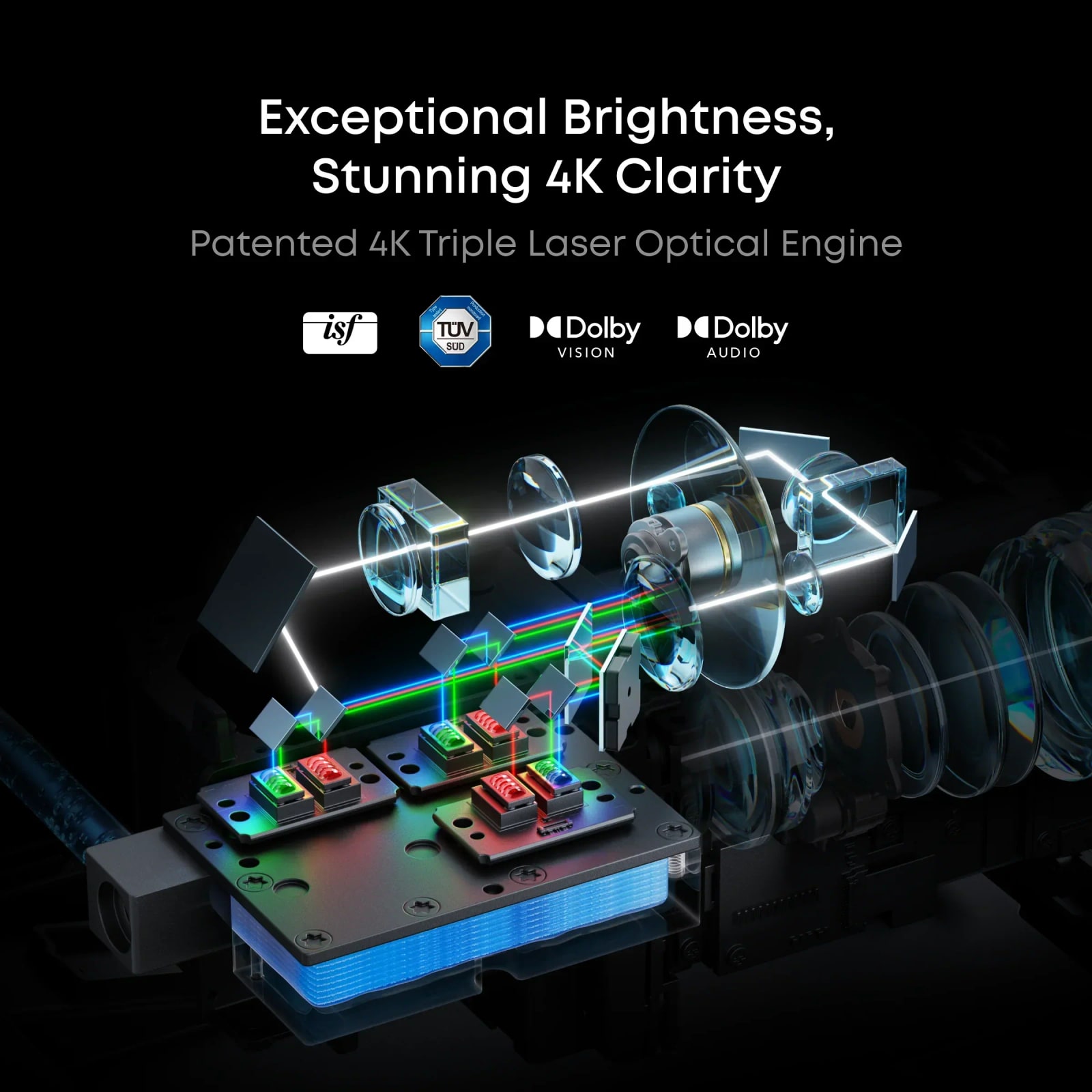
- Image quality and real brightness: 9/10. The 3500 ANSI-lumen claim, triple-laser light engine, Dolby Vision support, and 4K-class DLP/XPR image put it in a different brightness class from the battery minis. The score still leaves room for lab-by-lab variation and DLP rainbow sensitivity.
- Setup, focus, and placement: 9/10. The gimbal, optical zoom, autofocus, keystone, screen fit, obstacle avoidance, and spatial recall stack are the X1’s strongest everyday advantage. PCMag said, “The default automatic setup is impressive to watch.”
- Portability, power, and runtime: 5/10. It has a handle and can move around the house, but it has no captured internal projector battery and needs AC power. With the adapter and cable, PCMag put the carried weight near 16 pounds.
- Streaming and app behavior: 8/10. Google TV and captured Netflix support are strong, but the Amazon listing itself tells buyers to update firmware and Android software immediately.
- Fan noise, audio, and heat: 8/10. The liquid-cooling claim and built-in 15W x2 plus 5W x2 speaker setup are promising. One YouTube transcript said it “plays loud and clear with a lot of presence.”
- Inputs and compatibility: 8/10. HDMI 2.1/eARC, USB-A, USB-C, optical audio, Wi-Fi, and Bluetooth cover more serious setups than most small portables.
- Reliability and support: 7/10. The Amazon snapshot was clean — new, in stock, sold by AnkerDirect, shipped by Amazon — but long-term owner evidence was thinner than formal review and transcript coverage.
- Use-case fit: 8/10. It is excellent for premium backyard and big-room use, mediocre for battery camping.
- Evidence confidence: 8/10. The exact product identity is strong across official, Amazon, PCMag, ProjectorCentral, and transcript sources, with the main gap being long-term owner reporting.
What Feels Great After Setup
The X1’s best trick is that it makes a large projected image feel less like a home-theater project. Smaller portable projectors often make you solve the same little problems every time: aim the box, square the image, focus it, move it again, add a speaker, then explain why the picture looks dim. The X1 does not erase all of that, but it shifts the work in your favor.
The motorized gimbal matters because you can aim the image without propping up the whole projector at an awkward angle. PCMag described how the X1 projects a grid, moves the lens, adjusts keystone and zoom, accounts for obstacles, and focuses. That is the kind of convenience that keeps feeling useful after the novelty fades, especially if the projector moves between a living room, bedroom wall, patio screen, and garage setup.
Brightness is the other reason the X1 feels special. The official/Amazon copy says “3,500 ANSI lumens deliver a bright, clear image even in ambient lighting,” and while no projector turns a sunny yard into a TV, this is the only pick in this set built for a serious large-screen backyard lane. Add Google TV, Dolby Vision support, a 14-element glass lens, and built-in audio that one transcript said has “a lot of presence,” and the X1 starts to feel less like a gadget and more like a self-contained event machine.
What Gets Annoying
The first annoyance is the word portable. X1 is portable the way a premium speaker or small home-theater receiver is portable: you can move it, but you will notice. PCMag called it “luggable rather than portable,” especially once the AC adapter, cable, and remote are counted. If you are imagining a projector that runs from an internal battery at a campsite, this is not that product.
The second annoyance is first-night housekeeping. The Amazon listing says, “Please update the firmware immediately upon unboxing,” then separately says to “update to the latest Android 14 system software immediately upon unboxing.” That does not make the X1 a bad projector; it does mean the first setup may include updates before the picture and streaming behavior are at their best. Anker’s support text also says smart features work best within a projection distance of 13 ft (4 m), so very large or unusual placements may reduce some automatic environment detection.
The third caveat is image sensitivity. PCMag listed “frequent rainbow artifacts in our tests” as a con. Many viewers barely notice DLP rainbow flashes, but if you already know you are sensitive to them, take that warning seriously. Finally, price creeps fast: the standalone Amazon snapshot was $2,499, while the accessory pack and gimbal stand were separate add-ons in the captured source material.
How It Compares
Nebula X1 is not trying to beat Mars 3 Air at being the easiest casual portable, and that keeps the comparison honest. Mars 3 Air wins the parent ranking because it combines 1080p, battery use, Google TV/Netflix, a handle, and good-enough speakers without jumping to premium-home-theater pricing. XGIMI Halo+ is the proven 1080p runner-up, and MoGo 4 Laser has the smarter compact travel shape with its 360-degree stand. Those are better choices if you want lower cost, easier carry, and battery flexibility.
X1 pulls ahead when the screen gets bigger and brightness becomes the real problem. LG CineBeam Q is also compact and 4K-class, but it is a stylish dark-room shelf projector, not the brute-force backyard option. Capsule 3 is smaller and easier to tuck away, but its 200 ANSI-lumen class is much dimmer. Samsung Freestyle 2nd Gen has a TV-like interface but is best treated as a dark-room lifestyle projector. Aurzen ZIP is genuinely pocketable, but its whole appeal is tiny carry, not competing with a 3500 ANSI-lumen laser box.
So the X1 comparison is simple: buy it when the smaller projectors are not bright or automated enough for the screen you actually want. Do not buy it just because it appears in a portable-projector list.
Who Should Buy It
Buy the Anker Nebula X1 if you want a premium backyard or room-to-room projector with much more brightness than the battery minis, automatic setup that reduces repeated fiddling, Google TV, official Netflix support in the captured source material, and built-in audio that can plausibly handle casual movie nights without an immediate speaker purchase. It makes the most sense for patios, garages, bonus rooms, large dark indoor walls, and people who want the projector to feel impressive right away.
Skip it if you need cordless battery use, pocket or backpack carry, a budget-friendly first projector, verified competitive-gaming measurements, or a projector for bright daytime viewing. Also be cautious if rainbow artifacts bother you, because that was the clearest formal-review image caveat.
Bottom line: X1 is the premium specialist in our portable projector ranking. Recheck the exact B0DYV2CGTK listing, current seller, standalone-versus-bundle price, return window, and support terms before checkout. If those all line up and you have power where you watch, this is the projector in the set that can make a backyard screen feel genuinely exciting.
Tell us what this page missed
These pages get better when real buyer complaints make it back into the scoring model. If something important is underweighted, say it.
Rate this review
Give it a score from 1-10 and tell us what to improve.
0/4000 characters