
The recommendation
A three-second hold then release routine, with a deep drawer or counter box available.
Grades at a glance
| Product | Overall | Placement and handling | Controls | Routine care and storage |
|---|---|---|---|---|
| InstEcho Automatic Jar Opener for Seniors with Arthritis | 6.6 | 7.0 | 7.0 | 5.5 |
Does it fit your life?
Is this the right routine for your kitchen?
InstEcho is worth considering if you can make room for it in a deep drawer or a box on the counter. Its written procedure gives a defined start: hold the button for three seconds, then release it. A later press releases the jar body. The storage qualification is just as important as the button sequence: the editorial review explicitly warns that a small drawer may not be suitable. InstEcho editorial review InstEcho written procedure
Best match: A three-second hold then release routine, with a deep drawer or counter box available. Consider another option if: A shallow drawer is your only storage space, or plastic jars are the main use you have in mind.
InstEcho model-family illustration
Start with the surface and jar choice
Pros Cons Shopping begins with the jar on a flat surface and the opener placed on top. The same description says the device is not made or guaranteed for plastic jars. Keep that restriction attached to the placement advice; the presence of a general jar-opening description is no reason to assume that every container in the pantry is suitable. The useful purchase check is the kinds of jars you actually keep, followed by where you will set them down for the opener. InstEcho written procedure
Hold three seconds, then let go
The written sequence says to press and hold for three seconds, then release to let the jaws catch the lid and jar body. It does not tell you to keep holding until you see a grip. After rotation, it describes pressing again to release the body and checking that the lid is separate. That distinction is easy to lose in the phrase “one touch.” Choose this model if you are comfortable remembering the start and release as different moments. The editorial account also mentions noise and waiting, which make it worth planning a place where you are content to let the routine finish. InstEcho written procedure
A drawer recommendation with a qualification
The editorial review calls drawer storage easy but immediately says the drawer needs to be somewhat deep. It offers an open box on the counter if the drawers are small. Pros Cons Shopping also describes storing it in a kitchen drawer after the release and separation check. Taken together, these are reasons to plan a specific storage place rather than assume any utensil drawer will do. The publications give differing dimensions, so this review does not promise an exact fit from either set. InstEcho editorial review InstEcho written procedure
Compare the routine, alongside the score
| Model | Overall /10 | Placement /10 | Controls /10 | Care and storage /10 | Buyer decision |
|---|---|---|---|---|---|
| InstEcho Automatic Jar Opener for Seniors with Arthritis | 6.6 | 7 | 7 | 5.5 | A three-second hold then release routine, with a deep drawer or counter box available. |
| BLACK+DECKER Lids Off Jar Opener JW200 | 6.6 | 7 | 7 | 5.5 | A designated counter position near an outlet, with room to raise and lower the upper assembly. |
Scores cover placement and handling, controls, and routine care and storage. The different control and put-away tasks matter more than a small gap in the overall number. Follow the comparison below to choose between these two arrangements.
The alternative worth comparing
BLACK+DECKER JW200 is the alternative for someone who prefers placing a jar on an appliance base and lowering an upper assembly. Its storage description includes collapse, with counter space and an outlet still part of use. InstEcho’s drawer-depth qualification trades that appliance arrangement for a top-mounted one. Their 6.6 ordinary-task scores are tied, but their placement and put-away routines are quite different. Lids Off how-to JW200 storage review JW200 counter-placement review InstEcho editorial review InstEcho written procedure
Before you choose
Start with your storage space and your containers. If the only available place is a shallow utensil drawer, the review’s deep-drawer qualification is a reason to reconsider; if an open box on the counter would be acceptable, that compromise may work for your kitchen. Next, read the start and removal steps as two separate moments. The written procedure has you release after the three-second hold, then press again after rotation to release the body. Keep its plastic-jar restriction in view when deciding which containers you want to use. A higher placement score does not make those storage and container checks optional. InstEcho editorial review InstEcho written procedure
Sources
- 6 Best Jar Openers for Arthritic Hands – Expert Reviews
- Electric Jar Opener Seniors – Pros Cons Shopping
- How to use Black and Decker Lids off Jar opener #ebay #Kitchen #gadget
- Black & Decker Lids Off JW200 Automatic Jar Opener White Tested Ebay Showcase Sold!
- 6 Best Jar Openers for Arthritic Hands – Expert Reviews [Upd. Spring 2026]
- Black & Decker JW200 Jar Opener Reviews – Wanna Pasta
- Best Jar Openers for Arthritic Hands in 2025
InstEcho Automatic Jar Opener for Seniors with Arthritis
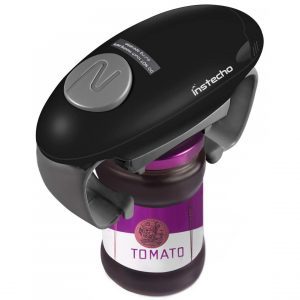
InstEcho
A three-second hold then release routine, with a deep drawer or counter box available.
InstEcho is worth considering if you can make room for it in a deep drawer or a box on the counter. Its written procedure gives a defined start: hold the button for three seconds, then release it. A later press releases the jar body. The storage qualification is just as important as the button sequence: the editorial review explicitly warns that a small drawer may not be suitable. InstEcho editorial review InstEcho written procedure
Reasons to choose it
- The procedure explicitly separates the three-second start from the later release.
- The storage account offers a drawer and an open-box alternative.
Tradeoffs to know
- The editorial review qualifies drawer storage with a depth requirement.
- The detailed product description excludes plastic jars from its guaranteed use.
Think twice if: A shallow drawer is your only storage space, or plastic jars are the main use you have in mind.
Further reading
Ratings
Editorial score 6.6
Placement and handling7
The written procedure describes a flat surface, placement, release and lift-off, with a restriction on plastic jars.
Controls7
The written start is a three-second hold followed by release, with a separate release press later; the review also mentions waiting and noise.
Routine care and storage5.5
Drawer storage is qualified by a need for depth; an open box on the counter is the suggested alternative.
Sources & further reading
houseandbeyond.org review
prosconsshopping.com review
youtube.com review
youtube.com review
wannapasta.com review
seniorsafetyadvice.com review
Keep reading
Something changed? Help us keep this useful.
Send a correction →