
The recommendation
Consider the AstroAI AIRUN H 12V for the reported vehicle-plug and screw-on routine, after checking the current fittings. The older listing-linked review reports wobbling, obstructed screen viewing and no cord storage; inspect those details rather than assuming the regional illustration represents the kit you will receive.
Grades at a glance
| Product | Overall | Target selection and control workflow | Hose and accessory connection | Power and storage handling |
|---|---|---|---|---|
| AstroAI AIRUN H 12V | 9.0 | 9.0 | 9.0 | 9.0 |
Does it fit your life?
Who this setup suits
The appeal is an ordinary sequence: bring the inflator to the vehicle, connect its power lead, attach the air hose, choose a target and start. The listing-linked A220B review, 0:51–1:43 describes the target-and-start task. The regional unboxing, 2:30 and Steve D’Souza’s vehicle demonstration, 1:28 show the vehicle-outlet part of that routine.
That makes this a candidate for someone who expects to work beside a vehicle outlet. If you want to take a small kit from a drawer to another task without arranging that lead, compare the AstroAI L4’s bag-and-USB routine. That is a difference in preparation and placement, rather than a reason to assume one pump inflates better.
Product illustration
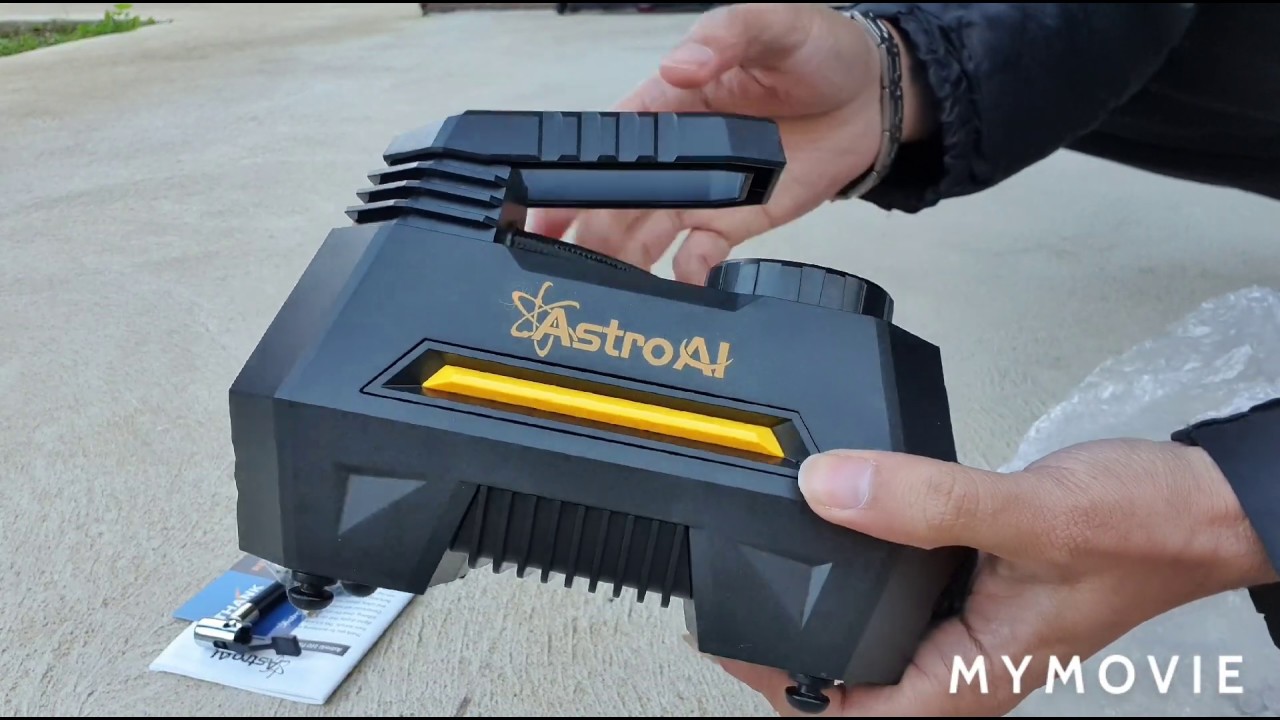
tusshhar reviewer video — A220B/ASIA220B-AU pictured; region and supplied kit may differ from the selected AIRUN H 12V.
Setting a target without borrowing another model’s buttons
The useful finding from the A220B account, 0:51–1:43 is modest: enter the desired PSI and start. Treat that as a reported interaction. Its promotional language about accuracy, durability and effortless results does not establish those outcomes for the AIRUN H you receive.
Use the setting appropriate to your own task rather than copying a number from a demonstration. For buying purposes, ask whether entering the target each time is acceptable. Someone repeatedly switching between familiar settings should also read about the Milwaukee’s saved settings. We do not transfer the exact M/plus/minus layout shown in other regional videos to every selected AIRUN H revision.
Screw-on fastening and the optional extension
Brian Nadel’s Tom’s Guide review, Setup section, published May 10, 2022, describes a native screw-on tire connector and an included clamp-on extension. Its product link ties that particular review to the selected listing. The older 100 PSI video, 1:03 and 9:34, describes a similar screw-on end and optional lever-style fitting. In tusshhar’s regional A220B unboxing, 2:30, the extra fitting screws onto the existing end.
This supports a practical choice: use the native threaded connection, or fit the extra joint when the supplied kit includes the extension you prefer. The second approach adds one fitting to retrieve, screw on and keep with the pump. Check the actual box contents and connection shown by the seller; a shared fastening task does not make Australian A220B bundles and the selected AIRUN H interchangeable in every respect.
The vehicle lead and the older review’s compromises
The vehicle-plug task is supported; a promise that its cable reaches every wheel on your vehicle is not. Plan where the pump and outlet will be before treating this as the right arrangement for you. Steve D’Souza’s 1:28–4:02 sequence is one vehicle’s setup, not a reach test for yours.
The older reports also have material reservations. Tom’s Guide describes a handle that can obscure the screen, no place to stow the cord and hose, and wobbling during operation. The supplied-product 100 PSI video, 8:44–9:34 criticizes the hose crossing the gauge and the lack of cord management, while describing its own unit more favorably on movement. These reports differ on movement, so they do not establish uniform behavior across versions. Before buying, look for a clear screen view and a workable place for the hose and lead in the current kit; those practical details matter more than a shared model-family name.
Tom’s Guide’s performance discussion also describes noise and a sticker requiring cooling breaks. That report concerns its older unit. It is a reason to check the current pump’s operating limits before planning repeated jobs, not to transfer that sticker’s timing to every AIRUN H revision.
When another setup makes more sense
Choose by the work surrounding the pump. The Avid Power ACAP115D uses a separate vehicle-power module as an alternative to its battery in the cited demonstrations. That brings a module swap and more pieces, but offers a different preparation routine. The L4 is worth comparing if storing a compact rechargeable kit with its accessories is the main attraction.
The AIRUN H remains a reasonable shortlisting choice for the reported vehicle-plug and fastening tasks. Its task scores do not resolve current kit contents or remove the older reports’ viewing, storage and movement reservations. If those details decide the purchase, confirm them on the current offering first. This is a review of reported use, not a test of the pump by us.
Reported workflow scores
| Workflow | Score / 10 |
|---|---|
| Target selection and control workflow | 9.0 |
| Hose and accessory connection | 9.0 |
| Power and storage handling | 9.0 |
| Overall | 9.0 |
The overall score summarizes the three reported workflows. It does not measure inflation speed, pressure accuracy or suitability for a particular tire.
Sources
Original reports used for the controls and handling discussed above:
AstroAI AIRUN H 12V
AstroAI
Vehicle-outlet use after checking the current fittings and kit
Reported target entry and vehicle-plug setup accompany a screw-on fastening task; the extension and current kit need checking against the older and regional reports.
Reasons to choose it
- The listing-linked A220B account describes target entry and start
- Cited kits offer screw-on fastening with an extra extension
- Vehicle-outlet hookup is a simple reported task
Tradeoffs to know
- Current AIRUN H and regional A220B kit details may differ
- The vehicle lead limits placement to outlet reach
- The older review reports wobble, awkward screen viewing and no cord storage
Think twice if: Your purchase depends on a confirmed extension, tidy cord storage or an exact match to the regional picture
Published specifications
- Attachment task reviewed
- Screw-on valve connection; optional extension in the cited kits
- Power setup reviewed
- Vehicle 12V outlet lead
Further reading
Ratings
Editorial score 9
Target selection and control workflow9
The listing-linked A220B account reports selecting a desired target and starting; detailed button geometry is not established for every revision.
Hose and accessory connection9
The listing-linked older review describes a screw-on connector plus extension, and the regional video screws that extra fitting into place; current kit inclusion remains to check.
Power and storage handling9
The useful reported task is bringing the pump to the vehicle and plugging in its lead; exact reach and storage arrangements remain unresolved.
Sources & further reading
youtube.com review
youtube.com review
youtube.com review
youtube.com review
tomsguide.com review
Keep reading
Something changed? Help us keep this useful.
Send a correction →