Local editorial reading preview · 24 October 2026 · Not a published page
Desktop
CPUs with integrated graphics: what to buy without a graphics card
KB4UB buying guide | Updated 24 October 2026 | US price examples
For a new desktop that must play games without a graphics card, I
would start with the Ryzen 5 8600G. The Ryzen 7
8700G buys extra graphics headroom and two more CPU cores, but
its price needs to make sense against the entire build. For an existing
AM4 machine, a sensibly priced 5600G or 5700G can be a
more useful purchase than replacing the motherboard and memory.
There is a second, equally legitimate kind of no-GPU PC: a machine
for office work, coding, photography or video conversion that simply
needs dependable display output. Here, the stronger CPU or appropriate
media engine can matter much more than game FPS. The Core Ultra
5 250K Plus is interesting for that job; the small graphics
engine in a Ryzen 7600 or 9600X also avoids the need to
buy a card just to connect a monitor.
This guide analyzes independent tests, official specifications and
documented owner experiences. KB4UB did not perform these benchmarks.
Most comparable socketed-APU game tests date from 2024; they establish
useful relative capability, not guaranteed FPS in October 2026 game
builds.
Four places to start
Ryzen 5 8600G · balanced
no-GPU gaming
 Choose it
for: a compact gaming PC where a separate card is genuinely off
the table. 6 cores / 12 threads, Radeon 760M, AM5 and DDR5.
Observed CPU offer: $193. Platinum Micro marketplace
seller at Newegg. The example platform below totals $812.98 before tax
and unconfirmed delivery charges. That is a warning to price the memory
first, not a claim that this is a cheap build. Check exact offer ·
Read the assessment
Ryzen 7 8700G · more
graphics headroom
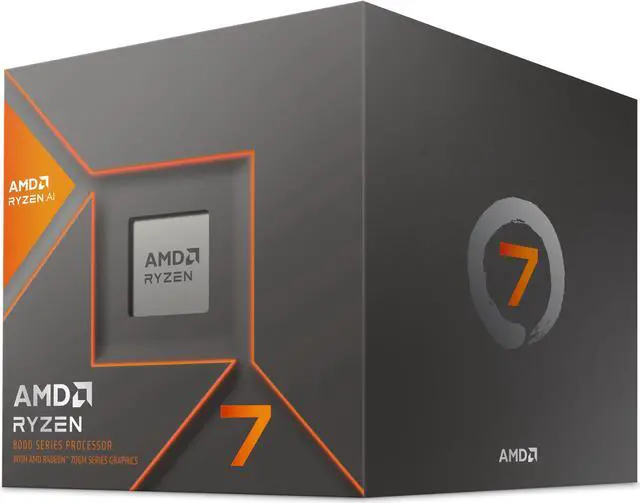 Choose it
for: the strongest extensively tested gaming APU in this retail
shortlist, especially when a card cannot physically fit. 8 cores / 16
threads, Radeon 780M.
Observed CPU offer: $325. The selected marketplace
offer ships from Hong Kong. I would seek a better local offer before
paying it. Its $132 premium over the 8600G here is much larger than the
gaming advantage in either matched suite below. Check exact offer ·
Read the assessment
Ryzen 5 5600G ·
make an existing AM4 PC useful
 Choose it
for: reuse of a compatible motherboard and dual-channel DDR4,
or a carefully checked used purchase.
No new-retail value award. The accessed $330
marketplace listing is poor value for this purpose. Its presence in the
guide is about inexpensive reuse, not an endorsement of scarce-stock
pricing. Check exact
listing · Read the assessment
 Choose it for: sustained CPU work and applications that
can use its officially supported AV1 encoder. 18 cores / 18 threads,
LGA1851, DDR5; buy a cooler.
Observed CPU offer: $219.99, sold and shipped by
Newegg. This is a CPU-work recommendation. We do not have a
comparable integrated-gaming panel that earns it an APU gaming award. Check exact offer ·
Read the assessment
Before buying: AMD
and Intel returns in brief
A low price from an unfamiliar importer can lose its appeal when the
only working processor has to be posted away. Establish who handles the
return before checkout.
The Intel time above is a published service description, not an
observed average or guaranteed end-to-end downtime. Rapid Replacement’s
fee is non-refundable and its deposit/return conditions matter. AMD may
replace with an equivalent product under its terms; neither table entry
promises an identical new retail box. AMD
boxed terms, AMD
OEM route, Intel
boxed eligibility, Intel
service routes, Rapid
Replacement terms
Full KB4UB guides: AMD CPU
returns · Intel CPU
returns.
Twelve CPUs, three different
jobs
A motherboard takes the memory type it was designed for. An LGA1700
DDR4 board does not accept DDR5. CU, EU and Xe-core counts describe
different architectures and are not a cross-brand performance scale.
Exact manufacturer pages are linked in each model assessment below.
What about the
newer Ryzen AI desktop chips?
AMD announced socketed AM5 Ryzen AI 400 desktop
processors for OEM systems, including the Ryzen AI 7 450G with
Radeon 860M and Ryzen AI 5 440G/435G with Radeon 840M. They deserve
attention when buying a complete machine. We did not verify a normal
boxed-DIY sales route and matched independent desktop benchmark suite
for them, so they are outside this retail ranking. They are socketed OEM
desktop products, not automatically soldered laptop chips. AMD’s
desktop announcement
Likewise, a mini-PC with a Ryzen AI Max or a mobile Core Ultra can be
an excellent whole-system alternative. Its memory configuration,
cooling, power allowance and soldered components belong to that system’s
review. A laptop’s Radeon 890M or Arc result cannot be pasted into a
socketed desktop CPU chart merely because both processors have
integrated graphics.
Gaming: keep each test
family together
The broadest overlap is among the 8700G, 8600G, 5700G and 5600G. Two
independent laboratories agree on their order, but the margins differ
substantially.
Two suites, two
answers to “how much faster?”
ComputerBase: corrected stock rows, 11-game
geometric mean, 1080p Low/Medium mix with title-specific FSR exceptions.
AM5 uses 32GB dual-channel DDR5-5200 CL32; AM4 DDR4-3200 CL14; 12500
DDR5-4800 CL40. Its P1 is percentile FPS, not necessarily the mean of
the slowest one percent of frames. Tom’s Hardware:
March 2024 stock rows, DDR5-5200 on the 8000G chips, native resolution;
PBO/EXPO and HYPR-RX rows excluded. The article’s stated aggregate game
count and individual headings differ, so we retain its published mean
rather than inventing suite membership. ComputerBase
corrected results, Tom’s
results, Tom’s
setup
The 8700G leads the 8600G by 21.7% in the first
average and 9.9% in the second. These are calculations
from rounded published values, not a universal 10–22% guarantee.
Averaging the two into one score would conceal differences in games,
settings and upscaling. Neither column supports a claim about today’s
highest settings.
Average FPS is
only half the purchase decision
Two native-resolution tests make the compromises clearer. The
following are ComputerBase’s corrected 1080p runs; both have upscaling
off. Baldur’s Gate 3 uses Low/DX11. Cyberpunk 2077: Phantom Liberty uses
the publisher’s custom Low-texture/Low-crowd setup, DX12, ray tracing
off and frame generation off.
Individual
game charts and settings
Even the leading APU does not hold a 30-FPS floor here. I would
approach demanding games with willingness to lower resolution, use
suitable upscaling, cap the frame rate or accept compromises. Lighter
games can look much healthier: TechSpot measured the 8700G at 119 FPS in
Counter-Strike 2 and 132 FPS in Fortnite at 1080p Low, using DDR5-6400
CL32. Those faster-memory runs are useful corroboration, not
interchangeable additions to the stock table. TechSpot’s
iGPU tests
A tail number cannot show exactly when a hitch happens. Shader
compilation, loading, a crowded scene and background applications need
frame-time traces and repeat runs to separate. We have no common
full-trace dataset across all twelve CPUs; “stutter-free” would
overstate this evidence.
Tweakers’ integrated-only section gives the 8500G a direct comparison
with its siblings. All AM5 entries here use 2×16GB DDR5-5200 CL36. These
are reported output resolutions and presets; internal
rendering/upscaling was not explicit for every row.
The GTA V test is the version available in early 2024, not a later
Enhanced release. AM4 entries use DDR4-3200 CL16. No matching 1% low is
available in this extracted panel. Tweakers
8500G review
This is why I would pay for the 8600G before spending on decorative
motherboard features. The 8500G’s four graphics CUs and reduced
expansion lanes make it a more constrained starting point. The 7600,
despite being a useful CPU, is a much less convincing choice when the
same integrated engine must run the games.
Memory is part of the
graphics system
An iGPU shares system memory. Buy the platform as CPU plus
motherboard plus a matched memory kit, then check the board’s supported
configurations. For a new gaming APU build, my practical default is
two 16GB modules, leaving space for the game, operating
system and shared graphics allocation. That is a capacity
recommendation, not a measured claim that 32GB automatically produces
more FPS than 16GB.
Tweakers measured this 8700G memory change within its own bench: 32GB
dual-channel at DDR5-5200 CL36 versus a DDR5-6400 configuration with a
manually set 1:1 memory-controller ratio. Timings and controller setup
change together, so the result is not pure frequency scaling.
FPS averages; base results with HYPR-RX excluded. Tweakers
memory experiments
TechSpot independently found meaningful losses going from its 6400
setup to 5200: 15% in Fortnite and 22% in Spider-Man. Going to 7200
yielded little in several of its tests. Spending more on memory
therefore needs game-specific justification, stability testing and a
look at the total bill. TechSpot
memory scaling
Channels, capacity, allocated VRAM and overclocking
Two appropriately installed DIMMs use both CPU memory channels; one
DIMM leaves part of the available channel bandwidth unused. DDR5’s
subchannels do not turn a one-DIMM desktop into a fully populated
dual-channel configuration. The theoretical bandwidth advantage does not
imply a fixed FPS multiplier. We did not verify a controlled
one-versus-two-DIMM and 16-versus-32GB test matrix across this
shortlist, so no measured percentage is assigned to either choice.
The BIOS UMA allocation is a reservation from system RAM. Raising it
cannot manufacture additional bandwidth or graphics execution resources.
Leave room for the operating system and application, and change it only
when an application or a tested configuration calls for that change. Do
not interpret “8GB shared graphics memory” as equivalent to an 8GB
discrete card.
Establish stability at supported default settings before enabling a
memory profile. DDR5-6000/6400 on an 8000G is an overclock relative to
its published DDR5-5200 support. AMD’s EXPO disclaimer says operation
outside published specifications, including overclocking and
undervolting, voids the applicable AMD product warranty, even when
enabled through AMD tools. A motherboard profile is not a blanket
guarantee. AMD
EXPO disclaimer
CPU workloads and power
still matter
The graphics engine is only one reason to buy an APU. ComputerBase’s
application results show why eight-core AM4 can remain useful even where
its graphics trail the newer six-core AM5 part.
Higher Cinebench points are better; lower render time is better.
These are the publisher’s stock/historical rows, with AM5 DDR5-5200 CL32
and AM4/Alder Lake DDR4-3200 CL14 in this application comparison. They
are separate from its DDR5-equipped 12500 gaming configuration. ComputerBase
applications
For newer CPU-heavy work, Gamers Nexus measured the 250K Plus at
about 9.2 minutes in its Blender logo render and
133 minutes in its Chromium compile, versus
16.4 and 235 minutes for the 9600X. These are rounded
source-reported times; the workload and testbed are different from
ComputerBase’s Blender. TechSpot’s independent 250K Plus review also
found strong multithreaded performance, while Photoshop favored the
9600X. Buying for a named application is more useful than buying the
biggest core count. Gamers
Nexus production tests, TechSpot
application tests
Package readings are not wall-socket consumption or a universal
efficiency ranking. These chips deliver very different FPS in this
workload. The nominal 65W TDP of the AMD APUs does not impose a 65W
ceiling on package power. Power
measurements
Phoronix supplies a separate Linux cross-check for the 8500G: across
its varied 150-plus-test workload, reported CPU power averaged 38W with
a 69W peak. That describes its Linux 6.7/Mesa 24.1-development test
platform and workload mix, not Windows gaming consumption. Phoronix
power results
A fast hardware encoder can be more valuable than a stronger gaming
iGPU in a media box. Hardware support is still conditional on codec
profile, bit depth, chroma format, driver, operating system and
application support.
AMD’s Ryzen 5000 media matrix lists H.264 8-bit and HEVC 8/10-bit
paths; its generic “Ryzen 7000” material also spans products beyond the
socketed 7600, so we do not transplant that row to this desktop chip.
The 8000G specifications and Intel’s exact Core Ultra pages directly
support the modern AV1 claims. AMD
media matrix, AMD
8700G specifications, Intel
oneVPL formats, Intel
245K specifications, Intel
250K Plus specifications
Why this is not a transcode-speed or picture-quality ranking
ComputerBase demonstrated AV1 hardware encoding in a HandBrake
nightly build on the 8600G: 36 seconds, against 446 seconds for a
software AV1 path on the 5600G. That is an illustration of different
available execution paths, not an equal-quality CPU contest. Encoder
implementation, preset and resulting quality were not held equivalent,
so we do not turn the ratio into a general speed claim. HandBrake
experiment
Intel lists one multi-format codec engine on the 12400 and two on the
12500. This does not promise twice the transcode throughput or a
particular number of simultaneous streams. Test the actual files and
software, especially for HDR tone mapping, 4:2:2 camera footage,
subtitles, container support and server-application licensing. We have
no matched quality-normalized encode/decode-throughput panel across all
twelve CPUs.
The twelve model assessments
### Ryzen 5 8600G
Summary: my first comparison point for a new gaming APU
PC. Strong enough for lighter games; demanding titles still need
compromises. Main caution: DDR5/platform cost can
overwhelm the CPU saving.
Read the full assessment
The 8600G’s six Zen 4 cores and eight-CU Radeon 760M put it in a
sensible middle ground. Three independent labs in our selected evidence
test its integrated graphics directly. It stays fairly close to the
8700G in Tom’s suite, while ComputerBase’s more demanding mix gives the
eight-core part more room to pull away.
I would prioritize a compatible, sensibly equipped motherboard and
two memory modules over premium chipset branding. The standard boxed
package includes a Wraith Stealth cooler; confirm the exact boxed SKU
rather than assuming a loose/tray offer includes one. It has fewer
expansion resources than ordinary Ryzen 7000: the graphics-card
connection is PCIe 4.0 ×8. That does not prevent a later card, but a
future dGPU-first build deserves a fresh CPU comparison.
AMD
specifications, Tom’s
review, Tweakers
review
### Ryzen 7 8700G
Summary: the stronger extensively tested retail gaming
APU here, with extra multicore capacity. Main caution:
pay for the measured advantage in your games, not for an expectation of
discrete-GPU-class performance everywhere.
Read the full assessment
The 12-CU Radeon 780M is the main attraction, supported by eight CPU
cores. Its advantage is easiest to justify when a graphics card cannot
fit, acoustic goals favor a simple system, or CPU work also benefits
from eight cores. The standard boxed 100-100001236BOX includes a Wraith
Spire; other package suffixes need checking.
Four independent testing lineages support this model’s position.
Early firmware complicates historical results: ComputerBase corrected
its testing, and Tom’s later review used updated STAPM behavior. Use the
corrected rows and a current board-supported BIOS. A 2024 launch-review
BIOS is documentation, not our installation recommendation. Avoid paying
a large import-marketplace premium just because the model tops this
restricted shortlist.
AMD
specifications, ComputerBase
correction history, TechSpot
review
### Ryzen 5 8500G  Summary: workable for a cheaper display/media PC with
occasional lighter gaming. Main caution: the 740M and
PCIe 4.0 ×4 graphics-card connection impose meaningful compromises.
Read the full assessment
Its six cores comprise two Zen 4 and four lower-clocked Zen 4c cores.
The names should not be confused with Intel’s P/E-core design. The
four-CU 740M is substantially smaller than the 8600G’s engine, and the
direct game results show the difference.
Tweakers provides the selected Windows iGPU comparison; Phoronix
independently tests CPU/Linux behavior. That is two laboratories, but
only one matched Windows FPS panel here and no matching tail metric. I
would need a meaningful saving on the whole platform, or a mostly
non-gaming workload, to choose it over the 8600G. The same expensive
board and RAM make a small CPU discount less persuasive.
AMD
specifications, Tweakers,
Phoronix
### Ryzen 7 5700G  Summary: a useful eight-core AM4 reuse option.
Main caution: older Vega graphics and no AV1 hardware
path limit its appeal as an expensive new purchase.
Read the full assessment
The 5700G is strongest when compatible DDR4 and a motherboard are
already paid for. Its eight cores can keep CPU work competitive with
newer six-core APUs, while the integrated gaming results are clearly
behind the 8000G leaders. A BIOS compatibility check remains essential,
even when the socket physically fits.
TechSpot’s early review used an OEM-sourced sample before boxed
availability; our purchase advice distinguishes that test history from
today’s boxed or used route. Four independent labs supply gaming
evidence across the 5700G/5600G pair. For an existing owner, reducing
game settings may be a better first move than changing the entire
platform.
AMD
specifications, TechSpot
review, Tom’s
later comparison
### Ryzen 5 5600G
Summary: a sensible economical AM4 reuse candidate when
the actual price is low. Main caution: old favorable
launch reviews do not validate a $330 current listing.
Read the full assessment
The six-core 5600G gives up some CPU throughput and a little graphics
capacity to the 5700G, but keeps the same basic reuse argument.
TechSpot’s 2021 tests already exposed the limits in demanding games: 25
FPS in Horizon Zero Dawn and 29 FPS in Shadow of the Tomb Raider at its
1080p Low settings. Easier games were more comfortable. Those historical
builds should not be confused with current patches or newer
editions.
For a used purchase, check the AM4 pins, seller return route, exact
CPU identity and whether a cooler is included. Do not budget on
receiving the original purchaser’s AMD warranty automatically. A
complete used business or small-form-factor PC can also deserve
comparison, provided its memory channels and expansion restrictions are
visible.
AMD
specifications, TechSpot
review, ComputerBase
later comparison
### Ryzen 5 5600GT  Summary: a price-led AM4 candidate, with an explicit
evidence gap. Main caution: no verified independent
matched gaming review in this package.
Read the full assessment
AMD specifies six Zen 3 cores, seven graphics CUs at 1.9GHz,
DDR4-3200, PCIe 3.0 and an included Wraith Stealth for the boxed
version. Its advertised CPU boost differs from the 5600G, but that
specification alone cannot establish a gaming improvement.
I would compare actual seller price, BIOS support and return terms
against the 5600G. We have not assigned it the 5600G’s measured FPS or
manufactured a second independent laboratory from a buying guide that
merely links to a 5600G review. The historical driver-installation case
below is useful troubleshooting evidence, not a benchmark or a reason to
declare the model unreliable.
AMD
exact specifications, documented
driver issue
### Ryzen 5 7600  Summary: a useful all-round AM5 CPU that can run a
monitor without a card. Main caution: its two-CU
graphics engine is a major step down from the gaming APUs.
Read the full assessment
The 7600 makes sense when CPU work is the priority or a discrete GPU
is a genuine later plan. Its ordinary desktop platform resources and CPU
performance can be more useful than buying a larger iGPU that will soon
sit idle. The standard boxed version includes a cooler.
The direct Tweakers integrated results are the important corrective
to its strong reputation in discrete-GPU gaming reviews. A fast
processor paired with an RTX card tells us little about what the tiny
built-in engine can render alone. We have broad CPU evidence from
ComputerBase and Tom’s plus direct integrated comparisons, so it earns a
display/CPU role rather than an APU gaming award.
AMD
specifications, Tom’s
CPU review, Tweakers
integrated comparison
### Ryzen 5 9600X  Summary: a CPU-first AM5 choice for responsive
applications and basic display output. Main caution:
budget for a cooler, and do not expect the model number to imply a large
iGPU.
Read the full assessment
Its six Zen 5 cores address a different need from the graphics-heavy
8700G. The two-CU integrated engine is principally a way to operate the
computer without an add-in card. We have no matched integrated-gaming
panel for this exact model in the selected evidence.
Gamers Nexus and TechSpot independently compare CPU workloads against
the 250K Plus. The Intel chip is compelling in heavily threaded work;
the 9600X can be more attractive for an application such as Photoshop.
Make that decision using the application, cooling and full platform
bill. Neither review’s high-end discrete-GPU gaming chart is evidence of
9600X iGPU gaming performance.
AMD
specifications, Gamers
Nexus comparison, TechSpot
comparison
### Core i5-12400  Summary: a sensible office or Quick Sync reuse
candidate on LGA1700. Main caution: buy the non-F model
and the correct DDR4/DDR5 motherboard variant.
Read the full assessment
The 12400 has six performance cores, twelve threads and UHD 730
graphics. It is an approachable way to retain a working Intel platform
without buying a graphics card. It also offers hardware media paths that
a simple gaming average overlooks.
ComputerBase and Tom’s provide independent CPU evidence; the selected
package does not contain a matched 12400 integrated-gaming panel. We
therefore do not estimate its FPS from the 12500’s UHD 770. For media
work, check application support for the exact codec and profile. The
12400F removes the integrated engine and is outside this no-card
shortlist.
Intel
specifications, Tom’s
review, ComputerBase
applications
### Core i5-12500  Summary: worth comparing with the 12400 for a
media-oriented LGA1700 system. Main caution: UHD 770
remains weak for the demanding games in the matched tests.
Read the full assessment
The 12500 retains six cores and twelve threads while moving to a
32-EU UHD 770 and two listed multi-format codec engines. The capability
can matter more than the small CPU difference if the software uses it.
It still lacks AV1 hardware encode in the 12th-generation media
matrix.
ComputerBase supplies the direct iGPU tests and application rows. Les
Numériques is a second independent CPU-review lineage, not a second
matched graphics suite. I would consider it for a measured media need or
a favorable existing-platform offer, rather than paying extra merely
because the graphics model number is higher.
Intel
specifications, Les
Numériques review, ComputerBase
integrated tests
### Core Ultra 5 245K  Summary: a discount or existing-LGA1851 option for CPU
work and modern media. Main caution: compare its whole
cost with the newer 250K Plus before buying.
Read the full assessment
Six performance cores and eight efficiency cores give fourteen
threads in total. Its four-Xe-core Intel Graphics includes officially
listed AV1 encode/decode support. That makes it more useful for some
media workloads than the older UHD desktop parts, without establishing
equivalent gaming performance to mobile Arc implementations.
Gamers Nexus and Notebookcheck provide independent CPU reviews, and
TechSpot includes it in the newer comparison. Their discrete-GPU game
results stay outside our iGPU ranking. A cooler and DDR5 are required; a
cheaper processor listing does not settle motherboard or memory cost. We
have not verified a matched iGPU game and tail-latency panel for this
model.
Intel
specifications, Gamers
Nexus review, Notebookcheck
review
### Core Ultra 5 250K Plus
Summary: the strongest CPU-work proposition among the
current-price hero offers. Main caution: the official
media feature list is better established here than integrated-game
FPS.
Read the full assessment
The 250K Plus combines six performance cores and twelve efficiency
cores, with eighteen threads and a four-Xe-core integrated engine. Intel
specifies 125W base and 159W maximum turbo power. Cooling and
motherboard power behavior belong in the buying decision even when there
is no separate GPU to cool.
Two independent 2026 reviews support its CPU-work strengths. TechSpot
used fast DDR5-8200 CUDIMMs on Intel and DDR5-6000 on AMD, so its result
is a platform comparison rather than memory-identical isolation of the
CPU. Our AMD-oriented Patriot kit below is explicitly listed as
incompatible with Arrow Lake; do not transfer that basket to this chip.
Check the exact memory QVL and BIOS support for the Plus model.
Intel
specifications, Gamers
Nexus review, TechSpot
review
These are exact US offers accessed on 24 October 2026, not launch
prices, a lowest-price survey or a checkout quotation. The motherboard
and memory are sold and shipped by Newegg; CPU seller routes differ.
Motherboard
offer, Patriot
exact kit. The memory’s advertised 6000 speed is overclocked for
these APUs; the stock benchmark tables above use 5200. Exact kit/board
QVL approval has not been established, so this is a cost-accounting
basket, not a guarantee of the advertised profile. The board has
HDMI/DisplayPort and BIOS Flashback; verify CPU support and display
capabilities for the intended monitor. Exact
White-model specifications
The unusual RAM cost was cross-checked against two other ordinary
32GB DDR5-6000 CL30 kits: Corsair CMH32GX5M2B6000Z30K at
$569.99, and G.Skill F5-6000J3038F16GX2-FX5 at
$659.99, also sold/shipped by Newegg. These three
offers show that the basket is not based solely on one luxury kit; they
do not establish the market-wide minimum or every retailer’s pricing. Corsair offer, G.Skill offer
This is not a complete PC price. Add case, PSU,
storage, operating-system licensing if needed, delivery/tax, Wi-Fi if
wanted, monitor and peripherals. Reusing those parts changes the bill.
No fully verified new AM4 or Intel platform basket was established here,
so we make no numerical claim that either is cheaper overall.
Could a cheaper CPU plus a graphics card beat the APU?
Yes, in appropriate games and at an appropriate purchase price.
ComputerBase’s matched 2024 comparison put a 7500F plus RX 6400 at 67
average / 49 P1 FPS in its 1080p suite, against the 8700G’s 56 / 40.
That is a separate complete CPU-plus-GPU configuration, not a faster
“7500F iGPU.” The 7500F has no integrated graphics. Matched
system comparison
Today’s selected offers do not make that exact example attractive:
$146.99 for a boxed 7500F, $449 for an ASRock RX6400 CLI 4G, plus the
same $119.99 board and $499.99 memory gives $1,215.97
before tax and unconfirmed delivery. The CPU is sold by SenyTech Global
and shipped by Newegg; the GPU is sold/shipped by Alliance Group (USA).
The live GPU page showed $449 while its search result showed $359, so
the live page takes precedence. The $89.99 refurbished listing was out
of stock and is excluded. 7500F offer, RX
6400 live offer
This is a deliberately transparent counterexample, not a
recommendation to spend $449 on an RX 6400. A different new or used card
may be much better value, but it needs its own current seller, warranty,
power, case-fit and benchmark checks. The lesson is to compare complete
configurations rather than declaring that an APU, or a CPU-plus-card
combination, is always cheaper.
Reliability:
distinguish a failed CPU from a difficult PC
We found nine distinct owner journeys worth retaining. They are
self-selected reports with unknown population denominators. They
cannot establish a model failure rate, a brand reliability ranking or an
average RMA turnaround. A replacement fixing a system
strengthens a CPU association, but usually does not reveal the
underlying failure mechanism.
5700G
DOA journey, 8600G
cross-check, 8700G
replacement, 5600GT
driver resolution, 12400
memory report
What the longer owner journeys say about downtime
A 5600G owner described a documentation loop lasting more than ten
days before RMA approval. Approval was reported on February 6, 2023;
receipt of a working replacement was not documented. Another 5600G owner
reported eight business days after carrier delivery while the portal
still showed the part as not received, followed by processing/approval
and a shipment update after contacting support. We do not turn either
intermediate milestone into a completed turnaround time. Documentation
case, Transit/status
case
A 5700G owner with freezes and restart/wake trouble later said that
buying another CPU fixed the machine, with the eventual warranty
replacement resold. It illustrates the cash and downtime burden of
return-first service; no exact service duration was established. A
separate 8600G owner reported recurring crashes on a warranty
replacement received about a month earlier. Driver timeouts on a
replacement do not prove that two CPUs permanently failed. 5700G
follow-up, 8600G
recurrence
The remaining newer Intel and AMD models lack comparably useful
completed owner journeys in this set. That absence is a coverage gap,
not evidence of zero failures. Likewise, instability discussions about
different Intel generations should not be assigned to a 12400 or Core
Ultra simply because the manufacturer matches.
A practical first-week
checklist
- Photograph the CPU, pins/socket and packaging, and save the invoice
and exact seller return policy. For a tray or OEM part, identify the
responsible seller/system builder in writing.
- Check the motherboard’s CPU-support list and required BIOS. Verify
the actual display connector and intended resolution/refresh rate, not
just the processor’s theoretical maximum.
- Start with supported default power and memory settings. Give memory
training time to finish according to the board’s instructions. Install
the appropriate chipset and graphics drivers.
- Test the actual jobs: video playback, sleep/wake, several games or
exports, and memory stability. Record errors and settings while the
retailer return window is open.
- If it fails, distinguish no power, no POST, no display, driver crash
and application failure. Try a known-good cable/display and supported
memory configuration. Do not keep moving a known-good CPU through a
board suspected of damaging processors.
- Document controlled cross-checks where safe, then follow
seller/manufacturer instructions. Avoid removing components
unnecessarily or making voltage changes to “prove” a warranty case.
The decision I would make
For gaming with a strict no-card constraint, compare the
8600G platform first, then pay for the
8700G only when the extra gaming and CPU capacity
justify the premium. Keep a healthy 5600G/5700G AM4
system in service if its games and workloads remain acceptable.
Treat 8500G and 5600GT as price-sensitive alternatives
with the limitations described above.
For work, media and everyday computing, choose the CPU and media path
for the job: 250K Plus for substantial threaded work
and supported AV1 encoding, 7600/9600X for CPU-first
AM5 use, and 12400/12500 where an existing LGA1700
platform or a specific Quick Sync workflow makes sense. The
integrated-graphics label alone cannot tell you which of those is the
better computer.
The unresolved areas are visible rather than filled with estimates:
direct 5600GT benchmarks, modern matched Intel iGPU gaming, full
frame-time traces, controlled channel/capacity scaling,
quality-normalized transcode throughput and complete current Intel/AM4
baskets. None is silently borrowed from a neighboring model or a
laptop.